
Kazakhstan: Digital Sovereignty Push for Domestic Tech, Data
Alexander Shlimakov specializes in Salesforce, Tableau, Mulesoft, and Slack consulting for enterprise clients across the CIS region. With a proven track record in technical sales leadership and a results-oriented approach, he focuses on the financial services, high-tech, and pharma/CPG segments. Known for his out-of-the-box thinking and strong presentation skills, he brings extensive experience in solution sales and business development.

Kazakhstan mandates domestic IT & data sovereignty, balancing global tech with national platforms & talent to secure its digital future.
Kazakhstan's digital sovereignty push for domestic tech and data is now a national priority, driven by a 2026 presidential decree. This directive mandates that all government IT spending must accelerate the development of domestic silicon, data infrastructure, and talent. While officially termed a "preference for nationally significant platforms," this policy is actively reshaping procurement, vendor selection, and the architecture of public-facing digital services across more than 1,500 state bodies.
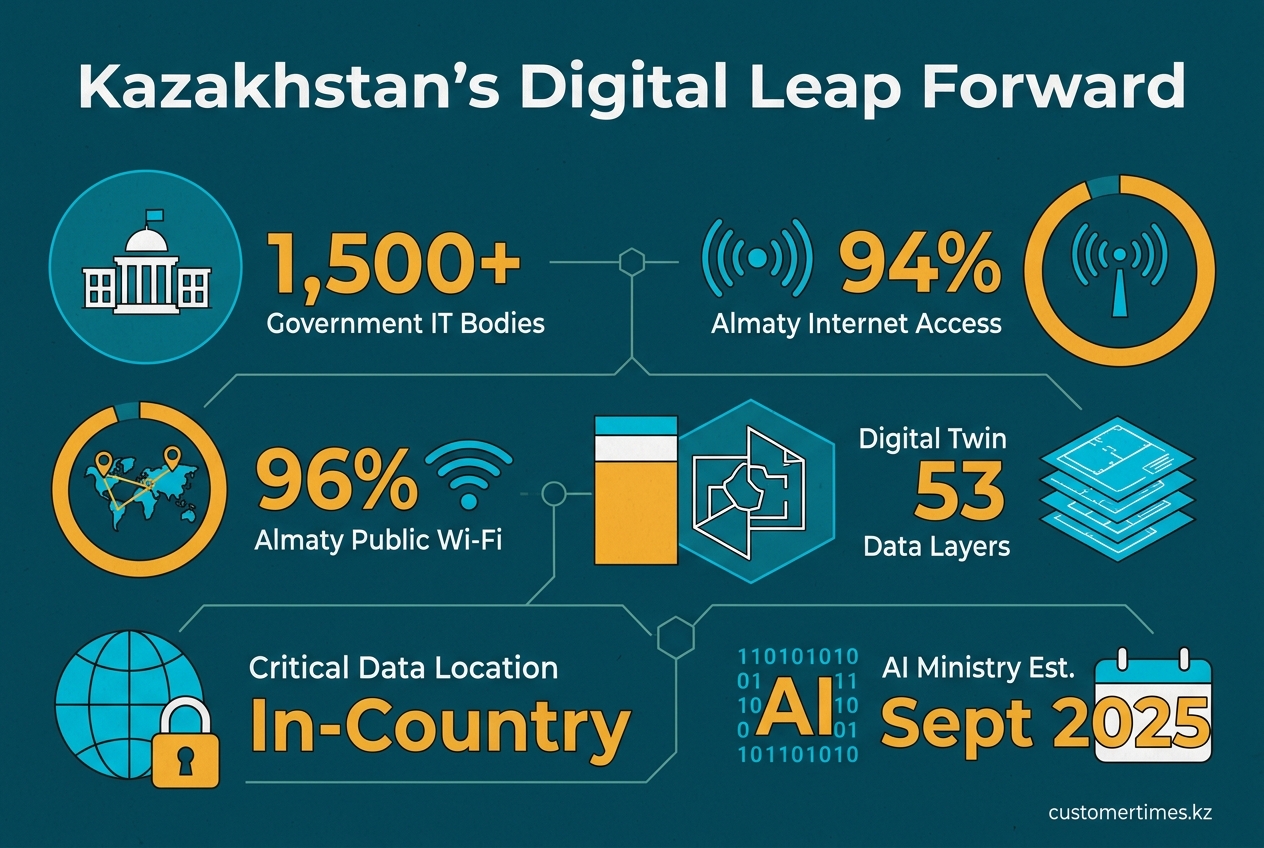
The national strategy is clear: secure control over the country's digital future. The government now requires all IT investments to bolster local technology and a skilled workforce, with a strict mandate that all critical data must reside within Kazakhstan's borders. This push for digital independence aims to grow the domestic tech market, protect jobs, and reduce reliance on major global digital powers.
What is Kazakhstan's new strategy for digital sovereignty and IT development?
Kazakhstan's strategy mandates that all state IT expenditures prioritize domestic technology and talent. Key initiatives include building sovereign data centers, developing national AI models like KazLLM, requiring foreign firms to host data locally, and training a new generation of AI-proficient public servants and citizens.
Nowhere is this shift more evident than in Almaty, the nation's commercial capital and the primary testbed for urban technology. By the end of 2025, the city had already achieved significant milestones:
- 94% of households had internet access, with 75% using fixed broadband, and 6,000 Wi-Fi nodes provided 96% coverage of public areas.
- City Hall was piloting a Chinese-Kazakh digital twin that synchronizes 53 data layers, from bus schedules to landslide sensors, every 30 seconds.
- Smart traffic grids, self-reporting waste bins, and residential heat meters all fed into a single on-premise data lake, physically located in a new 7.4 MW data center on the city's outskirts.
"The goal is real-time management," deputy mayor Bauyrzhan Baitan explained in November. "But the rule is that raw video or location data never leaves Kazakhstan's jurisdiction."
This policy reflects a nationwide balancing act: leveraging essential foreign technology from providers like Cisco, Huawei, and Microsoft while simultaneously preventing a loss of data sovereignty. This compromise was formalized with two key actions: the September 2025 establishment of a dedicated Ministry of Artificial Intelligence and Digital Development, and the rapid passage of the Law on Artificial Intelligence, effective January 18, 2026. This law does not prohibit foreign AI models but mandates that large systems register risk assessments, maintain logs within Kazakhstan, and disclose training data sources when personal data is processed.
To support this strategy, sovereign infrastructure is being developed at an accelerated pace. The cornerstone is Alem.Cloud, a public-private supercomputer that ranked 86th globally in November 2025. It provides 20.48 petaflops of processing power for critical tasks like climate modeling, seismic imaging, and the development of Kazakhstan's own large-language model, KazLLM. Two more supercomputers of similar scale are planned by 2027, housed in new Tier-III data centers that will add a combined 12.9 MW of capacity in Astana and Almaty.
| Infrastructure Milestone | 2025 Actual | 2026 Target | Sovereignty Angle |
|---|---|---|---|
| Rural fibre connections | 2,600 villages | 4,500 villages | Traffic routed via Kaztelecom's domestic backbone |
| State data centres | 3 facilities (17.3 MW) | 6 facilities (30+ MW) | All certified under new "Data Subject Rights" clause |
| AI-ready public servants | 0 | 500 chief digital officers | Must pass AI Governance 500 exam designed by local universities |
| Home-grown LLM tokens | 0 | 1 billion/month | Trained on Kazakh/Russian corpora hosted on Alem.Cloud |
Financial incentives are aligned with these strategic goals. The 20 Digital Transformation Roadmaps program requires government ministries to automate 72 business verticals by December 2027, using "primarily domestic software or verified open-source" solutions. Compliance is enforced through a powerful mechanism: budget allocations are frozen until the requirement is met. This tactic effectively redirected an estimated USD 180 million to local tech startups in the first quarter of 2026 alone.
Private sector adoption is quickly adapting to this new landscape. An international CRM vendor active in the market reports that nearly all new tenders now mandate an on-shore data hosting option and a clear plan for integrating Kazakh-language AI. In response, engineering teams are containerizing analytics services within Kaztelecom's local cloud and developing smaller, client-hosted language models - a complex configuration that has rapidly become a standard requirement.
"Customers still want global innovation," a solution architect told Digital Review, "but the contract is signed only after we prove the data stays between the Caspian and the Altai."
The economic incentives for multinationals to adapt are substantial. Kazakhstan's domestic IT market exceeded USD 1.6 billion in 2025 and is projected to contribute at least 2% to the national GDP annually through 2030. Tech exports are growing even faster, with the Astana Hub tech park reporting USD 4.3 billion in cumulative startup revenue. This ecosystem has produced a unicorn, generative-video firm Higgsfield AI, valued at USD 1.3 billion. The government fuels this growth with attractive incentives, including a zero corporate tax rate for accredited IT firms until 2033, unrestricted profit repatriation, and a regulatory sandbox for testing new AI products.
Beyond economics, the sovereignty initiative is driven by social and labor concerns. With official estimates warning that imported AI could automate 29% of jobs by 2030, developing national alternatives is seen as crucial for political stability. This has spurred a massive public education campaign aiming to achieve basic AI literacy for one million citizens by 2028, beginning with programs like "Tomorrow School" and "TUMO." Universities are now required to integrate AI governance into computer science curricula, and a proposed law would compel large foreign tech companies to fund local reskilling scholarships.
Geopolitical pressures further heighten the urgency. Positioned between China's Belt and Road Initiative, Russia's SORM-compliant digital ecosystem, and Western hyperscalers, Kazakhstan has adopted a multi-vector digital foreign policy. Astana strategically engages with all three powers - accepting 5G financing from Beijing, exploring data-reserve zones with Moscow, and backing open-access cables with Washington - on a non-exclusive basis. To bolster its position, the government is promoting a Digital Economy Partnership Agreement with other Turkic-speaking nations and pursuing "trusted cloud" agreements with both the EU and China, creating a competitive environment for its own platforms to grow.
The success of this ambitious strategy hinges on rapid execution. The government faces aggressive deadlines: a fully operational digital twin for Almaty by late 2026, nationwide 5G coverage in all regional centers by 2027, and a complete e-government stack before the 2029 election season. Any significant delay threatens to deepen the country's dependence on foreign ecosystems - the very outcome the sovereign infrastructure laws are designed to prevent. While progress continues, the challenge remains to build and sustain a truly independent digital future.