
Salesforce Shifts to AI, Consumption Pricing Amid Tech Giants' Rivalry
Alexander Shlimakov specializes in Salesforce, Tableau, Mulesoft, and Slack consulting for enterprise clients across the CIS region. With a proven track record in technical sales leadership and a results-oriented approach, he focuses on the financial services, high-tech, and pharma/CPG segments. Known for his out-of-the-box thinking and strong presentation skills, he brings extensive experience in solution sales and business development.
Salesforce pivots to AI-led growth with Agentforce, facing threats from Microsoft, Google, and pricing shifts. Can it hit 2026 targets?
Salesforce Shifts to AI, Consumption Pricing Amid Tech Giants' Rivalry
Salesforce shifts to AI, consumption pricing amid tech giants' rivalry, a strategic pivot underscored by its new Agentforce Slackbot. This move from seat-based SaaS to outcome-based AI growth aims to counter competitive pressure and pricing compression from Microsoft and Google, while retaining talent with a recent $41.18 million shelf registration for its employee stock plan.
What is driving Salesforce's shift to AI and consumption-based pricing in 2026?
Salesforce is transitioning from traditional seat-based licenses to an outcome-driven, AI-led growth model. This strategic shift, exemplified by its new $2-per-conversation Agentforce Slackbot, is a direct response to intensifying competition, declining per-user pricing, and surging market demand for AI-native CRM capabilities.
The numbers behind the AI bet
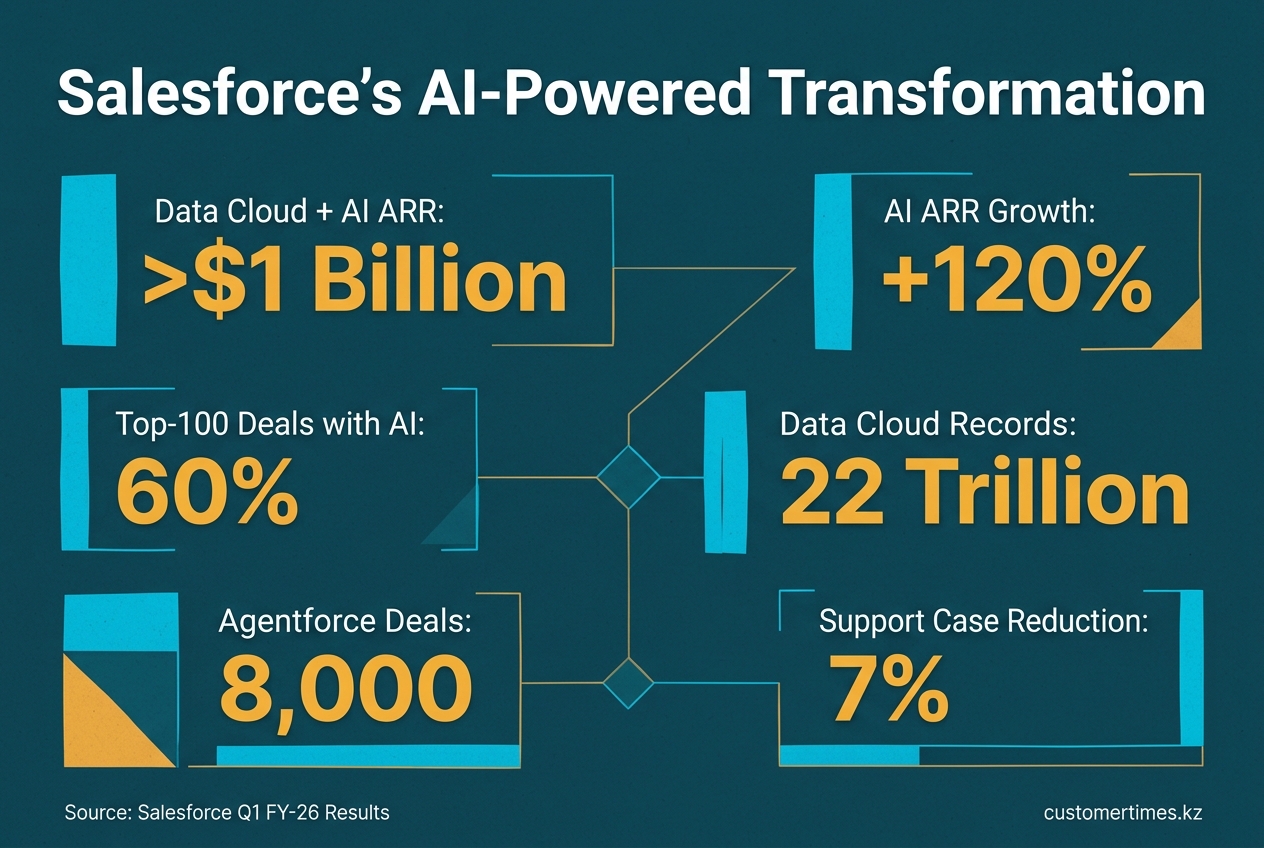
Salesforce raised its fiscal 2026 revenue guidance by $400 million to $41.0 - $41.3 billion, a move management credits primarily to its Data Cloud and AI products. This mid-year re-forecast is supported by compelling performance metrics:
Salesforce's strategic pivot to AI and consumption-based pricing is driven by significant early success in its AI product adoption. Key performance indicators, including a 120% year-over-year increase in AI-related annual recurring revenue, demonstrate strong market validation and justify the company's updated growth strategy.
| Metric | Q1 FY-26 result | YoY change |
|---|---|---|
| Data Cloud + AI ARR | >$1 billion | +120 % |
| Top-100 deals that include AI | 60 % of total | - |
| Records ingested by Data Cloud | 22 trillion | +175 % |
Since its launch, Agentforce has secured 8,000 deals (50% paid), while internally, the AI bot handled 750,000 requests, reducing support case volume by 7%. These results are detailed in the official earnings release.
From seats to conversations - pricing in motion
The new Agentforce pricing of $2 per conversation marks a clear departure from per-seat licenses. This consumption model lowers adoption barriers for enterprises hesitant to pay $50 - $200 monthly per user for AI features - functionality that competitors like Zoho and Monday.com often include standard. While the CRM market is projected to hit $320 billion by 2034, average per-user prices are expected to stagnate as AI becomes a standard feature, not a premium add-on.
"Vendors that gate AI capabilities behind premium tiers risk losing market share to competitors offering AI as standard functionality."
Competitive chessboard - Microsoft and Google make their moves
While the Agentforce Slackbot aims to keep users within the Salesforce ecosystem, its primary competitors are integrated directly into Microsoft Teams and Google Chat:
| Capability | Agentforce Slackbot | Microsoft Copilot Studio | Google Gemini Enterprise |
|---|---|---|---|
| Decision engine | Atlas Reasoning + RAG | Azure OpenAI + intents | Vertex AI (contextual) |
| Native CRM depth | 10/10 | 6/10 | 4/10 |
| Pricing anchor | $2 per conversation | $21 - 30 user/mo | $0 - 22 user/mo |
| Best fit | Salesforce + Slack shops | Microsoft 365 ecosystem | Workspace + cost-sensitive firms |
Microsoft's competitive edge lies in its deep workflow integration; Copilot can draft emails, summarize meetings, and sync data with CRMs via Power Automate. Google competes on cost, offering zero-cost inclusion in Workspace, though custom agents require development. Salesforce is betting on its CRM-native autonomy and large Slack enterprise user base to build a strong defensive position.
Workflow compression - less grunt work, fewer licenses?
AI automation is reducing the manual tasks that historically justified high seat counts. With sales reps spending up to 30% of their time on data entry, AI-powered CRMs are delivering a reported 30% reduction in this administrative burden. For example, one B2B firm saw a 40% efficiency gain in six months using AI for lead scoring and follow-ups. This trend suggests that as AI boosts efficiency, the total addressable market for traditional seat licenses may shrink, even as AI consumption grows.
"Businesses using AI in their CRM are 83 % more likely to exceed sales goals and deliver $8.71 in value for every $1 invested."
Regional reality check - lessons from Central-Asia roll-outs
In markets like Central Asia, system integrators report that consumption-based AI models accelerate procurement, allowing CIOs to fund pilots from operational expenses without long-term license commitments. Furthermore, local data residency requirements favor platforms like Agentforce, which supports in-country data metering via Hyperforce. Early deployments also show AI reduces training time by delivering next-best actions through accessible channels like Slack or SMS, a key advantage for mobile-first workforces.
What investors will watch next
- Conversation Volume Growth: Investors will monitor if revenue from $2 conversations can outpace the potential decline in traditional seat license sales.
- Gross-Margin Trajectory: Consumption models often have lower upfront cash flow, requiring Salesforce to achieve operating leverage through internal automation.
- Competitive Bundling: The primary threat remains Microsoft's ability to bundle Copilot with its E5 subscriptions at a marginal cost, pressuring Salesforce's pricing.
The recent $41.18 million shelf registration indicates Salesforce's intent to use equity to retain key AI talent. The success of this strategy and its impact on revenue guidance will be revealed in the upcoming quarters through key metrics like Slackbot conversation volume and Data Cloud adoption rates.