
Yandex, Kaspersky eye Almaty: 500 devs, $70M for new hub

Alexander Bazilevich is a CRM expert and Top Salesforce Partner with over 17 years of sales experience in the IT industry. He specializes in transforming corporate goals into profits through cross-functional collaboration and innovative business solutions, with deep expertise in business systems and IT products.

Yandex & Kaspersky plan a joint engineering hub in Almaty, Kazakhstan, to bypass sanctions, attracting $70M+ and 500 developers.
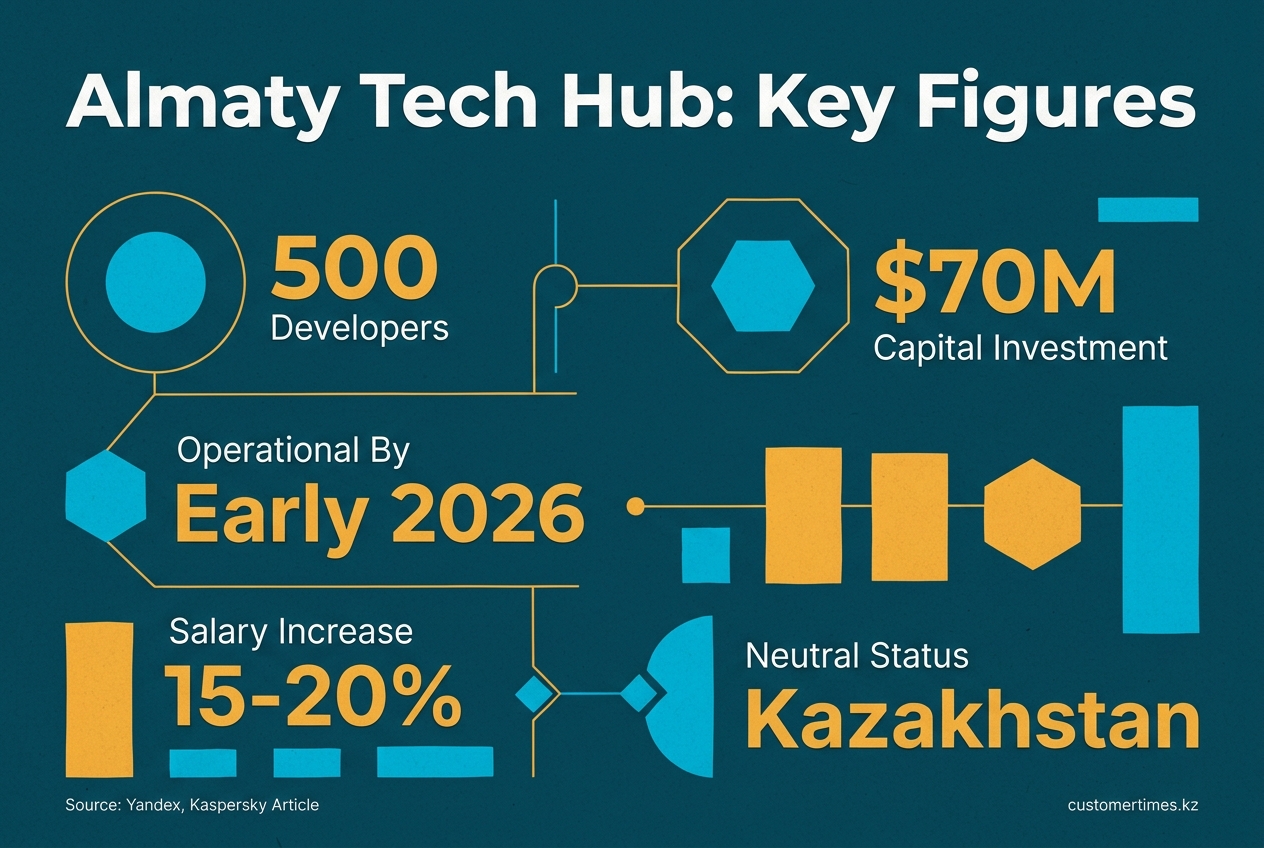
Tech giants Yandex and Kaspersky are planning a joint engineering hub in Almaty for 500 developers, a move poised to attract $70 million in capital. This strategic relocation aims to leverage Kazakhstan's neutral status and tech-friendly rules to sidestep potential U.S. and EU sanctions. The Almaty hub is expected to accelerate local tech growth through significant investment and job creation, with the new center projected to be operational by early 2026.
Why are Yandex and Kaspersky setting up a joint engineering hub in Almaty?
Yandex and Kaspersky are establishing a joint engineering hub in Almaty to insulate operations from new U.S. and EU sanctions. The move leverages Kazakhstan's geopolitical neutrality, attractive tech park incentives, and a growing local talent pool. The hub plans to host 500 developers and secure $70 million in capital by 2026.
The move is a direct response to recent U.S. and EU restrictions targeting dual-use software and cloud services. These sanctions have compelled Russian tech firms to find neutral jurisdictions to continue global product development without risking secondary sanctions. Almaty offers an ideal compromise: its proximity to Moscow facilitates management, while its location provides sufficient jurisdictional separation.
"Kazakhstan offers the last neutral gateway in Eurasia," a senior official at Astana Hub told colleagues during a closed briefing last month, pointing to the country's balanced diplomacy and recent chairmanship of the Eurasian Economic Union that prioritised AI and logistics modernisation.
What is already on the ground
The primary drivers for Yandex and Kaspersky establishing an Almaty hub are geopolitical and economic. The companies seek to mitigate sanctions risk by operating from a neutral country, gain access to Kazakhstan's favorable tech park incentives and data laws, and secure a strategic base for global operations.
- Yandex Qazaqstan employs several dozen people in Almaty and, according to local media, is forming a Central-Asia cluster for its Plus subscription service.
- Kaspersky's regional sales team has used co-working space in the city since 2023 but has not yet opened a full R&D suite.
Both companies are scaling up their presence. Industry recruiters report that job postings for C++, Python, and data engineering roles with Almaty relocation packages began appearing in February. These offers include salaries 15-20% higher than Russian averages, plus housing allowances.
Why Kazakhstan wins the bid
| Factor | Kazakhstan | Armenia | UAE |
|---|---|---|---|
| Visa-free entry for Russian citizens | yes | yes | limited |
| OECD-compliant personal data law | yes | no | partial |
| GDP-linked incentives for tech parks | 0.5 % of GDP | < 0.1 % | n/a |
| Direct flights to EU & China | 40+ weekly | 20 | 200+ |
| Sanctions exposure | minimal | rising | low but costly |
Kazakhstan's 2024 investment strategy, which aims for USD 150 billion in FDI by 2029, actively targets "second-stage relocations" - companies seeking a permanent base after an initial exit from Russia. Since March 2024, 41 Russian firms valued at USD 1.5 billion have relocated teams or headquarters, with deep-tech companies comprising a third of this value.
"Astana Hub residency gives a three-year tax holiday on corporate income and a 50 % discount on social-tax wages for software engineers," notes a confidential slide deck prepared for relocating firms and seen by this publication.
Knowledge spill-over the country is betting on
The arrival of 500 senior engineers from Yandex and Kaspersky is set to increase Almaty's senior tech talent pool by approximately 8%, a significant boost considering local universities graduate around 4,000 IT specialists annually. Historically, such relocations create a 'spill-over' effect, with expatriate engineers becoming mentors, open-source contributors, and angel investors. For instance, after a European telecom relocated 120 developers to Almaty in 2022, meet-up attendance doubled, leading to the incubation of three new startups within 18 months.
Local vendors are already preparing for this influx. A Salesforce-exclusive integrator in Almaty plans to triple its capacity in 2025 to service new anchor clients requiring rapid localization for their existing codebases.
Compliance maze still ahead
Navigating U.S. sanctions remains a critical challenge. To avoid violating the 50% ownership rule that triggers automatic blocking, a two-tier legal structure is being proposed. This model involves:
1. A Kazakhstan-registered entity to own assets and employ staff;
2. A separate Cayman Islands unit to hold intellectual property, which is then licensed back under strict export controls.
However, the U.S. Treasury's OFAC has warned against "form over substance" structures. Both companies must prove that the new entity's equity, cash flow, and governance are genuinely independent from their sanctioned parent companies to maintain access to Western cloud GPUs and software.
Bottom-line numbers
The project's financial and logistical footprint is projected as follows:
- Planned campus size: 8,000 m² in Bostandyk district, expandable to 20,000 m²
- Average annual cost per engineer seat (rent, utilities, compliance): USD 24k
- Expected cumulative subcontracting to Kazakh SMEs: USD 12-15m over three years
- Forecast tax intake for city budget: USD 4-5m yearly once fully staffed
If the agreement is finalized before summer, construction could begin in September, with the hub becoming operational by January 2026. This timeline would position Almaty as a key jurisdiction enabling Russian tech talent to engage with global markets while operating within complex international compliance frameworks.