
Almaty, Astana Drive Kazakhstan's Digital Growth Via Different Paths

Almaty & Astana race to make Kazakhstan Central Asia's digital heart. Almaty leads in VC, Astana in state-backed tech zones. It's a relay, not a rivalry.
Almaty vs. Astana: A Two-Pronged Strategy for Kazakhstan's Digital Future
Almaty and Astana drive Kazakhstan's digital growth via different paths, creating a powerful, complementary ecosystem for tech innovation. In this strategic relay, private capital from Almaty and state power from Astana combine to propel the nation's tech ambitions. Rather than a zero-sum contest, this dynamic allows startups to leverage Almaty's investment scene and Astana's government support, accelerating the entire digital economy.
What is the main difference between Almaty and Astana in Kazakhstan's digital economy race?
Almaty commands the private sector, securing roughly two-thirds of the nation's venture funding for its thriving fintech and AI scenes. Astana leverages government authority, deploying state funds into Special Economic Zones, major policy incentives, and large-scale investments to foster state-driven innovation and high-tech infrastructure.
Private capital flows: Almaty sets the pace
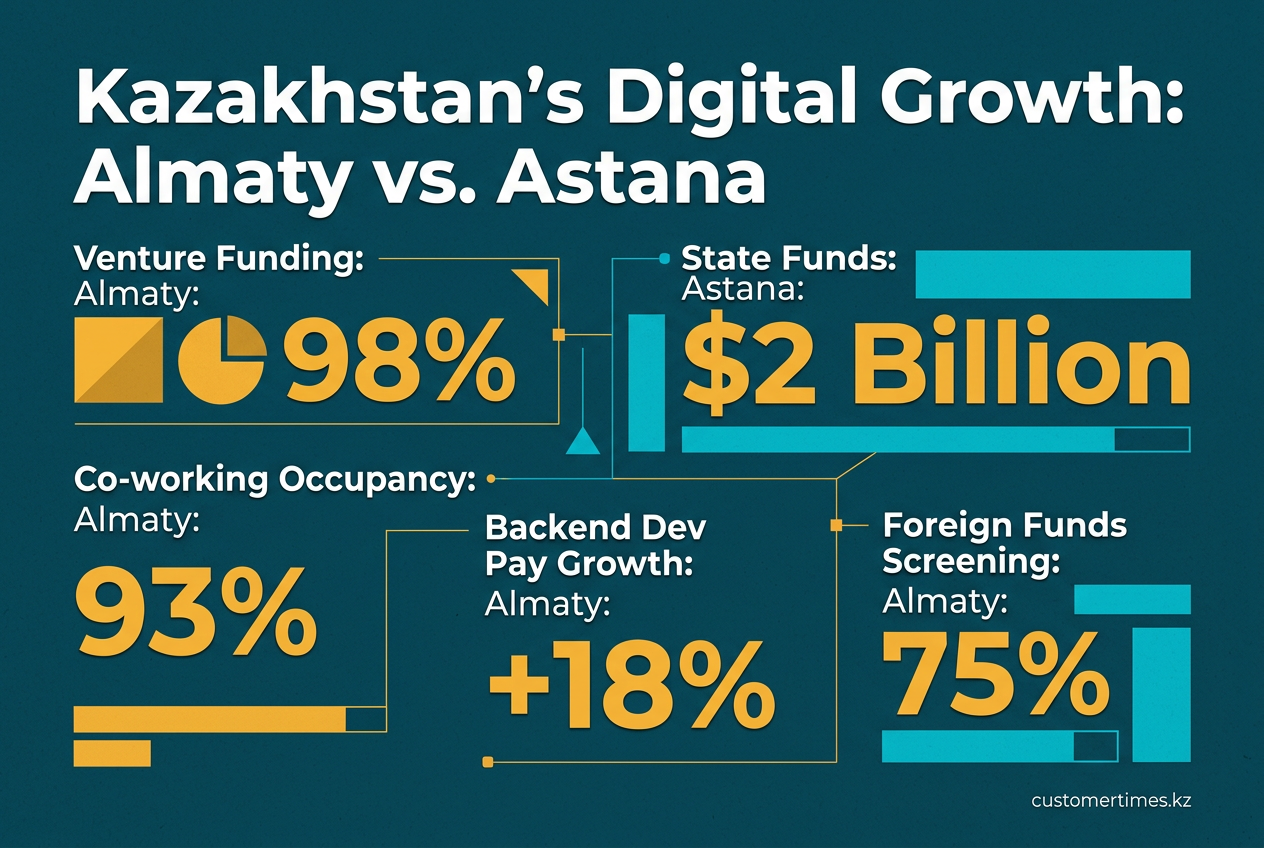
In early 2026, Almaty's startups secured USD 19 million in venture investment, representing 98% of all disclosed city-level deals. This 31% quarterly increase puts the commercial capital on track to surpass USD 80 million for the year. This capital is diverse, fueling fintech (42%), AI-driven retail analytics (28%), and logistics marketplaces linked to the Almaty Accord supply-chain corridors.
Almaty leverages its status as a commercial hub to attract private venture capital, creating a dense ecosystem of mentors, talent, and successful startups. Astana, in contrast, utilizes state power and substantial public funding to build high-tech clusters and incentivize growth through Special Economic Zones and tax waivers.
"Almaty's ecosystem is already the default landing pad for foreign angels. Government support is welcome, but the deals close here because mentors, exit stories and bilingual talent are all within a five-block radius."
- partner at a USD 50 million blended fund that doubled its first close in April 2026
The city's magnetic pull is reflected in its high co-working occupancy (93% vs. 71% nationwide) and faster salary growth for tech roles, with median backend-developer pay rising 18% year-on-year, compared to Astana's 11%. Prominent international funds like White Hill Capital, Genesis Investments, and Vostok Global established a presence in 2025-26, screening over 240 Kazakh startups, with 75% of them based in the Almaty region.
Astana's counter-move: policy firepower and SEZ cash
Astana's strategy is built on scale. In February 2026, President Tokayev's administration allocated 1 trillion tenge (approx. USD 2 billion) for high-tech clusters over the next three years. This capital is channeled through Special Economic Zones (SEZs) like Astana Hub and the Silk Road Innovation Zone, offering major incentives to resident firms:
| Instrument | Amount | Purpose |
|---|---|---|
| Zero corporate income tax | 25-year waiver | Resident startups with >50% export revenue |
| Subsidised cloud credits | Up to USD 120k per firm | GCP, AWS local zones purchased in bulk by state fund |
| Co-investment tickets | 1 tenge for every 2 tenge of private lead | Caps at USD 2 million per round |
By March 2026, the state's Digital Investment Platform had reviewed 1,319 projects valued at USD 165 billion. These ventures are concentrated in sectors like AI, rare-earth hardware, and green data centers - industries that rely on land and power, resources Astana has in abundance. Notably, 47% of applicants chose Astana or its surrounding region as their legal base, even while maintaining R&D teams in Almaty.
Sector heat-map: where each city wins
| Vertical | Almaty advantage | Astana advantage |
|---|---|---|
| Mobile consumer apps | Large安卓/iOS user base, ad agencies | 5G testbed licences issued Feb 2026 |
| AI analytics | 100+ start-ups, Tableau user meet-ups | Exascale cluster at Nazarbayev University |
| Fintech | Payment APIs, merchants | Regulatory sandbox, National Bank liaison office |
| Clean-tech equipment | Logistics to Kyrgyz/Uzbek markets | Land banks for solar-panel factories |
In a move reflecting a focus on balanced regional development, the annual Digital Almaty forum was rebranded as Digital Qazaqstan and relocated to Shymkent. This allows the event to retain its established brand while the government rotates the venue, signaling a collaborative national strategy over a single city's victory.
Forecast horizon: 2027 and the 65 percent question
By 2027, analysts project Almaty will retain 60-65% of Kazakhstan's venture capital share. However, the total investment landscape is set to expand dramatically. If the national plan to attract USD 400 billion in investment reaches its 2029 target, the total VC pie could triple to USD 600 million. In this scenario, Astana's absolute funding will soar, driven by large-scale government rounds in semiconductors and AI that dwarf typical consumer app investments.
Private investors are already adapting. The Tumar Venture Fund is closing a USD 50 million fund, with half its capital from retail conglomerates shifting from physical assets to software. Their key condition - that portfolio companies open an Astana office to access co-investment grants - shows how the rivalry is evolving into a complementary circuit.
"We don't see a binary choice. Founders register in Nur-Sultan for tax breaks, keep developers in Almaty for hiring depth, and sell to clients in the SCO region. The cities are different nodes of the same network."
- EBRD venture principal speaking at CEVF 2026
Infrastructure scorecard: bandwidth, brains and board flights
- Internet: Both cities feature 10 Tbit/s international fiber, but Almaty has a faster last-mile average speed of 84 Mbps compared to Astana's 66 Mbps (Feb 2026).
- Talent pipeline: Almaty's 48 universities produce 5,400 STEM graduates annually versus Astana's 3,100 from 22 universities. However, Astana's Nazarbayev University hosts an elite MSc in AI program with a 4% acceptance rate, creating a coveted talent pool for state labs.
- Connectivity: Almaty's 27 direct international routes are crucial for investors, while Astana's introduction of 72-hour visa-free transit in January 2026 boosted pitch-week attendance by 18%.
Reading the road signs
While no official rivalry exists, every metric reveals two cities on parallel sprints. Almaty excels in speed, network density, and risk-taking, while Astana provides scale, policy stability, and patient, state-backed capital. For tech founders, the competition is less about choosing a city and more about leveraging a powerful national network. The ultimate challenge is not internal, but whether Kazakhstan's dual-engine ecosystem can execute quickly enough to capture the attention of global investors watching from the sidelines.