
Amazon Bio Discovery: AI Speeds Drug Design 10X for Cancer
Alexander Shlimakov specializes in Salesforce, Tableau, Mulesoft, and Slack consulting for enterprise clients across the CIS region. With a proven track record in technical sales leadership and a results-oriented approach, he focuses on the financial services, high-tech, and pharma/CPG segments. Known for his out-of-the-box thinking and strong presentation skills, he brings extensive experience in solution sales and business development.

Amazon Bio Discovery: AI generates 288,000 antibody designs in 72 hours for rare pediatric cancer, accelerating drug discovery.
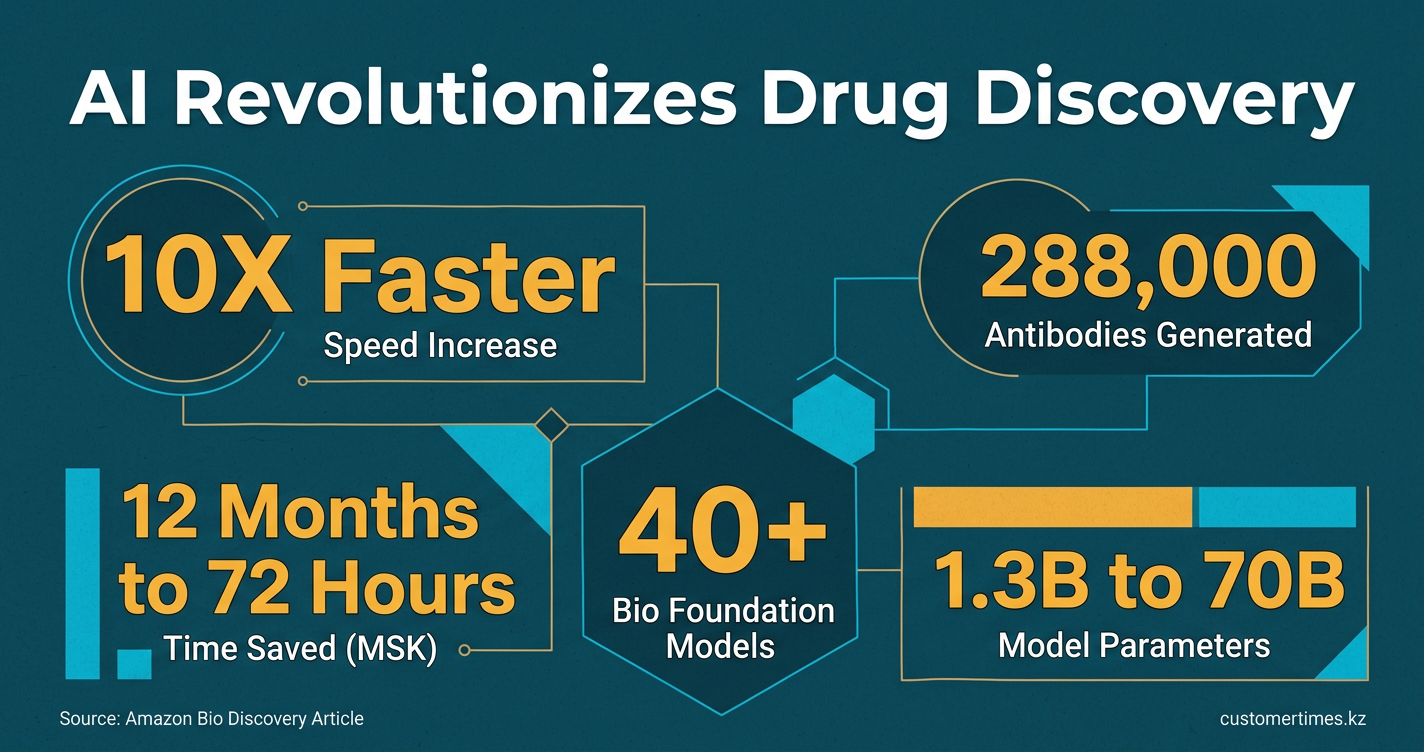
With Amazon Bio Discovery, AI speeds drug design 10X for cancer and other diseases, compressing research timelines from years into weeks. In a landmark case, researchers at Memorial Sloan Kettering Cancer Center (MSK) used the platform to generate 288,000 antibody designs for a rare pediatric cancer in under 72 hours - a task that traditionally required over 12 months. This powerful new platform accelerates the creation and testing of millions of novel drug candidates by integrating advanced AI models with automated laboratory workflows.
What is Amazon Bio Discovery and how does it accelerate AI-driven drug discovery?
Amazon Bio Discovery is an end-to-end AI platform designed to accelerate drug discovery. It allows researchers to generate, rank, and refine millions of potential drug candidates, like antibodies, in weeks rather than months by integrating powerful biological foundation models, automated lab workflows, and secure data management.
Core Architecture
Amazon Bio Discovery accelerates research by combining over 40 biological foundation models with a conversational AI agent for zero-code experiment design. It automates lab synthesis and testing through a 'Lab-in-the-Loop' fabric, allowing for rapid, iterative cycles of in-silico design and real-world validation.
| Component | Purpose | Notable Stats |
|---|---|---|
| 40+ Biological Foundation Models (BioFMs) | Predict molecular properties, fold stability, off-target risk | Models range from 1.3 B to 70 B parameters and span genomic, proteomic, and antibody design tasks |
| Conversational AI Agent | Zero-code experiment design | Accepts plain-language instructions such as "optimize for minimal cardiotoxicity while retaining binding affinity to GD2" |
| Lab-in-the-Loop Fabric | Automated synthesis & assay ordering | Partners include Twist Bioscience, Ginkgo Bioworks, and soon A-Alpha Bio |
| Custom Model Fine-Tuning | Leverage proprietary datasets | 3-click retraining keeps models private to the organization |
| Experimental Data Registry | Unified view of inputs & results | Handles triage, lineage, and version control |
"We're glad to join forces with Amazon Bio Discovery to develop the next generation of antibodies that will potentially speed up the process to help patients worldwide... Patients come here with a clock. We need results sooner." - Nai-Kong Cheung, M.D., Ph.D., Enid A. Haupt Chair in Pediatric Oncology, MSK
First Front-Line Test
The pilot project at MSK focused on a single genomic signature linked to neuroblastoma. The platform generated 288,000 candidate antibodies, which the AI agent then ranked based on composite scores for developability, manufacturability, and predicted safety. The top 100,000 candidates were sent to Twist Bioscience for synthesis and screening, with results returned to the platform in just four days. This initiated an immediate second round of digital refinement, achieving a throughput 10 times greater than traditional methods, which typically yield around 200 designs per quarter.
Early Adopters Beyond Oncology
Adoption of the platform extends beyond oncology, with several key partners leveraging its capabilities:
- Bayer is deploying the platform to develop next-generation small-molecule crop-protection agents.
- Broad Institute is integrating its proprietary CRISPR screen data to fine-tune the platform's variant effect predictors.
- Voyager Therapeutics is using the platform to explore capsid optimization for gene therapies targeting the central nervous system (CNS).
Market Pulse
Following the 2022-2023 venture capital surge, market focus has shifted toward clinically validated platforms. Analysts project the AI-enabled drug discovery market will reach USD 33.95 billion by 2036, growing from an estimated USD 8.18 billion in 2026 at a 15% CAGR. This growth is driven by demand for capital-efficient solutions. Amazon Bio Discovery is positioned as an "AI-native biotech" platform, combining cloud-scale computing with direct wet-lab integration - a key differentiator from services that only license algorithms.
Competitive Footprint
| Platform | Distinctive Edge | 2025 Focus |
|---|---|---|
| Amazon Bio Discovery | Lab-in-the-Loop + AWS serverless scale | Pediatric oncology & antibody engineering |
| Roche Internal AI Division | 200-person in-house team | Oncology target ID |
| Recursion/OSR | Petabyte-scale imaging data | Phenomics-driven phenotypic screens |
| BenevolentAI | Knowledge graph reasoning | Neuroscience pipeline progression |
Deep integration is now a critical factor for adoption, as pharmaceutical partners prioritize systems that seamlessly connect with existing ELN/LIMS workflows and ensure strict data privacy. Amazon Bio Discovery addresses this with a single-tenant, S3-backed enclave, guaranteeing that all proprietary data and fine-tuned models remain completely isolated and private, even from AWS support personnel.
From Console to Clinic: The 2025 Roadmap
- Q2 2025: Launch of a public access tier featuring pay-per-query pricing and 10 GB of included model output storage.
- Q3 2025: Introduction of an FDA pre-submission package generator to the AI agent's capabilities.
- Q4 2025: A pilot program in Kazakhstan for rare disease discovery, utilizing de-identified genomic data stored locally to comply with national data-residency laws.
Kazakhstan's recent implementation of Law No. 94-V on personal data reflects the global trend toward data sovereignty. To meet these requirements, Amazon Bio Discovery's architecture supports a Region-in-Country deployment. This allows research centers in Kazakhstan to keep raw patient genomic data on domestic servers while accessing the platform's global suite of foundation models.