
Tableau Services Market to Hit $6.86B by 2033 Driven by AI, Cloud
Alexander Shlimakov specializes in Salesforce, Tableau, Mulesoft, and Slack consulting for enterprise clients across the CIS region. With a proven track record in technical sales leadership and a results-oriented approach, he focuses on the financial services, high-tech, and pharma/CPG segments. Known for his out-of-the-box thinking and strong presentation skills, he brings extensive experience in solution sales and business development.

Tableau Services market to hit $6.86B by 2033, driven by cloud, AI, and healthcare. 12.58% CAGR predicted.
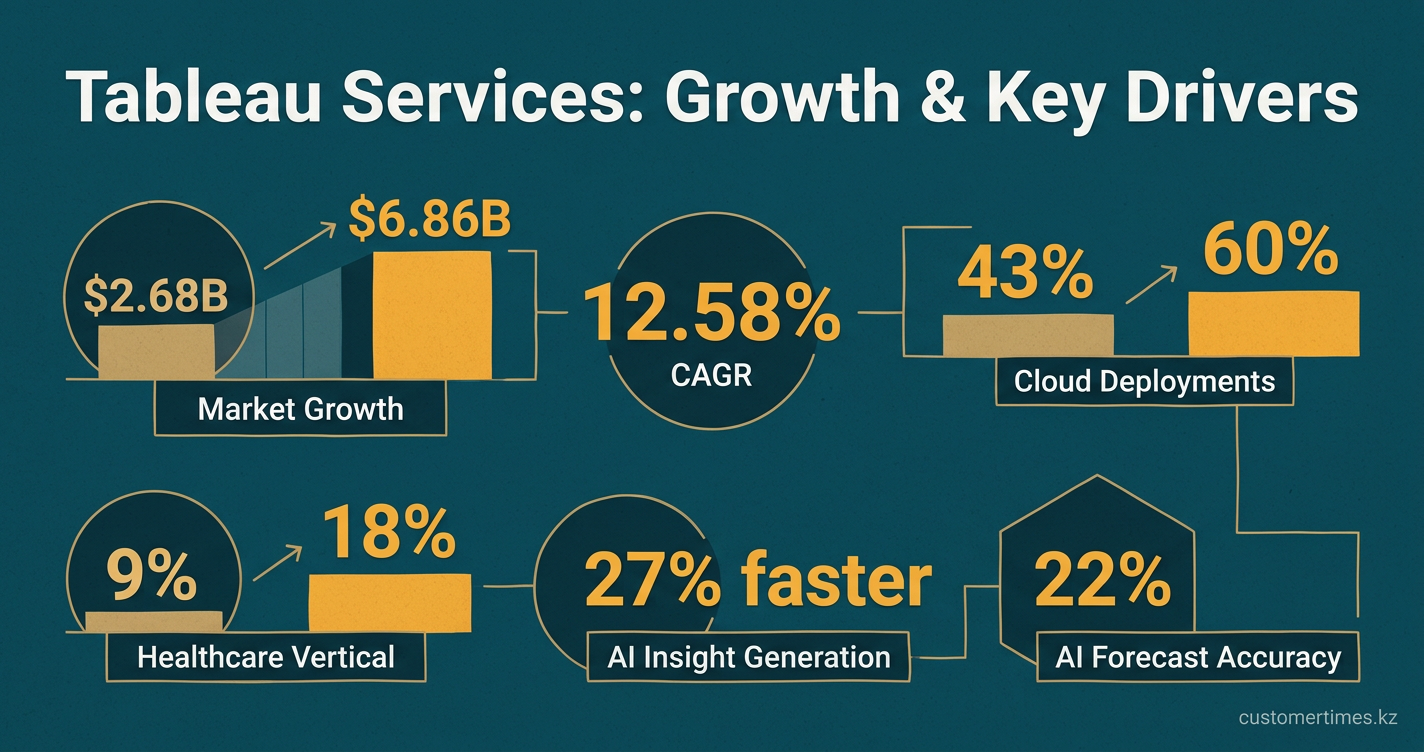
The global Tableau Services market is set to hit $6.86 billion by 2033, driven by AI and cloud adoption, expanding from a 2025 value of $2.68 billion, according to SNS Insider. This growth represents a 12.58% compound annual growth rate (CAGR) and is fueled by surging demand for AI-augmented analytics and cloud-native deployments, particularly within the healthcare sector and across the Asia-Pacific region. This trajectory positions Tableau services among the fastest-growing segments in the business intelligence landscape.
What is the projected growth and key drivers of the Tableau Services market through 2033?
The Tableau Services market's projected expansion to $6.86 billion by 2033 is powered by a 12.58% CAGR. Primary drivers include the enterprise shift to cloud-based analytics, the integration of AI features, rapid adoption in healthcare, and accelerated growth in the Asia-Pacific region's key economies.
The market is forecast to grow from USD 2.68 billion in 2025 to USD 6.86 billion by 2033. This growth is propelled by key factors including cloud-first strategies, AI integration, accelerated healthcare adoption, and significant expansion in Asia-Pacific and data-preparation services.
"Cloud deployments already account for 43 % of all new Tableau engagements and are expanding at 13.20 % CAGR, pulling the entire ecosystem toward hybrid, real-time analytics stacks."
Growth levers at a glance
| Driver | 2025 baseline | 2033 outlook | CAGR |
|---|---|---|---|
| Cloud-first implementations | 43 % share | 60 % share (est.) | 13.20 % |
| Data-preparation services | 15 % share | 25.7 % share | 15.01 % |
| Healthcare vertical | 9 % share | 18 % share (est.) | 14.31 % |
| Asia-Pacific region | 22 % share | 34 % share (est.) | 14.80 % |
Modern enterprises are shifting from isolated Tableau license purchases to comprehensive, outcome-based service packages. These bundles typically integrate cloud migration, AI-ready data pipelines, and vertical-specific dashboards. The healthcare vertical exemplifies this trend, growing at a 14.31% CAGR by using Tableau with HL7-compliant data lakes to track critical KPIs like bed occupancy and patient readmissions, surpassing the 11.9% growth of the BFSI sector.
AI augmentation becomes a default requirement
AI augmentation is now a standard requirement in Tableau services. The 2025.1 release introduced an embedded AI agent for natural language queries and predictive suggestions, enabling early adopters to achieve 27% faster insight generation and a 22% increase in forecast accuracy. Service providers are now contractually obligated to meet these benchmarks, driving a surge in demand for fixed-price, AI-ready data preparation services - a segment poised to grow at a market-leading 15.01% CAGR.
"Customers no longer ask if AI can be added; they ask how quickly the model will adapt when business definitions change next quarter."
Regional hotspots
While North America remains the largest market - projected to grow from 39% share in 2025 to 42.6% by 2035, largely due to U.S. federal modernization - the Asia-Pacific region is the primary growth engine. With a rapid 14.80% CAGR, this expansion is driven by key projects like self-service analytics portals in Kazakhstan's telecom sector, real-time risk dashboards for Vietnamese banks, and predictive supply chain monitoring in India's pharmaceutical industry.
Competitive landscape
The competitive landscape is dominated by global systems integrators like Accenture, Deloitte, TCS, Capgemini, and Cognizant, which command about half of the market's 2025 revenue. However, specialized firms such as Interworks, Bilytica, and Perceptive Analytics are capturing significant share in data preparation and training by offering agile "AI-accelerator" packages that combine Tableau, Snowflake, and AutoML.
Pricing and delivery trends
Pricing models are evolving. While the average implementation cost for a 500-user Tableau Cloud tenant has dropped 18% since 2023, associated services revenue has increased 11% due to a preference for ongoing "insight-as-a-service" retainers. Reflecting this trend, a 2024 Gartner CIO survey found 62% of enterprises favor outcome-based contracts for BI programs, compelling providers to link fees directly to measurable business KPIs.
Market challenges ahead
- Skills gap: Demand for Tableau-certified developers is growing 2.3× faster than supply; day rates in Western Europe have jumped 14% year-over-year.
- Data complexity: Multi-cloud estates (AWS, Azure, GCP) create lineage issues that lengthen average data-prep cycles by 30%.
- Cost pressure: SME clients push for subscription models that cap annual spend at 8% of license value, squeezing provider margins.
Despite these challenges, market momentum remains strong. Pipeline surveys show 74% of CIOs intend to boost their Tableau services budgets in 2026 - twice the rate for generic BI tools. This commitment supports the projected 12.58% CAGR, keeping the market on track for its $6.86 billion valuation by 2033, contingent on providers delivering measurable business impact through AI-driven, cloud-native analytics.