
Almaty Hub's AI Ethics Framework Sets Central Asia Standard

Alexander Bazilevich is a CRM expert and Top Salesforce Partner with over 17 years of sales experience in the IT industry. He specializes in transforming corporate goals into profits through cross-functional collaboration and innovative business solutions, with deep expertise in business systems and IT products.

Almaty Tech Hub launches Central Asia's first AI ethics framework, translating Kazakhstan's AI law into practice with training & certification.
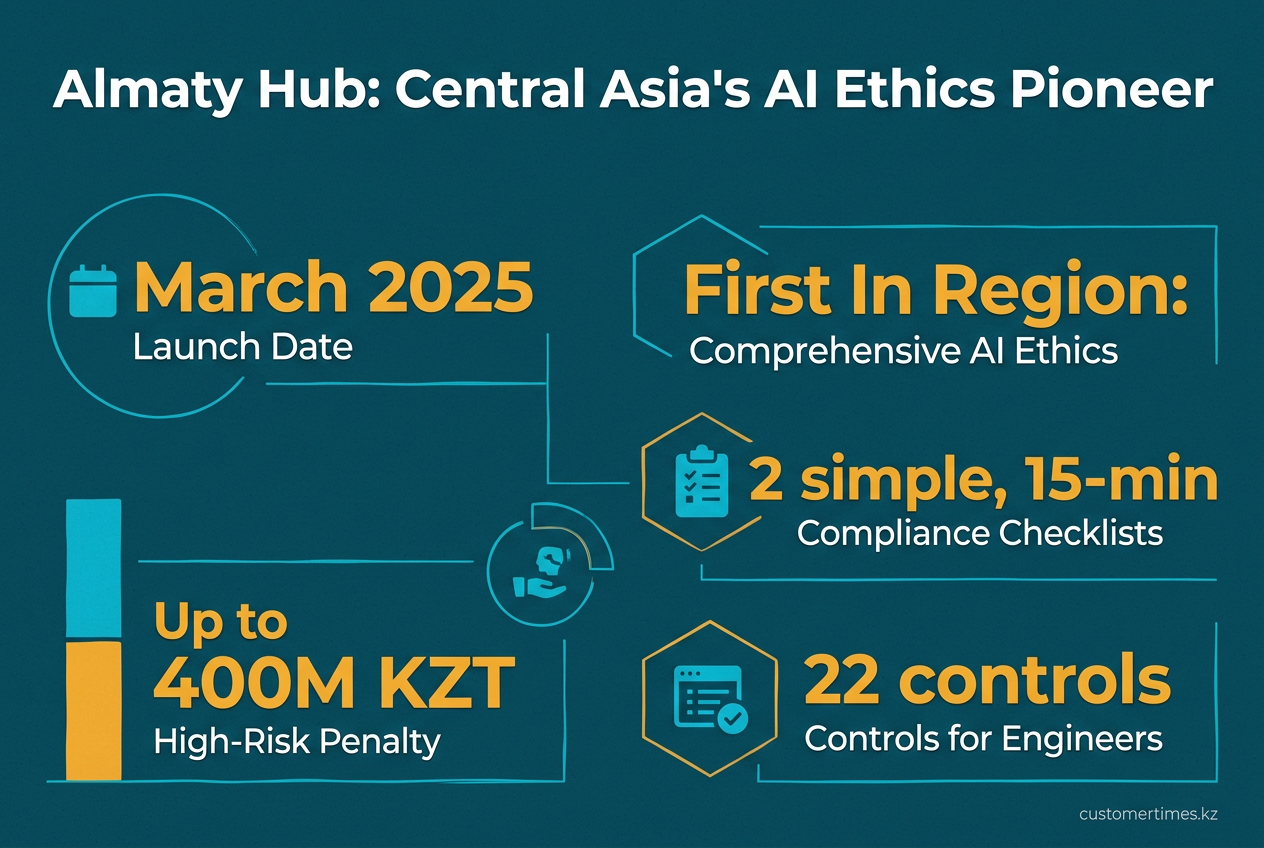
The new Almaty Hub's AI Ethics Framework sets Central Asia standard for responsible AI, translating Kazakhstan's national law into practice. Unveiled in March 2025, the framework combines legally-binding rules with industry-specific training and certifications, making it the first of its kind in the region. By providing clear compliance checklists and a certification path that boosts investment prospects, the initiative aims to build a trusted and financially robust AI ecosystem. This comprehensive approach could set the standard for AI across the whole region.
What is the Almaty Tech Hub AI ethics and governance framework?
The Almaty Tech Hub AI ethics and governance framework is a comprehensive program designed to implement Kazakhstan's national AI law. It provides startups and organizations with practical compliance tools, industry-specific training tracks, and a certification process to promote responsible AI development and build public trust.
The Almaty Tech Hub AI ethics and governance framework is Central Asia's first comprehensive program to implement Kazakhstan's 2025 AI Law. It features practical compliance check-lists, industry-specific training, and independent certification, aiming to close ethics, audit, and public trust gaps for startups and organizations.
1. Why the framework appeared
The framework was developed at the request of Kazakhstan's Ministry of Artificial Intelligence (created 1 Jan 2026) to address key gaps before the law's August 2026 compliance deadline:
| Gap | Target | Deadline |
|---|---|---|
| No common ethics code for start-ups | 250+ Hub residents | 30 Jun 2025 |
| Shortage of certified auditors | all banks, clinics, telecoms | 31 Dec 2025 |
| Public fear of "black-box" AI | general population | rolling |
The Hub's answer is a three-layer programme addressing policy, people, and proof, as described below.
2. Policy layer - turning the law into check-lists
The framework translates Kazakhstan's four-tier AI law into two simple 15-minute checklists for development teams, categorizing systems by risk level:
| Tier | Example use | Owner must... | Penalty (KZT) |
|---|---|---|---|
| High-risk | credit scoring, CV screening | bias audit + log register | up to 400 million |
| Limited | chat-bot, price forecast | label output + opt-out button | up to 40 million |
"We removed legalese and kept only the 22 controls that an engineer can code or a product manager can tick off," says Aizhan Akhmetova, head of the Hub's Ethics Lab.
A free open-source repository provides Python decorators and JSON schemas to help developers automatically flag non-compliant models.
3. People layer - new training tracks and micro-credentials
Starting in June 2025, the Hub offers three specialized training tracks in both Kazakh and Russian to build a skilled workforce:
- Track 1: Developer fundamentals - A 12-hour course covering transparency logs, fairness metrics, and explainability toolkits. Completion earns an online badge recognized by Astana Hub's resident directory.
- Track 2: Governance professional - A 32-hour course mirroring Texas DIR 2026 standards and the IEEE CertifAIEd syllabus. Participants conduct a live bias audit on anonymised data from a partner bank.
- Track 3: Sector specialist - 20-hour modules for health, fintech, and retail, which include role-playing incident responses to simulated model failures.
While the current pass rate is 71%, the Hub will raise the threshold to 80% for the August 2026 wave to align with EU AI Act preparations.
4. Proof layer - independent certification and venture boost
To provide tangible proof of compliance, the Hub has partnered with two international audit firms and the domestic firm Qorgau* * to offer an "AI-Ready" seal. Startups earning this certification are fast-tracked to the final interview stage of the $1 billion Astana Hub venture fund** announced in February 2025. Early recipients include:
- AgroMind - A computer-vision pest detection startup that implemented transparency logs in just two weeks.
- CardioLite - A portable ECG device that now includes a patient-information leaflet explaining its algorithmic confidence scores.
5. What still needs to be written
Despite its comprehensive nature, experts acknowledge that several areas require further development:
- Secondary legislation on biometric data is not expected until late 2025.
- Legal precedents have not yet been set to define "creative contribution" in AI-generated content.
- Smaller regional clinics may lack the resources for continuous AI bias monitoring.
To address these evolving issues, the Hub hosts a collaborative wiki where legal, technical, and civic experts co-author future regulations, a model inspired by the consultation process for Kazakhstan's New AI Regulatory Framework.
6. Regional ripple effect
The framework is already creating a ripple effect across the region. Delegations from Kyrgyzstan and Uzbekistan attended the March 2025 launch and have shown interest in adopting the checklist model. If widely adopted, the Almaty framework could establish the de-facto Central-Asian baseline for AI governance, streamlining compliance for global companies entering the 83 million-strong EAEU market.
"The fastest way to attract responsible capital is to show that ethical rules are not an after-thought but a pre-loaded compiler flag," argues Adil Mukashev, director of the Almaty Tech Hub.
Early data confirms this strategy's success. Venture capital inquiries to the Hub surged by 38% in Q1 2025 over the previous quarter. Furthermore, 11 foreign AI companies have already applied for relocation grants, citing the clear governance roadmap as their primary motivation.