
Kazakhstan: AI Powers 75% of Bank Decisions, % Fraud Drops
Kazakhstan is rapidly becoming an AI leader in payments, with banks using machine learning for credit, fraud, and personalization.
AI Revolutionizes Kazakhstan's Payments: A Deep Dive into the Fintech Boom
In Kazakhstan, AI powers 75% of bank decisions as fraud drops and payment systems become a high-tech laboratory. Banks and fintechs are leveraging artificial intelligence to accelerate transactions, prevent fraud, and deliver hyper-personalized services. From instant QR code payments to automated micro-loans, AI is now the engine driving the nation's financial infrastructure, fueled by rising investment and a supportive regulatory landscape.
How is AI transforming Kazakhstan's payment systems?
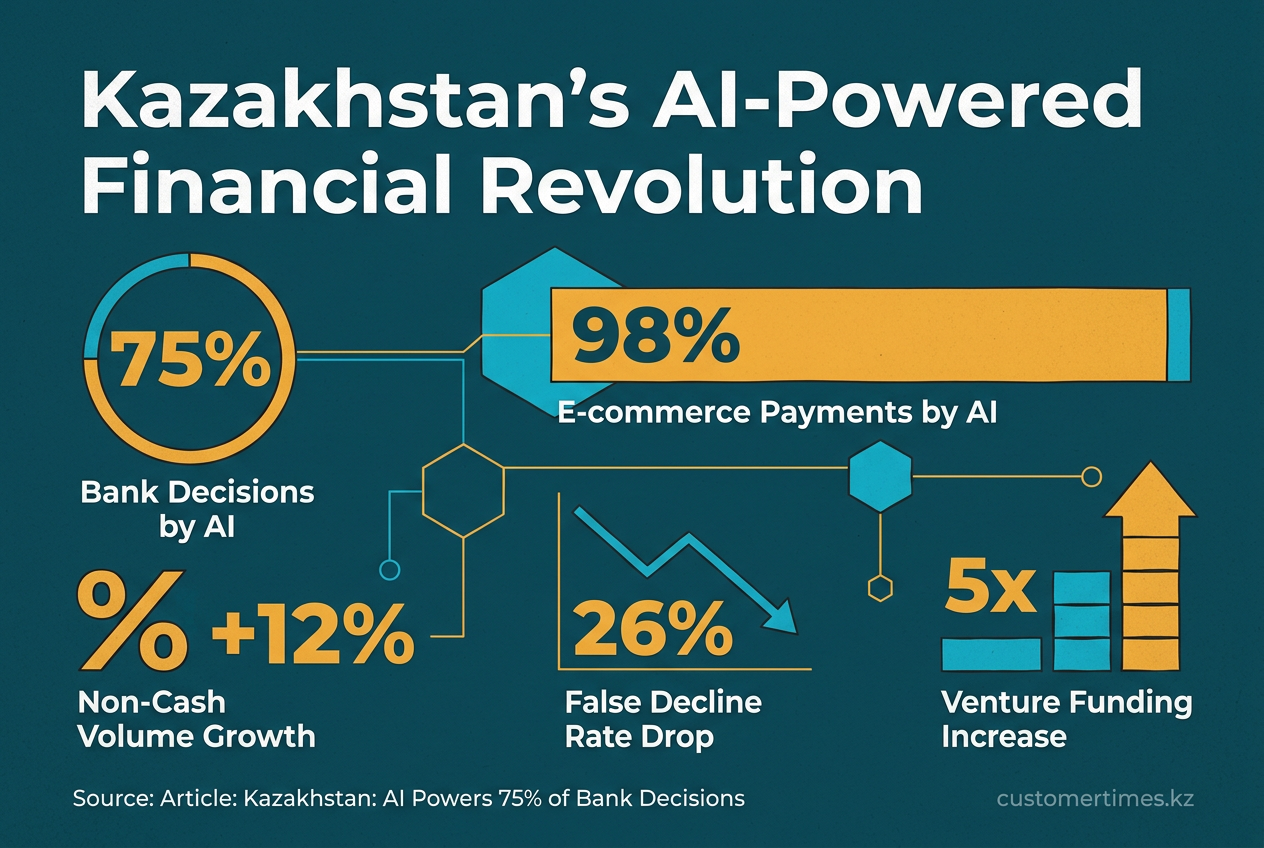
AI is fundamentally reshaping Kazakhstan's payment ecosystem by delivering faster transactions, stronger fraud prevention, and customized user experiences. By 2025, 75% of domestic banks adopted machine learning for critical functions like credit scoring and security. AI-driven systems now process 98% of all e-commerce payments, significantly cutting fraud and accelerating loan approvals.
According to the National Bank, non-cash transaction volume reached 186 trillion tenge in 2025, a 12% increase year-on-year. This growth reflects a deeper trend: three in four domestic banks now use machine-learning models for credit scoring, anti-fraud measures, and targeted marketing. This technological shift is evident in daily life, from sub-second QR payments on Almaty buses to micro-loans approved instantly within banking apps and cross-border remittances secured by behavioural biometrics.
"AI-driven projects, cryptocurrencies, open banking and blockchain are transforming payment methods. The development of regulatory frameworks will play a crucial role, and Mastercard is committed to contributing to these efforts." - Sanzhar Zhamalov, Country Manager, Mastercard Kazakhstan & Central Asia
Mastercard's data confirms this trend. The company's Transaction Stream real-time risk engine uses hybrid AI models to process 98% of e-commerce purchases in Kazakhstan. Since its implementation, false-decline rates have plummeted by 26%, while the average authorisation time remains a swift 320 ms, ensuring a seamless user experience for services like one-click taxi apps.
From digitalisation to AI-first infrastructure
AI transforms Kazakhstan's payment infrastructure by enabling real-time credit scoring, advanced fraud detection, and hyper-personalized customer services. This shift is supported by government initiatives, growing venture capital investment, and the development of sovereign cloud platforms for secure data processing.
The government's Kazakhstan AI Country Report 2025 identified payments as the "first sector to move from digitalisation to large-scale AI adoption." Venture funding for local AI start-ups soared to $73 million in 2025, a fivefold increase from 2023. Over half of these start-ups are focused on creating B2B tools for the financial sector. The availability of sovereign cloud nodes with NVIDIA A100 clusters allows fintechs to innovate while complying with the data residency requirements of the new Law on Artificial Intelligence.
| Metric | 2023 | 2025 | Delta |
|---|---|---|---|
| AI venture investment | $14 M | $73 M | ×5.2 |
| Non-cash volume | 166 tr KZT | 186 tr KZT | +12 % |
| Banks using ML in back office | 51 % | 75 % | +24 pp |
| Generative-AI users (adults) | 2.6 % | 13.7 % | +11.1 pp |
Credit, fraud and hyper-personalisation in action
Major retail lenders like Kaspi, Eurasian Bank, and Bank CenterCredit now use gradient-boosting models that analyze up to 400 behavioural variables. This allows them to adjust unsecured consumer credit limits within 90 seconds and has expanded access to credit, with 18% more thin-file borrowers qualifying for their first card. Meanwhile, Mastercard's Decision Intelligence platform analyzes 120 unique fraud signals for each transaction, including device gyroscope patterns. This has led to a 34% reduction in card-present fraud, while counterfeit losses at ATMs have been virtually eliminated.
Marketing has also been transformed. Freedom Bank's "Aral Sea" eco-card uses AI to select personalized 3% cashback categories for customers weekly. By using an LLM to A/B test notification copy, the bank doubled its click-through rates.
By 2026, agentic commerce is expected to handle 15-25 % of e-commerce purchases in leading markets; Kazakh fintechs are piloting "Buy for Me" bots inside super-apps that can autonomously order groceries when the fridge barcode scanner reports low milk stock.
Stablecoins, CBDC and cross-border AI corridors
The National Bank's digital tenge pilot, leveraging Mastercard's Multi-Token Network, successfully processed 100,000 peer-to-peer transfers in March 2025 with settlement times under 1.5 seconds. Its smart contracts demonstrate a viable model for automating fee splits, which could be extended to B2B stablecoin flows. The adoption of stablecoins in emerging markets has quadrupled since 2023, largely driven by AI-powered market-makers.
Challenges under the surface
Significant challenges remain. An estimated 30% of transaction volume is still processed by legacy core-banking systems from the 2000s, and data silos hinder effective model training. The KPMG 2025 AI Readiness Survey finds that while Kazakh banks have successful proofs-of-concept, they lack enterprise-scale MLOps. Furthermore, cyber-criminals are weaponizing AI, with deepfake voice fraud attacks on call centres increasing by 220% in the past year.
What happens next
Almaty is solidifying its position as a CIS payments tech hub. Mastercard's new Tech & Cyber Centre plans to hire 120 engineers to develop quantum-safe cryptography and privacy-preserving federated learning solutions. In parallel, start-ups in Astana Hub's AI accelerator are training multilingual LLMs on sovereign cloud infrastructure to enable secure, compliant voice payment systems.
If current trends continue, non-cash volume will exceed 200 trillion tenge by 2026, with AI models responsible for over half of all credit decisions in Kazakhstan. The primary focus is now on ensuring these powerful algorithms remain fair, efficient, and firmly under local governance.