
Kaspi.kz: Super-App Powers New SaaS for Central Asia Retail

Kaspi.kz expands its super-app services to Central Asian businesses with Kaspi Pay Business Cloud, offering a localized SaaS bundle.
In a significant move for regional commerce, Kaspi.kz: Super-App Powers New SaaS for Central Asia Retail with a stand-alone toolkit for local businesses. This new offering, Kaspi Pay Business Cloud, packages the fintech giant's powerful back-end services into a single, localized dashboard. Designed for the region's retailers and cafés, the platform simplifies payments, inventory, and compliance, keeping all data within Kazakhstan to meet local regulations and help small businesses go digital faster.
What is Kaspi Pay Business Cloud and how does it benefit retailers in Central Asia?
Kaspi Pay Business Cloud is an integrated merchant SaaS solution from Kazakhstan's Kaspi.kz, unifying payments, inventory management, e-invoicing, lending, and advertising in a single dashboard. Custom-built for Central Asian markets, it provides a localized, compliant, and all-in-one platform that streamlines operations and accelerates digital transformation for retailers and cafés.
The new offering, branded Kaspi Pay Business Cloud, consolidates six micro-services under one login:
- POS orchestration (tap-to-phone, QR, online checkout)
- Same-day reconciliation with Kazakhstani banks
- AI-driven demand forecasting for SKU-level inventory
- E-invoicing that auto-updates the State Revenue Committee
- One-click consumer lending at checkout
- Merchant ads that place products inside the Kaspi marketplace feed
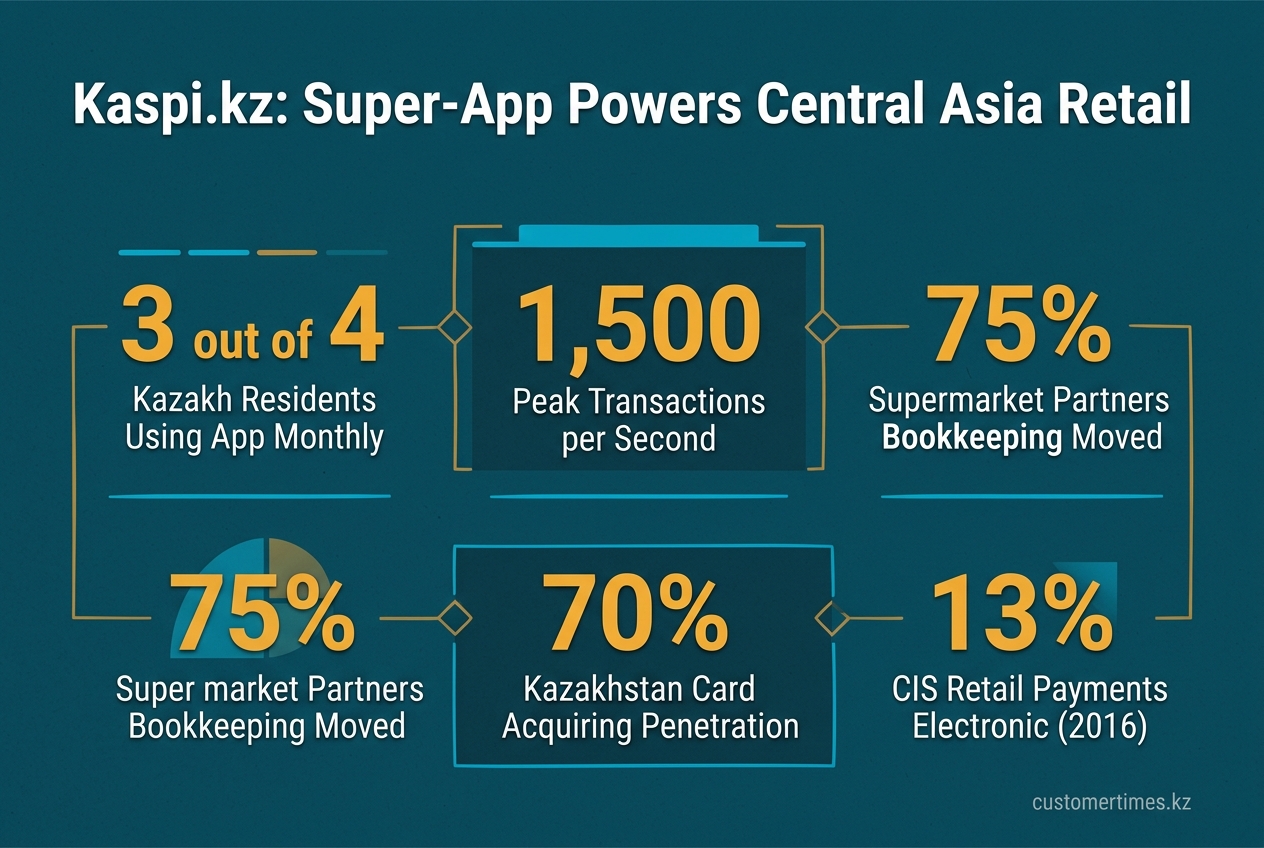
Company data shows that early adopters in Almaty and Shymkent, using standard Android phones, managed peak-day volumes of 1,500 transactions per second without extra hardware.
"We simply turned the modules we use internally into public APIs; 75 % of our supermarket partners moved their entire bookkeeping to the new console within three weeks," a Kaspi product manager told local tech site Qorus Global.
Why the CIS matters
Kaspi Pay Business Cloud is an all-in-one SaaS platform for Central Asian merchants. It integrates POS payments, inventory management, e-invoicing, consumer lending, and marketing tools into one dashboard. The system is designed for local compliance, streamlining operations and helping businesses efficiently digitize their processes.
With three out of four Kazakh residents already using the super-app monthly, Kaspi's home market is nearing saturation. The wider Commonwealth of Independent States (CIS), however, presents a significant opportunity. As recently as 2016, only 13 % of retail payments in the CIS were electronic, creating a gap between outdated cash registers and global SaaS products that often lack support for Cyrillic tax codes.
| Market | Card-acquiring penetration (2024) | SMEs with cloud POS | Forecast e-commerce CAGR to 2027 |
|---|---|---|---|
| Kazakhstan | 70 % | 42 % | 18 % |
| Uzbekistan | 31 % | 9 % | 29 % |
| Azerbaijan | 38 % | 12 % | 24 % |
Kaspi's expansion strategy is tailored for this environment. The company first establishes its marketplace in a new country, then integrates payments, and finally adds inventory and lending services as merchant data grows. Pilot results from Baku are promising: cafés that adopted Kaspi QR and inventory suggestions cut write-offs by 17 % within two months. The firm is now replicating this model in Tashkent.
Regulatory edge
Unlike global competitors, Kaspi hosts all data in Kazakhstan-certified data centers, ensuring compliance with Law 94-V on personal data localization. This approach resolves a major hurdle in Central Asian procurement tenders. The platform's architecture already includes multi-entity pricing tables, enabling an Uzbek franchise to transact in soum while its headquarters reports financials in tenge.
"Regional CFOs want real-time margin visibility across currencies; we give them one ledger that talks to three different tax engines," explained Kaspi's head of merchant solutions at a Salesforce & Tableau Day conference, where retailers discussed moving from spreadsheets to cloud solutions.
Competitive chessboard
While pure SaaS providers like 1C, Bitrix24, and Mindbox are active in the region, none have an integrated, closed-loop payments system. Local banks such as Halyk's Halo Bank, Jusan, and Freedom SuperApp offer digital wallets but depend on third-party POS software. Kaspi's key advantage is its built-in financing; 64 % gross merchandise growth in e-grocery last year was driven by instant, zero-interest installment plans offered at checkout.
Cross-border e-commerce players like Wildberries and Yandex Market compete for marketplace dominance but lack Kazakhstan-specific tax modules, giving Kaspi a distinct advantage with local accountants.
Roadmap to 2027
Partner-shared forecasts reveal three primary milestones:
1. Achieve 200,000 active SME tenants across Kazakhstan, Uzbekistan, and Azerbaijan by mid-2026.
2. Secure 15 % of all CIS cloud POS licences by 2027, which translates to approximately 600,000 seats based on World Bank data.
3. Reach break-even per country within 18 months by using interchange revenue to subsidize software fees, mirroring its free model in Kazakhstan.
To hit these targets, Kaspi is partnering with local systems integrators, offering a 70 % revenue share on first-year subscription fees and free migrations from legacy 1C systems. Startups at Astana Hub are already creating joint offerings, lowering deployment costs for small stores hesitant about upfront investment.
Whether Kaspi can secure a 15% regional share depends on its ability to replicate its success outside Kazakhstan. However, its familiar Cyrillic interface, regulatory compliance baked in, and extensive consumer-financing reach provide a powerful head start in markets where cloud adoption is just beginning.