
Kazakhstan Targets 150,000 Foreign Students, Boosts Digital EdTech
Alexander Shlimakov specializes in Salesforce, Tableau, Mulesoft, and Slack consulting for enterprise clients across the CIS region. With a proven track record in technical sales leadership and a results-oriented approach, he focuses on the financial services, high-tech, and pharma/CPG segments. Known for his out-of-the-box thinking and strong presentation skills, he brings extensive experience in solution sales and business development.

Kazakhstan's Bett UK 2026 pavilion showcases its rise as a global EdTech leader, targeting 150k int'l students by 2029.
Kazakhstan Targets 150,000 Foreign Students, Boosts Digital EdTech
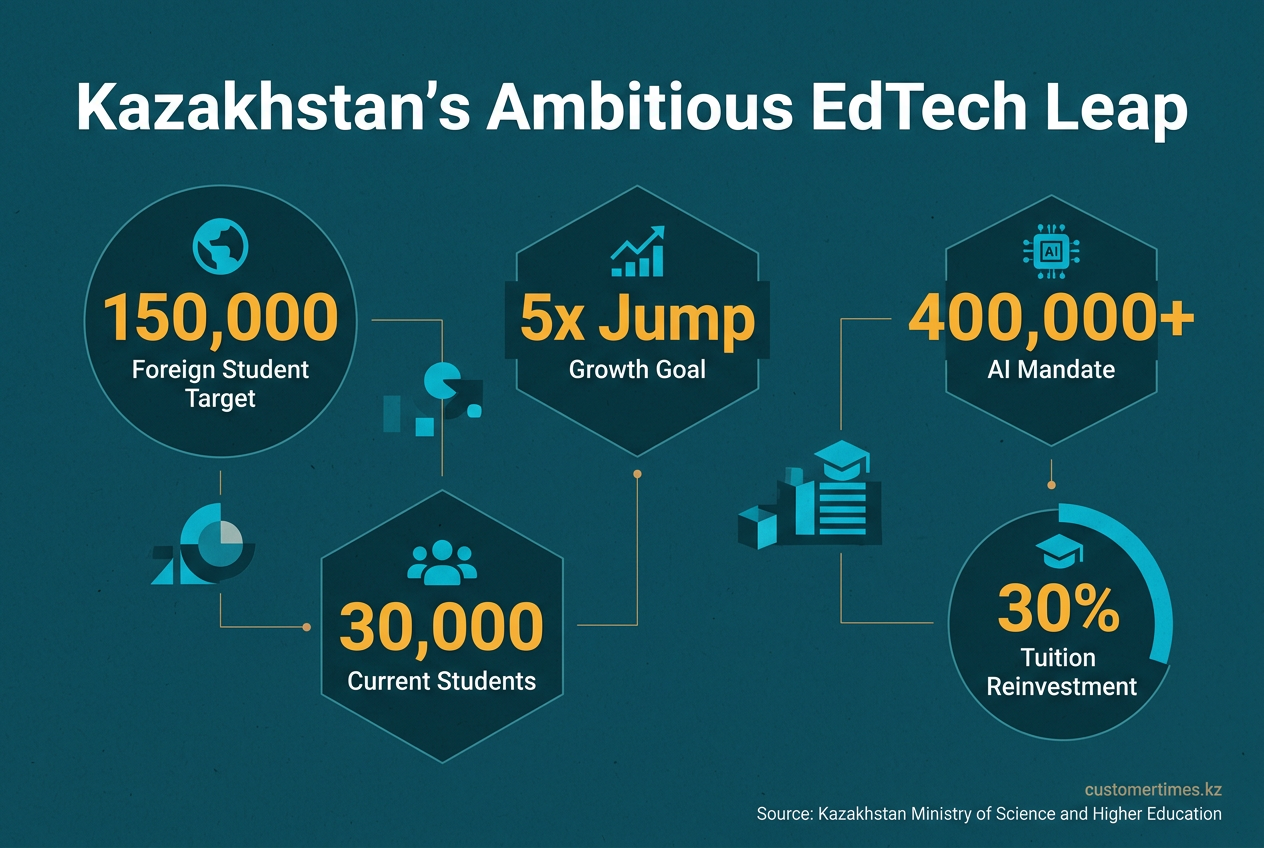
As Kazakhstan targets 150,000 foreign students by 2029, the nation is boosting its digital EdTech capabilities, turning its first-ever national pavilion at Bett UK 2026 into a launchpad for regional leadership. Led by the Ministry of Science and Higher Education, nine universities arrived with ready-to-sign cooperation packages. Minister Sayasat Nurbek presented the "Study in Kazakhstan" brand, highlighting the goal of a five-fold jump from 30,000 current international students, which would make Kazakhstan one of the world's fastest-growing study destinations. Inside the pavilion, visitors tested advanced technologies like AI tutors and VR labs, demonstrating the country's commitment to becoming a top digital education hub.
What is Kazakhstan doing to become a leading digital education hub in Central Asia?
Kazakhstan is implementing nationwide digital education reforms. These include mandating AI coursework for all undergraduate students, creating partnerships with global tech firms, and expanding its network of international branch campuses to streamline degree recognition and attract foreign talent.
Digitalization is no longer a slide in a strategy deck; it is the admission ticket to global higher-ed markets.
Since 2025, AI has been a compulsory discipline for all bachelor students, potentially placing over 400,000 undergraduates annually in courses on machine learning or data engineering. The state links this mandate to strong incentives: universities receive ranking bonuses when graduates earn international AI certificates from providers like Salesforce, AWS, or Cisco. Additionally, faculties gain autonomy to reinvest 30% of tuition revenue into R&D, creating a self-financing cycle where digital infrastructure attracts more students, funding further tech upgrades.
This strategic ambition was on full display inside the 300-square-metre pavilion, where visitors could test AI-powered Kazakh-language tutors, cloud labs, and blockchain-verified diploma modules. The exhibitor lineup showcased the depth of this strategy:
| University | Flagship Tech on Show | Planned UK Link |
|---|---|---|
| Nazarbayev University | AI research sandbox | Joint PhD tracks with Imperial & UCL |
| Satbayev University | Industrial IoT platform | Dual-degree in AI with University of Leicester |
| Gumilev Eurasian National U | VR chemistry lab | Teacher-exchange with Coventry University |
| Al-Farabi Kazakh National U | Big-data climate model | Summer school with King's College London |
In parallel, Minister Nurbek held closed-door meetings with Lenovo, Intel, Microsoft and Google. Discussions centered on building AI curricula that auto-update with labor-market data, installing edge-computing labs in Kazakh universities, and creating a "Central-Asian EdTech Garage" in Astana for student prototyping. Lenovo's AI classroom, already launched at Nazarbayev Intellectual Schools, serves as a precedent for nationwide replication.
The goal is to graduate market-ready AI technicians every year, not to buy hardware once.
The Bett appearance also served to market seven new foreign branch campuses opening in 2025-2026, including Cardiff University in Astana and Gazi University in Shymkent. This brings the total number of partnerships with 39 foreign universities, the densest network in Central Asia. As a member of the Bologna Process, degrees from Kazakhstan are automatically recognized in 49 European countries - a significant advantage.
To simplify entry, the country has rolled out digital-visa portals and English-taught modules. A pilot QR code system at the pavilion processed 1,200 applications in three days, with officials expecting the tool to handle 20% of the 2026 intake.
Corporate partners confirm the strategy's impact, with surging demand for data lakes, multilingual chatbots, and CRM suites like Tableau and Salesforce Education Cloud to improve student retention. Although no final agreements were signed at the event, a packed follow-up schedule - including a Strategic Partners Forum in Astana and an AI hackathon with Google - signals serious intent. If these initiatives succeed, Kazakhstan's pavilion will be remembered as the moment Central Asia's EdTech sector claimed its place on the global stage.