
Kazakhstan reforms innovation: new HQ, digital tools, private investment.

Kazakhstan mandates innovation with new HQ, digital platforms, and private sector focus to boost global standing and R&D.
Kazakhstan's 2026 Innovation Overhaul: A Guide to the New Reforms
Kazakhstan's innovation reforms, featuring a new HQ and digital tools, now mandate private investment to accelerate tech growth by 2026. On March 31, Prime Minister Olzhas Bektenov initiated a plan to embed innovation into national policy, moving it from a buzzword to a core government function. The goal is to elevate Kazakhstan's global innovation standing through a structured, results-driven approach.
What are Kazakhstan's key innovation reforms in 2024-2026?
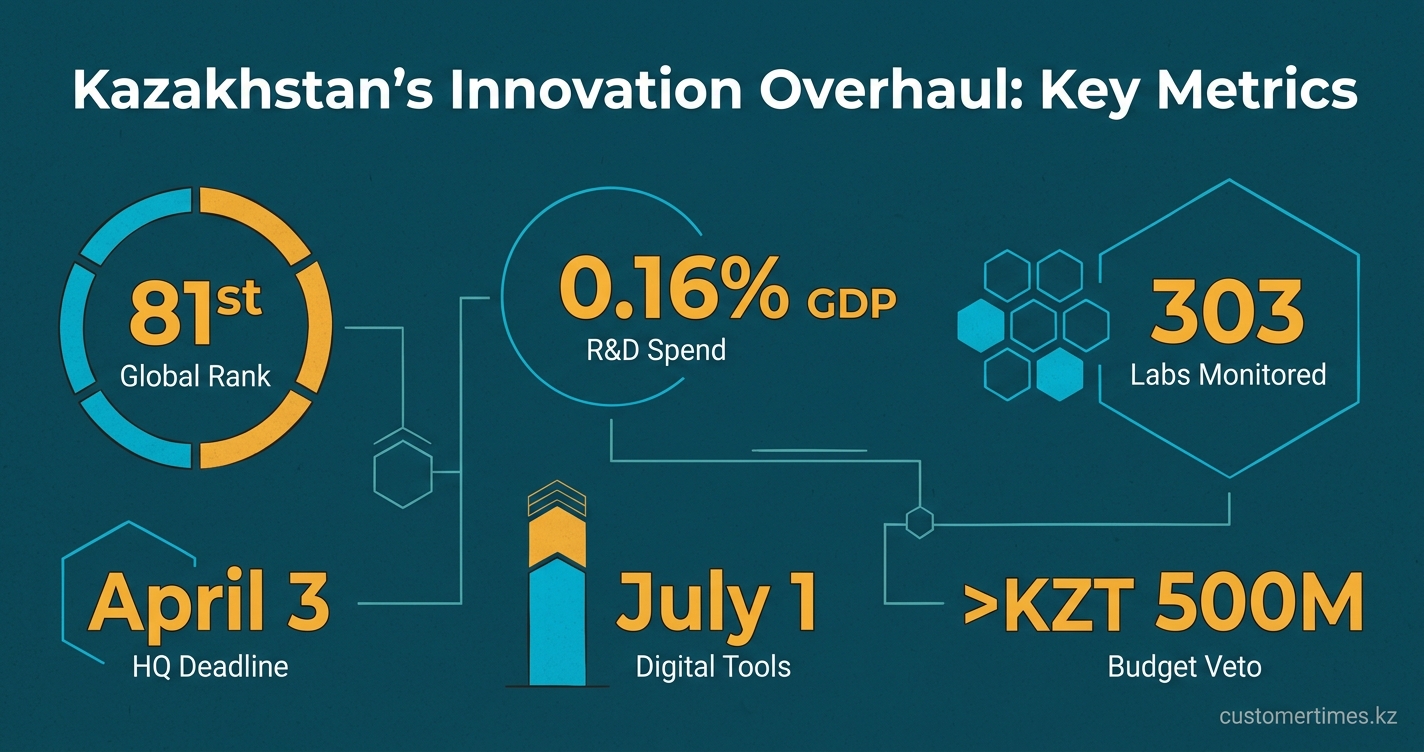
To address its current standing at 81st in the Global Innovation Index and an R&D spend of just 0.16% of GDP, Kazakhstan is launching a strategic overhaul of its innovation ecosystem. Prime Minister Olzhas Bektenov has mandated a time-bound roadmap with three core deliverables designed to drive practical returns on all scientific investment and eliminate inter-agency friction.
The most visible components of this roadmap are three key deliverables due by midsummer 2024:
| Deliverable | Owner | Deadline | Purpose |
|---|---|---|---|
| Innovation Headquarters | Deputy PM Aida Balaeva | April 3 (3 days after decree) | Cross-ministry command centre |
| Digital "single window" | Ministry of Science + MAIDD | July 1 | One-click registration & monitoring for any innovation project |
| National Innovation Register | QazInnovations | July 1 | Open list of teams, technologies, investors |
Science Minister Sayasat Nurbek emphasized that because innovation is cross-sectoral, the new Headquarters must operate above individual ministries to be effective.
"Innovation is inherently cross-sectoral; no single ministry can carry it alone," he stated.
What the Innovation Headquarters will actually do
The Innovation Headquarters will centralize Kazakhstan's tech strategy by setting national priorities and KPIs for all ministries. It will manage the entire innovation pipeline from idea to market, approve major projects, and use a live data dashboard to monitor progress across national labs and tech hubs.
The Headquarters is designed to be the central nervous system of the nation's tech ambitions. Its key functions include:
- Defining national tech priorities for 2026-2030 and assigning performance indicators (KPIs) to every ministry and state institution.
- Managing a unified process from grant application and experimentation to market launch, procurement, and export.
- Operating a central dashboard with live data from 303 labs, 62 tech-commercialisation centres, Astana Hub, and the Alem AI centre.
- Vetoing any "innovation" budget request over KZT 500 million that lacks a private co-investor or a confirmed off-take agreement.
Staffing will consist of seconded vice-ministers, private venture partners, and chief innovation officers from major state holdings. A strict 30-day milestone reporting rule will be enforced, with non-compliance leading to automatic grant suspension.
Digital rails being laid right now
Two public-facing digital platforms are being developed to support the new framework:
-
Single-Window Portal
This portal will allow project teams to submit their data once, with the system automatically sharing it across relevant tax, statistics, procurement, and export-control agencies. The platform will feature English and Kazakh interfaces and an open API for integration with banking and venture capital due-diligence systems. -
National Innovation Register
Functioning like a public database for Kazakhstan's tech scene, this register will list every protected technology, research team, patent status, and investor commitment. Set to launch on July 1, it will be fully searchable without a login and offer anonymized data exports under a Creative Commons licence for third-party analysis.
Why the private sector is watching
The government's new policy firmly positions private capital as the primary driver of innovation. Startups must now secure private investment or confirmed purchase orders before they can access state funding.
"From 2026 on, the state acts as a follow-on investor or a guaranteed first customer, never as a sole donor," Prime Minister Bektenov announced, marking a decisive shift in policy.
This "private-sector-first" approach is already yielding results. According to the Ministry of Digital Development, venture investment in Kazakh AI companies surged from USD 14 million in 2023 to more than USD 73 million in 2025. Sovereign funds such as Baiterek are now mandated to co-invest only after a private lead investor is secured.
From decree to deployment - key dates to track
The government has set an ambitious timeline for these reforms:
- 1 June 2026 - Publication of the official "Concept for the Development of Innovations" strategy document.
- 1 July 2026 - Public launch of the single-window portal and the National Innovation Register.
- 1 September 2026 - Release of the first regional KPI scorecards, with underperforming regions facing budget cuts.
- 1 December 2026 - Parliamentary review of a new "Digital Code" to consolidate regulations for AI, blockchain, and robotics.
If this schedule is met, Kazakhstan will have built a data-driven, full-cycle innovation governance system in under a year - a transformation that took established innovation hubs like Singapore and South Korea over five years to achieve.