
2026 Healthcare CRM: $120K-$250K Budget, Key Cost Drivers

Alexander Bazilevich is a CRM expert and Top Salesforce Partner with over 17 years of sales experience in the IT industry. He specializes in transforming corporate goals into profits through cross-functional collaboration and innovative business solutions, with deep expertise in business systems and IT products.
Healthcare CRM budgets in 2026: $120K-$250K. Learn how HIPAA, EHR, and AI impact costs, and how to control spend.
A 2026 Healthcare CRM budget lands between $120,000 and $250,000, with key cost drivers making it roughly double the spend of non-regulated industries. This premium covers essential compliance and integration needs, including robust security, connections to medical records, and legacy data migration. While agentic AI can significantly boost revenue and efficiency, its success hinges on clean data. Opting for configuration-first features and proven templates is the most effective strategy to control costs without extensive custom development.
What is the typical budget for a healthcare CRM in 2026 and what are the key cost drivers?
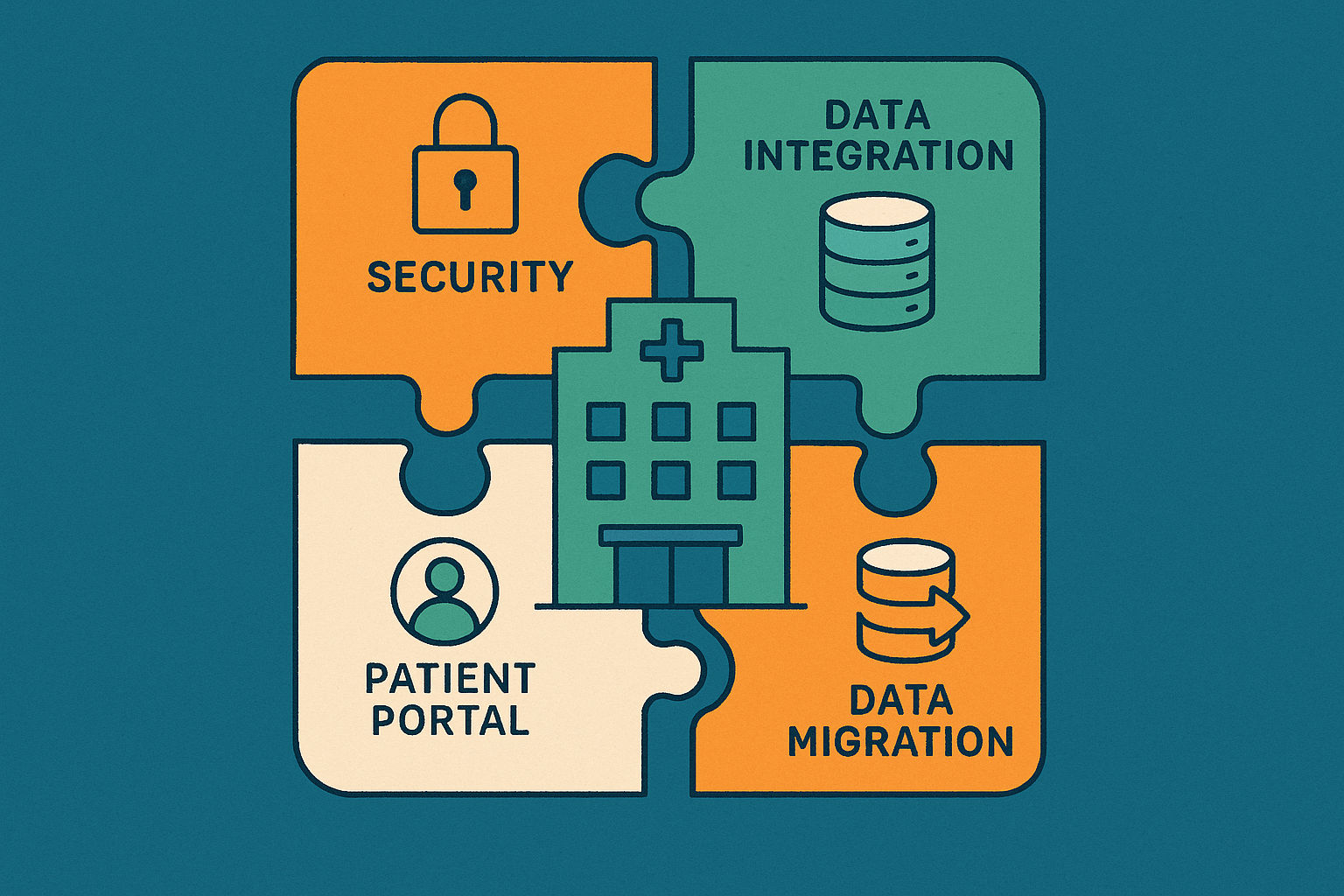
In 2026, a typical mid-sized healthcare CRM budget falls between $120,000 and $250,000, which is double the investment seen in non-regulated sectors. The primary cost drivers are HIPAA-compliant security, essential EHR/EMR integrations, patient portal development, and legacy data migration - all critical for ensuring regulatory compliance and delivering seamless patient care.
This cost discrepancy is consistently driven by four mandatory line items on every healthcare CRM estimate: HIPAA-grade security, EHR/EMR connectors, patient-facing portals, and legacy data migration. The following cost map details typical spending and provides strategies for keeping your project budget below the enterprise tier ($300k - $1M).
| Component | Mid-Size Clinic ( beds <300) | Multi-Entity Hospital Group | Notes on Controlling Spend |
|---|---|---|---|
| HIPAA & Security Layer | $15 k - $30 k | $40 k - $80 k | Use pre-audited cloud (AWS, Azure) templates to avoid custom encryption builds |
| EHR / EMR Integration | $25 k - $50 k | $60 k - $120 k | Prefer HL7-FHIR gateways over point-to-point APIs; reduces build time by 30 % |
| Patient Portal & Telehealth | $10 k - $25 k | $30 k - $70 k | Buy white-label SDKs instead of ground-up coding; saves 45 % |
| Data Migration & Cleansing | $15 k - $35 k | $40 k - $100 k | Parallel run for 90 days cuts re-migration risk by 60 % |
| Training & Change Mgt. | $5 k - $12 k | $15 k - $30 k | Micro-learning videos <3 min lift adoption 28 % vs. day-long workshops |
| TOTAL (typical) | $70 k - $152 k | $185 k - $400 k | Projects stay in "mid-tier" band when >70 % of features are config-first |
"Integration complexity is the silent budget killer; 60 % of healthcare CRM overruns trace back to underestimated EHR connector work."
AI as a cost balancer, not a cost driver
Organizations that implement agentic AI on a clean data foundation typically recover the additional investment within 9-15 months. Early 2026 results demonstrate significant ROI:
- 20-30 % revenue lift from next-best-action prompts in patient outreach
- 32 % drop in customer-acquisition cost after predictive lead scoring
- 83 % faster complaint resolution when AI triages tickets before human hand-off
However, these outcomes are only achievable with meticulous data hygiene. For example, a mid-sized pharmaceutical distributor in Almaty invested $18k in data deduplication and field mapping before activating AI, an investment that paid for itself in just 11 weeks by reducing sample waste.
Customization levels that keep you out of the $300 k+ tier
| Level | Price Bracket | What You Get | Tactics to Stay Here |
|---|---|---|---|
| Config-First | $5 k - $20 k | Objects, page layouts, validation rules, workflow rules | Use Salesforce Health Cloud templates; 80 % of HIPAA fields pre-built |
| Low-Code Extend | $20 k - $50 k | Flows, Omni-Channel routing, Tableau CRM dashboards | Adopt native Einstein modules instead of external AI |
| Code-Light | $50 k - $100 k | Custom Apex for claims logic, FHIR wrappers | Re-use open-source connectors (e.g., Redox, Aidbox) |
| Heavy Custom | $100 k - $250 k+ | New data models, mobile offline, blockchain consent | Benchmark ROI; if payback >36 months, phase scope |
"Heavy customization is rarely the highest ROI move; 70 % of healthcare KPI gaps are closed with config-first tweaks and better user adoption."
Regional watch: Kazakhstan compliance twist
In Kazakhstan, compliance with Law 94-V requires the in-country data residency of all personal health records. Cloud providers address this mandate with dedicated "Health Lake" instances within the Almaty availability zone. This adds an annual overhead of $6k - $10k compared to standard US/EU hosting. Overlooking this requirement can lead to post-launch re-architecture fees exceeding $50k.
Timeline reality check
- MVP portal + EHR hook: 3-4 months
- Mid-tier with AI scoring: 6-8 months
- Enterprise multi-entity: 10-12 months
Executing parallel work-streams - such as the security audit, data cleansing, and user story development - can compress these timelines by 15-20% without increasing project headcount.
Quick sanity checklist before you sign the SOW
-
Is the security line-item over 10% of the total budget?
If so, require a shared responsibility matrix to avoid paying for vendor-certified controls you already have. -
Is the integration budget under 20% of the total?
This is a red flag. Reliable estimates allocate 25-35% for complex EHR connector work. -
Is training limited to 1-2 day classroom sessions?
Insist on a role-based e-learning subscription. Clinics using micro-training modules see 28% higher physician adoption rates. -
Is the AI module priced before a data audit is complete?
Halt the process. A $15k data cleanse upfront prevents a $60k model rebuild later.
By leveraging this guide's cost tables, expert insights, and pre-SOW checklist, you can confidently manage your 2026 healthcare CRM investment. This strategic approach ensures your project stays within the $120k - $250k budget while successfully delivering on HIPAA compliance, EHR integration, and AI-driven patient engagement.