
Kazakhstan Digitizes Science: World's First National Research Map

Alexander Bazilevich is a CRM expert and Top Salesforce Partner with over 17 years of sales experience in the IT industry. He specializes in transforming corporate goals into profits through cross-functional collaboration and innovative business solutions, with deep expertise in business systems and IT products.
Kazakhstan digitizes its scientific infrastructure, creating a transparent marketplace for labs, equipment, and research. 1.7M users, 35M page views.
In a landmark move, Kazakhstan digitizes science with the world's first national research map, a single online portal at astanahub.com providing real-time data on its entire scientific infrastructure. The platform makes over 900 laboratories, 2,000+ pieces of major equipment, and thousands of research profiles searchable and accessible.
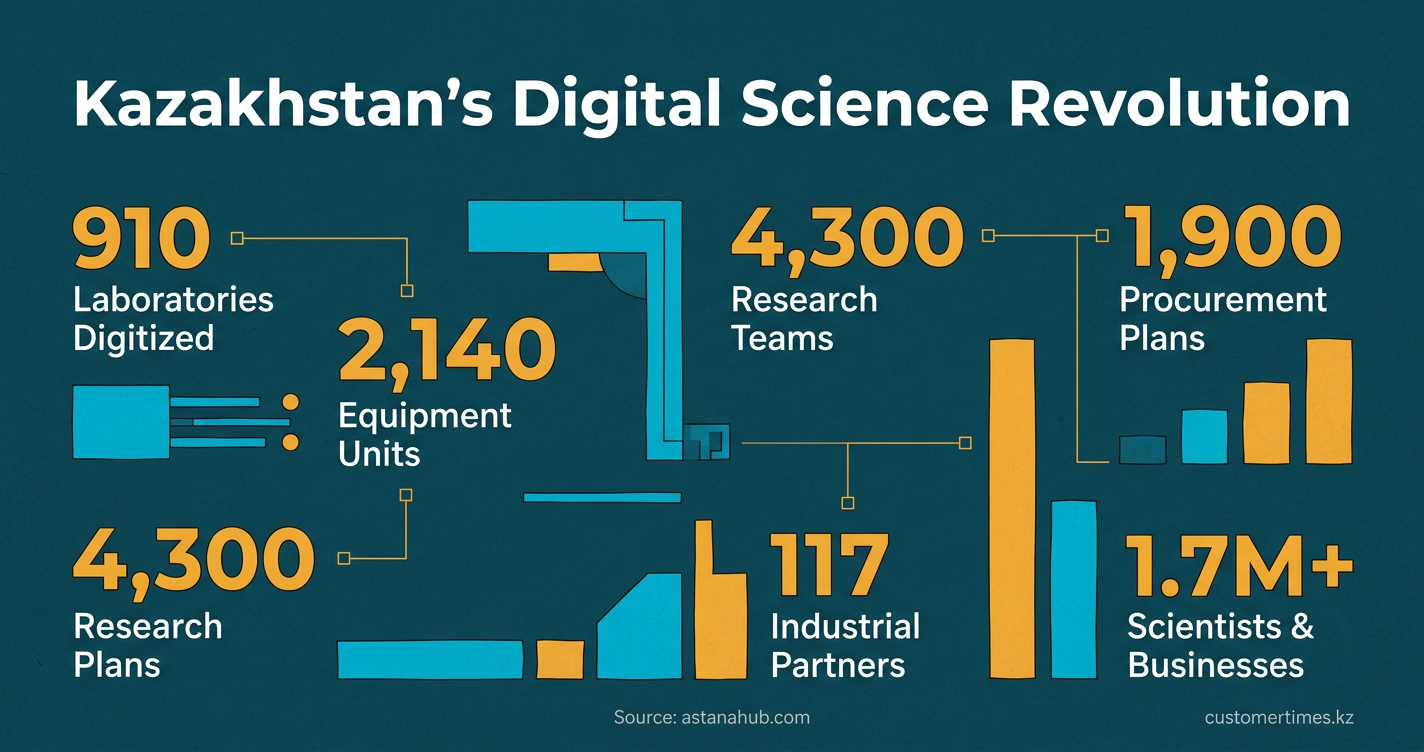
Now, more than 1.7 million scientists and businesses can instantly find partners, book equipment, and apply for grants, saving significant time and money. This transparent digital marketplace is accelerating innovation and establishing Kazakhstan as a major science hub for the entire region.
What has Kazakhstan achieved with its digital science infrastructure map?
Kazakhstan's digital map provides a transparent, centralized online portal listing over 900 laboratories and 2,000 major equipment units. It allows researchers and businesses to find partners, book instruments, and apply for grants, dramatically improving efficiency, resource sharing, and innovation across the nation's scientific ecosystem.
The project has successfully transformed a once-fragmented ecosystem into a transparent marketplace. It enables research institutes, start-ups, and industrial factories to locate partners, reserve instruments, or apply for grants through a streamlined digital process, eliminating paper forms and middlemen.
What is actually online?
| Section | Records digitised (live update) | Sample search filters |
|---|---|---|
| Laboratories | 910 | Region, discipline, accreditation, open hours |
| Equipment units | 2 140 | Type, brand, year, utilisation rate, booking calendar |
| Research teams | 4 300 | Expertise, publications, past grants, contact person |
| Procurement plans | 1 900 | Budget, deadline, tender stage, co-investor wanted |
| Industrial partners | 117 | Sector, required tech readiness level, export target |
Every asset is assigned a unique QR code for on-site verification, and GPS coordinates are validated by the State Geodesic Service to eliminate phantom listings that can plague regional portals.
"For the first time a professor in Aktau can see that a mass-spectrometer he needs sits idle in Almaty every Thursday morning and book it with one click, paying only for the hours used."
- Ministry of Science and Higher Education, April 2025 briefing
How the map feeds the real economy
The dataset is the engine of Kazakhstan's Year of Digitalisation and Artificial Intelligence. Algorithms trained on the open inventory match factories with nearby R&D groups, cutting the average partner-search time from 4-6 months to just 9 days in pilot projects.
Early adopters report measurable gains:
- KAZ Minerals located a PhD team at Satbayev University with the exact X-ray diffractometer needed for its analysis. Outsourcing the tests saved $0.9 million in equipment costs and shortened a mine expansion study by seven weeks.
- AQLA Biotech, an Astana Hub start-up, reserved clean-room hours at the National Centre for Biotechnology instead of building its own facility, bringing a veterinary vaccine to clinical trials six months faster and securing a Series A round.
- Air Astana used the portal to select three AI laboratories that are now jointly developing a computer-vision inspection tool for aircraft turbines, projected to reduce maintenance downtime by 12% in 2026.
State auditors calculate that optimizing the use of existing equipment could free up approximately KZT 28 billion (≈ USD 60 million) in procurement budgets during 2026-2027 for reinvestment.
Governance layer: from transparency to automatic grants
The infrastructure register also serves as a powerful governance tool. Because equipment hours are time-stamped, the Science Ministry can correlate grant reports with actual lab usage. Proposals that list unavailable or heavily overloaded instruments are now automatically flagged before peer review.
In the first quarter of 2025, the share of applications rejected for "unrealistic resource claims" rose to 18% from just 4% in 2024, indicating that hidden duplication is being systematically eliminated.
The roadmap adopted in February 2026 calls for:
- 50 AI-powered government services that will use live data from the map to auto-issue R&D permits, import quotas, or tax offsets.
- Alem.Cloud supercomputer queue integrated with the booking engine so SMEs can rent GPU time as easily as a microscope.
- Blockchain notarisation of every equipment hour to create an immutable audit trail for international partnerships and IP courts.
Numbers that matter
- 1.7 million authenticated portal users out of ≈1.85 million scientists and engineers in Kazakhstan.
- 35 million total page views in twelve months, with user engagement totaling 2.9 million hours.
- KZT 11.3 billion worth of equipment booked through the platform during 2025.
- 44% year-on-year growth in IT exports from Astana Hub companies that use the map for contracts.
- 32,500 tech jobs created by Hub residents since 2019, many after finding lab partners via the portal.
Foreign entities are taking notice. 470 start-ups with outside capital are registered on Astana Hub, and cross-border equipment reservations jumped from 3% to 17% in 2025, confirming the map's role as a regional asset.
"We came for the cheap GPU cycles, but stayed because we could immediately locate a metallurgy lab willing to stress-test our battery alloy. The whole supply chain is suddenly visible."
- Ukrainian founder of Li-Metal, November 2025
Practical access for business readers
Access is open to all; no citizenship or science degree is required. Corporate R&D managers can register with a company certificate and search the database in English, Kazakh, or Russian. Equipment prices are published as hourly fees, allowing for immediate and realistic budget forecasting.
For complex inquiries, such as combining services across the country, an in-chat procurement lawyer provides support within 24 hours to help firms navigate logistics and regulations.
Kazakhstan's strategy is straightforward: make every scientific asset discoverable and transparently priced, and the market will allocate resources far better than ministries ever could. One year of live data suggests the wager is paying off, turning the nation into Central Asia's open laboratory.