
Kazakhstan Invests $340M to Localize 356 Medicines

Alexander Bazilevich is a CRM expert and Top Salesforce Partner with over 17 years of sales experience in the IT industry. He specializes in transforming corporate goals into profits through cross-functional collaboration and innovative business solutions, with deep expertise in business systems and IT products.

Kazakhstan secures $340M for new pharma plants, localizing 356 medicines & boosting domestic production to 28% with policy support.
Kazakhstan Invests $340M to Localize 356 Medicines
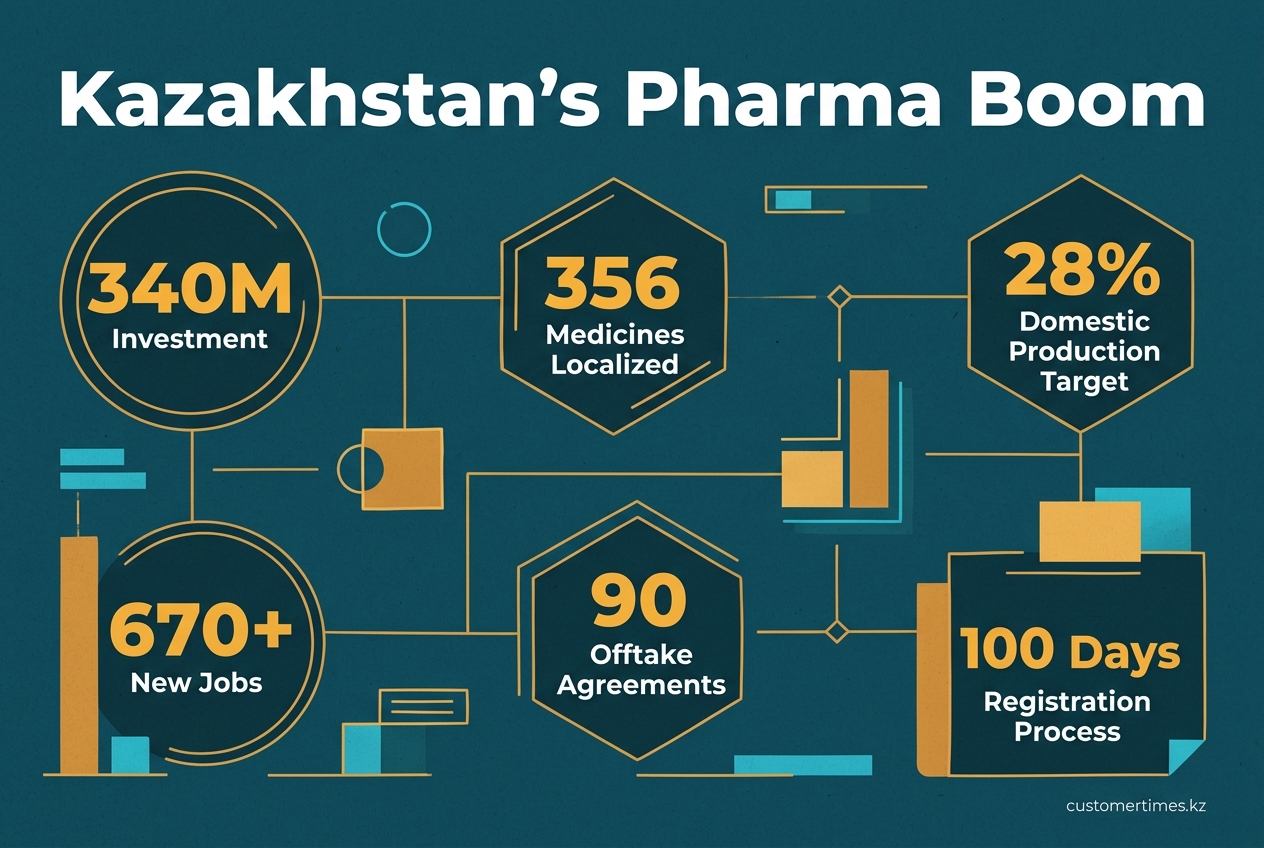
In a landmark move for its domestic drug supply, Kazakhstan invests $340M (173 billion tenge) to localize 356 medicines, a plan solidified by four investment agreements signed on January 22, 2026. This investment will establish new pharmaceutical plants producing everything from oncology and diabetes therapies to antiviral and immunobiological drugs. Coming just six months after the 103 billion tenge Khan Tengri BioPharma project, total private capital investment in the sector has now surpassed half a billion dollars in the last year, positioning Kazakhstan to achieve end-to-end drug manufacturing.
What are the latest developments in Kazakhstan's pharmaceutical industry in 2026?
Kazakhstan's pharmaceutical sector is undergoing a major expansion in 2026, driven by over USD 340 million in new investments. This funding is dedicated to building state-of-the-art facilities to manufacture 356 different medicines, boosting domestic production to 28% of national consumption, accelerating technology transfer, and creating hundreds of high-skilled jobs.
Where the money is going
The USD 340 million investment is allocated across four major pharmaceutical projects. These include the AltINPHARM, Nobel, and Abdi Ibrahim Global Pharm facilities in the Almaty region, and the MSP-ROMPHARM plant in the Turkistan region, collectively creating over 670 specialized jobs and expanding local manufacturing capacity.
| Investor / Project | Location | Planned output (selected) | Jobs |
|---|---|---|---|
| AltINPHARM | Park of Innovative Technologies SEZ, Almaty city | tablets, capsules, cephalosporin powders | ≈ 180 |
| Nobel Almaty Pharmaceutical Factory | Almaty city | APIs, biopharmaceuticals, disposable syringes | ≈ 220 |
| Abdi Ibrahim Global Pharm | Almaty region | hormonal, gastro-intestinal, CNS finished forms | ≈ 150 |
| MSP-ROMPHARM (Turkistan) | TURAN SEZ, Turkistan region | high-potency anti-anaemia, antifungal, oncology drugs | ≈ 120 |
These four projects are set to increase the domestic share of medicines to 28% of total consumption. Crucially, they will also cover two-thirds of all medications on the government's list of "socially significant" drugs, ensuring stable access for citizens.
Why now - policy levers in play
Government policy is a key driver, with President Tokayev's 50% domestic production target now embedded in long-term offtake contracts. The Ministry of Healthcare has secured 90 such agreements with 34 manufacturers, guaranteeing sales for up to seven years. This eliminates market-entry risks that previously discouraged local investment. Further incentives include a fast-track 100-day registration process for products involving technology transfer and a zero-reference-price rule, which lets local producers set tender prices without being tied to import costs.
Special Economic Zones (SEZs) offer significant financial incentives. Investors benefit from a 0% corporate income tax for five years, waivers on land tax and VAT for imported equipment, and a 7.5% social contribution rate - half the national average. Almaty's Park of Innovative Technologies (PIT), where AltINPHARM is located, provides these fiscal breaks plus access to incubators and leasable clean-room facilities to support startups.
Market backdrop - stable demand, rising complexity
The market backdrop is stable. Despite regional price turbulence in 2025, Kazakhstan's pharmaceutical market demonstrated resilience. Data from Proxima Research for Q1 2026 shows total market value fell just 0.9% year-on-year, even as package volume dropped 7.7%. This indicates a market shift towards higher-value, more complex therapies. Furthermore, the state's social medical insurance fund covers 13.3 million citizens, ensuring a predictable revenue stream for manufacturers.
International endorsement - technology transfer in action
- Polpharma Group: Finalizing a USD 130 million expansion of its Shymkent facility to add EU-GMP certified lines for oral solid and beta-lactam drugs, targeting the Eurasian Economic Union market.
- Pfizer, AstraZeneca, and Roche: Have signed agreements to transfer manufacturing technology for 25 molecules currently imported, with plans to train 380 local specialists by 2028.
- STADA: Recently implemented a Salesforce-based CRM system tailored for Kazakh compliance, demonstrating that global digital standards can be successfully adapted to local data residency requirements.
Future legislation is expected to further bolster local production. A senior Ministry official noted that upcoming regulations will ban the import of 42 active pharmaceutical ingredients (APIs) once domestic manufacturing capacity for them reaches 80% of annual demand. This strategy is already being integrated into new plant designs.
From bricks to bytes - digital twins on the shop-floor
New facilities are being built with digitalization at their core. At the PIT, for example, construction includes the immediate integration of IoT sensors and Manufacturing Execution System (MES) dashboards. This 'digital twin' approach allows for remote regulatory audits, which is projected to reduce GMP certification timelines by six to eight weeks. Pilot programs in other regions have already shown a 23% reduction in deviation-closure cycles using similar digital tools.
Forecast snapshot (2026-2030)
| Indicator | 2026 | 2030 (projected) | CAGR |
|---|---|---|---|
| Market size (billion USD) | 2.80 | 3.60 | 5.06 % |
| Domestic share | 28 % | 50 % (policy) | n/a |
| GMP-certified plants | 25 | 36 | 9.5 % |
| Export share of output | 8 % | 20 % (target) | n/a |
The number of manufacturers grew to 207 by mid-2026, an increase from 193 the previous year, indicating the sector is reaching critical mass. The new investments provide the infrastructure, talent, and guaranteed demand necessary for Kazakhstan to transition from simple packaging to sophisticated, end-to-end drug manufacturing, positioning it for future advancements in areas like biosimilars and mRNA technologies.