
DMG Mori: SAP S/4HANA Unifies Global Factories by 2030

DMG Mori's global SAP S/4HANA migration: one part number, one routing, one costing view worldwide. Learn about their strategy.
In a strategic move, DMG Mori: SAP S/4HANA Unifies Global Factories by 2030, a project designed to streamline operations worldwide. This comprehensive upgrade will standardize part numbers, manufacturing processes, and costing across all plants, driving significant efficiency gains and faster, data-driven decisions. Early adopters in Germany and China have already reported significant reductions in errors and faster results. The primary challenge is synchronizing data across dozens of sites before the 2027 support deadline for older systems.
What is DMG Mori's SAP S/4HANA global rollout strategy?
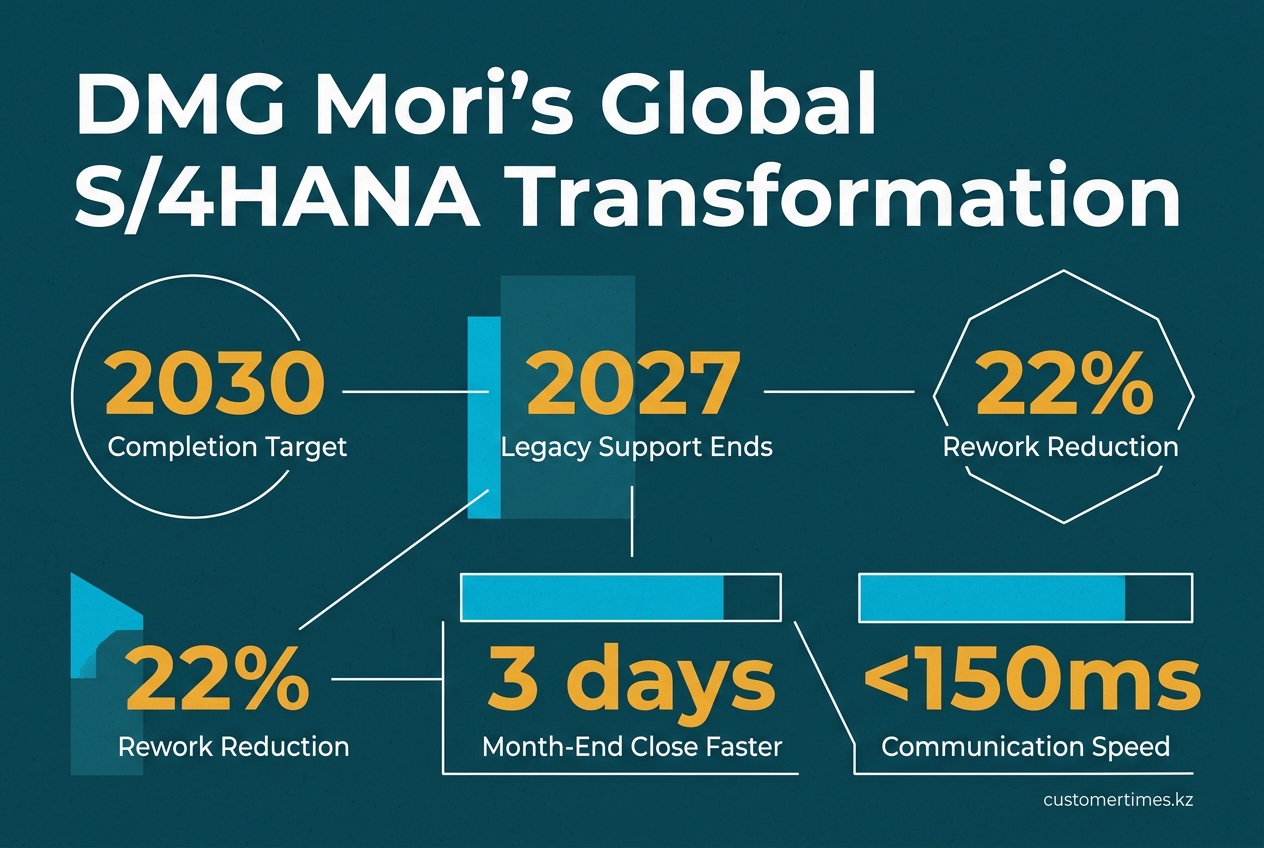
DMG Mori is implementing a phased global rollout of SAP S/4HANA, targeting completion by 2030. The strategy involves a 'clean-core plus edge' template, starting with greenfield and brownfield sites in Germany, China, Japan, and the USA. The goal is a single, unified ERP system for all operations.
The rollout has already begun at key sites. Plants in Pfronten and Seebach, Germany, along with a facility in Shanghai, China, are the first to transition to SAP S/4HANA. The objective is clear and ambitious: a single, globally consistent view of part numbers, routings, and costs, accessible from any company device.
"Discover how to transform from an organically grown towards a globally unified IT landscape with SAP S/4HANA as the digital core."
- Hannover Messe 2026 lecture abstract, DMG Mori
This transition is time-critical. SAP is ending support for its legacy ECC suite in 2027, creating a hard deadline for manufacturers. DMG Mori's early adoption strategy aims to avoid the escalating costs and resource shortages seen across the industry. LeverX market data shows projects initiated in 2025 cost 30% more than those started a year prior, with top implementation partners booked through 2028.
- What has been switched on so far?*
| Site | Go-Live Wave | Scope |
|---|---|---|
| Pfronten (DE) | Q2-2025 | Finance, production orders, plant maintenance |
| Seebach (DE) | Q3-2025 | Supply-chain, quality management |
| Shanghai (CN) | Q4-2025 | Full ERP plus CELOS X connector |
| Nara (JP) | planned 2026 | Brownfield conversion |
| Davis (USA) | planned 2027 | Greenfield template roll-out |
The Shanghai plant serves as a powerful case study. By integrating the SAP core with its proprietary CELOS X manufacturing platform, DMG Mori achieved sub-150ms communication between the shop floor and financial systems. Initial results include a 22% reduction in unplanned rework and a three-day faster month-end close, aligning with the 31% faster decision cycles Salesforce reports for similar cloud ERP projects.
However, the scale of this project presents significant challenges. With 14,000 machines built annually, each comprising up to 12,000 parts from global suppliers, master data harmonization is a monumental task. As other SAP users have found, a single data error, like a duplicate supplier code, can cause hundreds of transactional failures when replicated globally.
E3-Magazin survey, March 2026: 33 % of manufacturers cite "IT landscape adaptation" as the top barrier; IT teams give S/4 projects only a 66 % satisfaction score, lagging management approval by 19 points.
To manage this complexity, DMG Mori is adopting a "clean-core plus edge" architecture. Standard ERP processes remain in the SAP core, while plant-specific applications - like CELOS machine dashboards and tool-life algorithms - run on SAP's Business Technology Platform (BTP) and connect via stable APIs. This model, similar to Ahlstrom's rapid factory rollout, preserves core system integrity while allowing for customized, high-value functionality.
This ERP transformation is a cornerstone of the company's broader MX (Machining Transformation) strategy. Advanced digital tools, such as AI-powered chatter prediction and the set-up-time-reducing Tool Master app, feed data directly into the unified SAP system. This converts real-time shop-floor insights into actionable financial signals for management.
Upcoming milestones will showcase the project's progress. At the Hannover Messe in April, DMG Mori will demonstrate live data synchronization between its Pfronten and Nara plants on a single S/4 instance. By the Aerospace Forum in May, the company plans to prove full lot traceability for aerospace components - a critical capability for regulated industries that is notoriously difficult with disparate legacy systems.
Ultimately, the project's success hinges on people as much as technology. Securing experienced S/4 migration architects, who command rates over €1,800 per day, and training staff on new interfaces are key hurdles. With the 2027 deadline for legacy SAP support looming, the clock is ticking, and every delay increases the pressure to complete this essential transformation.