
CortexAI: AI Predicts Kidney Transplant Failure in 33 Seconds

Alexander Bazilevich is a CRM expert and Top Salesforce Partner with over 17 years of sales experience in the IT industry. He specializes in transforming corporate goals into profits through cross-functional collaboration and innovative business solutions, with deep expertise in business systems and IT products.

CortexAI wins 5M tenge at Digital Qazaqstan Battle for AI that predicts kidney graft rejection in 33 seconds, boosting transplant rates.
CortexAI, a groundbreaking Kazakh MedTech startup whose AI predicts kidney transplant failure in 33 seconds, has secured 5 million tenge after winning second place at the Digital Qazaqstan Battle grand final. The cloud-based tool analyzes 34 health data points to deliver a prognosis with greater speed and accuracy than traditional 12-hour tests. The prize money, won at the prestigious Shymkent tech forum on March 27, 2026, will fuel CortexAI's expansion into hospitals across Kazakhstan and neighboring countries, aiming to help save more lives and make transplants safer and quicker.
What is CortexAI and how does it improve kidney transplant outcomes in Kazakhstan?
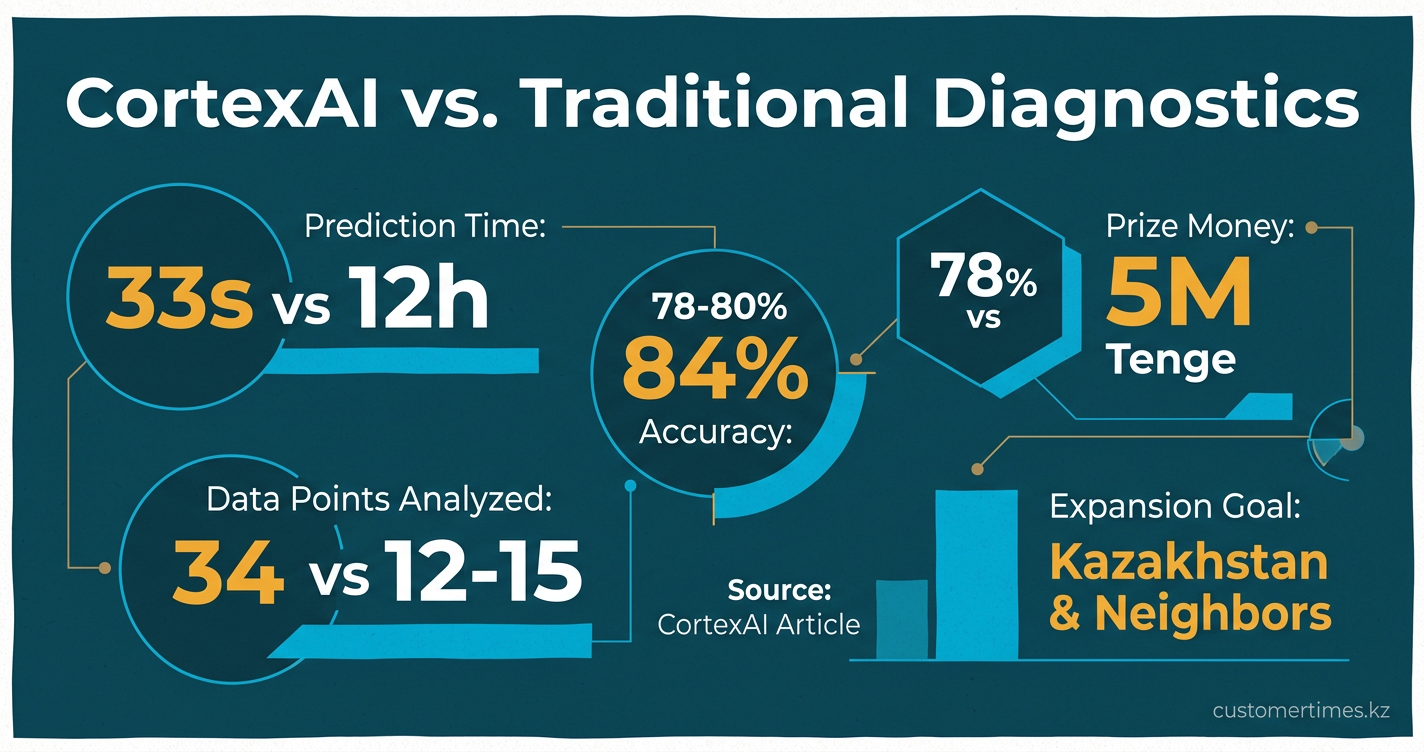
CortexAI is a cloud-based medical decision-support tool designed to predict kidney graft rejection. By analyzing 34 clinical and genomic parameters in 33 seconds, it provides surgeons with rapid, accurate risk assessments, achieving 84% sensitivity and significantly outperforming traditional 12-hour diagnostic tests for transplant patients in Kazakhstan.
33 seconds instead of 12 hours
CortexAI improves kidney transplant outcomes by providing surgeons with a rapid and highly accurate prediction of graft rejection. The AI model analyzes 34 patient data points in 33 seconds, enabling faster clinical decisions, reducing patient uncertainty, and increasing the potential throughput of successful transplant procedures.
CortexAI's core technology is an AI model that predicts kidney graft rejection probability by processing 34 clinical and genomic parameters in just 33 seconds. This replaces a diagnostic process that traditionally took 12 hours. Internal validation using anonymized regional data demonstrated 84% sensitivity, an accuracy level comparable to more time-consuming multi-day panel tests.
| Benchmark | Traditional panel | CortexAI v1.0 |
|---|---|---|
| Turn-around | 12 h | 33 s |
| Parameters | 12-15 | 34 |
| Accuracy | 78-80 % | 84 % |
The project originated in the Startup Orda pre-accelerator at Korkyt Ata Kyzylorda University and matured as the flagship resident of the Kyzylorda Hub. Led by Asylzhan Abdullaev, the engineering team refined the algorithm using an expanded dataset from the regional hospital network after winning their local semi-final.
Regional incubators are no longer just co-working spaces - they are clinical trial partners that can compress years of validation into months.
From grant to go-to-market
The 5 million tenge prize provides critical funding to overcome major MedTech hurdles in Central Asia. It will cover HIPAA-compliant cloud hosting for 18 months and a 510(k)-style local certification package. Founder Asylzhan Abdullaev confirms the funds will also finance a pilot API, enabling integration with existing hospital information systems and embedding CortexAI's intelligence directly into electronic health records.
The roadmap is aggressive:
- Q2 2026 - integration with Astana's National Transplant Centre
- Q3 2026 - bilingual interface (Kazakh/Russian) and HL7-FHIR export
- Q4 2026 - paid licences in Kyrgyzstan and Uzbekistan where living-donor programmes are expanding
The startup's plan for international expansion is supported by its cloud-agnostic architecture. The technology stack, built on Google Cloud VMware Engine, can be easily replicated to comply with Kazakhstan's data-residency laws, which mandate that personal health information remains on sovereign servers. This flexibility simplifies entry into new markets with similar data protection requirements.
Why second place can outperform first
While the first-place winner, agro-tech startup Gro.now, secured 10 million tenge, CortexAI's second-place position is uniquely strong. MedTech investors prioritize a strong regulatory moat, which CortexAI has built with three provisional patents and a strategic MoU with the Kazakh Ministry of Health. This agreement allows it to provide risk scores at no cost throughout 2026, creating non-monetary assets that are highly attractive for venture valuation.
In deep-tech, a two-million-dollar grant can be worth less than a signed pilot protocol with a national hospital network.
Digital Qazaqstan as a launch runway
The competition is a key component of the Digital Qazaqstan forum, which focused this year on Industry 5.0 and applied AI. Prime Minister Olzhas Bektenov announced a national goal to double AI-derived GDP value to 5% by 2029, underscoring the strategic importance of high-impact tools like CortexAI. The forum also showcased Kazakhstan's export ambitions with technologies ranging from AI-driven solar forecasting to unmanned ecological monitoring drones.
CortexAI's next step is joining Astana Hub's acceleration cohort in May. Graduates receive guaranteed pitching opportunities at major events like Digital Bridge and the Silk Road Innovation Summit. According to a 2025 Astana Hub market report, top-three finishers in the Digital Qazaqstan Battle historically secure seed rounds 4.2 months faster than the national average.
Anatomy of a 5-million-tenge pitch
According to founder Asylzhan Abdullaev, the team's winning pitch focused on workflow delta rather than just technical accuracy. The structure highlighted four key value propositions:
- Time Saved: Quantified the time saved per patient at 11 hours and 27 minutes.
- Increased Throughput: Translated savings into a potential for 2.3 additional transplants per week at each center.
- Cost Reduction: Monetized the logistical impact, such as reduced need for dialysis and shorter ICU stays.
- Regulatory Path: Presented a clear timeline for certification, confirmed IP status, and highlighted secured clinical partnerships.
This approach mirrors successful global HealthTech strategies, which calculate ROI in terms of clinical efficiencies, like bed-days freed, rather than software licensing fees.
Looking south, thinking north
While Kyzylorda is primarily an agricultural region, its local university has developed the fastest-growing MedTech pipeline outside the capital. CortexAI is the third startup from the region in two years to achieve national recognition, following OncoTracker (a breast cancer AI) and RetinAQ (a diabetic eye screening tool). Together, these startups already serve 42 public hospitals, demonstrating that geographic location is no barrier to success with the right cloud infrastructure and clinical partners.
CortexAI's ability to expand internationally now hinges on its speed in converting prize money into tangible regulatory stamps and hospital procurement codes. This next phase of the journey will be critical, requiring a different kind of endurance than the 33-second analysis its AI performs.