
ALEM TECH FEST 2026: Central Asia's Largest Student Robotics Event

Alexander Bazilevich is a CRM expert and Top Salesforce Partner with over 17 years of sales experience in the IT industry. He specializes in transforming corporate goals into profits through cross-functional collaboration and innovative business solutions, with deep expertise in business systems and IT products.

ALEM TECH FEST 2026: Central Asia's largest student robotics & STEM event. Students compete for global finals and scholarships.
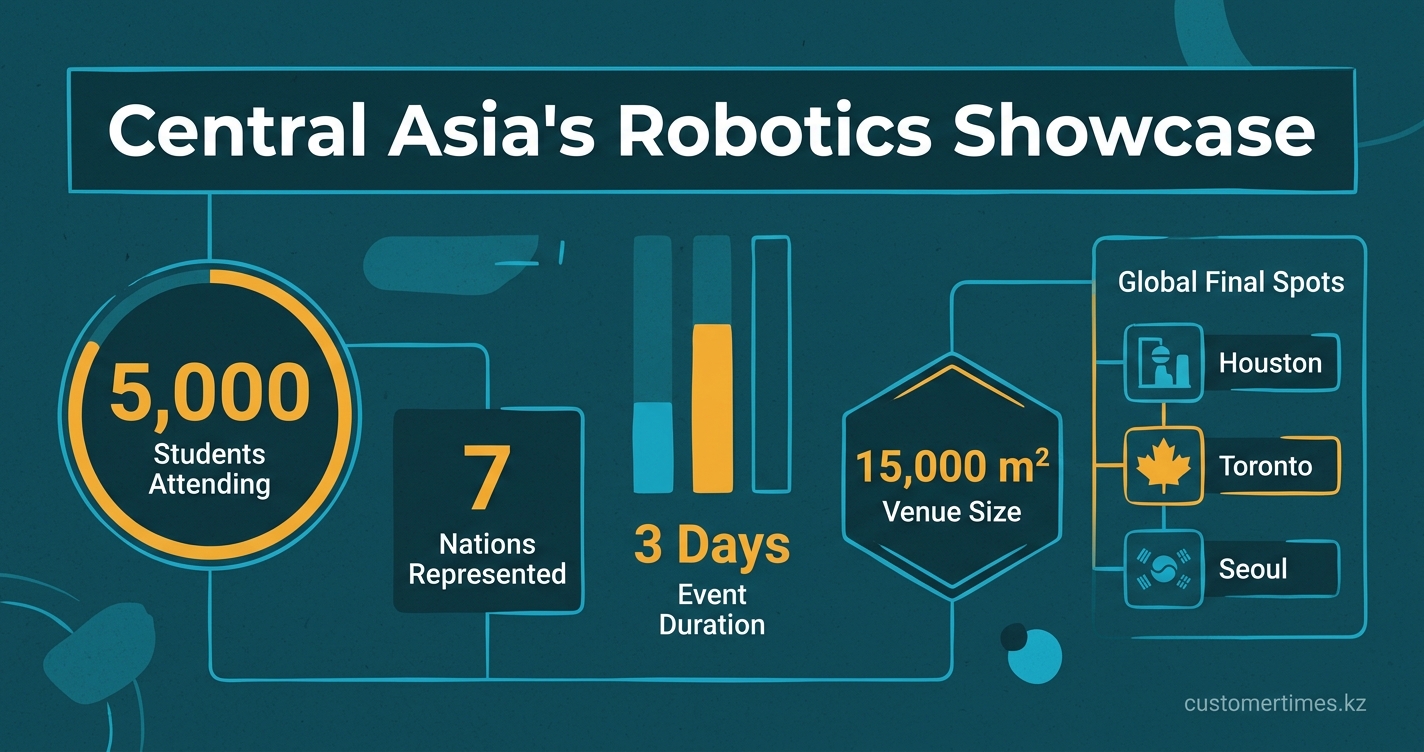
ALEM TECH FEST 2026 is Central Asia's Largest Student Robotics Event, a landmark gathering from February 11-13 in Astana. Held at the 15,000 m² EXPO International Exhibition Center, the festival brings together 5,000 students from seven nations to compete in coding, robotics, and drone piloting. Under the theme of "Archaeology," this three-day STEM playground is designed to identify and accelerate young tech talent, with winners earning scholarships and spots at global finals in Houston, Toronto, and Seoul. The event serves as a crucial engine for nurturing Central Asia's next generation of homegrown engineers.
What is ALEM TECH FEST 2026 and why is it significant?
ALEM TECH FEST 2026 is Central Asia's premier student robotics and STEM competition, taking place in Astana from February 11-13. More than 5,000 students will engage in high-stakes challenges in robotics, coding, and drone piloting. The event is significant as a launchpad for the region's future tech leaders, with winners securing prestigious scholarships and spots in global finals.
What the three days actually look like
The three-day event features a non-stop schedule of hands-on competitions for all age groups. Younger students engage in foundational challenges, while older participants tackle advanced robotics, AI, and drone piloting missions. Every activity is scored in real-time, creating a high-energy, competitive environment for all attendees.
| Time-block | Hall A | Hall B | Hall C |
|---|---|---|---|
| Morning | FLL Discover (ages 4-6) - colour-coded archaeology bricks | RoboCup Rescue - dog-shaped rovers map a 30 m² earthquake scene | Hour of AI - no lectures, only laptops and instant ML games |
| Mid-day | FLL Challenge (10-16) - 16 tables run the "Archaeology" mission | Physical AI Championship - humanoid robots recognise and lift artifacts | Alem Drone League - fastest lap wins scholarship points |
| Afternoon | Battle of Bots - combat brackets with 3-minute knockout rounds | Central Asia FIRST Championship - final alliances, judges' call | Award shows, visa paperwork for world finals |
All activities are hands-on and competitive, with no time allocated for passive lectures. Scores are calculated instantly and streamed live to the global FIRST leaderboard.
Why archaeology became the 2026 theme
The 2026 theme, "Archaeology," was selected by FIRST HQ to develop students' precision and attention to detail. The challenges, which mimic delicate tasks like excavating artifacts, are analogous to handling sensitive components in high-tech manufacturing. This theme also aligns with Kazakhstan's national strategy to double its IT exports to USD 1 billion, which requires a new generation of engineers skilled in managing fragile digital and physical assets.
Scholarship pathway baked into the rules
- The top scorer in the FLL Challenge earns a direct invitation to the FIRST Championship in Houston, supported by a $3,000 travel grant from Samruk-Kazyna.
- Winners from the Physical AI Championship gain entry into the 2027 cohort of the Silkway Accelerator, a premier Astana Hub program that has fostered 73 startups with a combined valuation of $575 million.
- The Alem Drone League's fastest pilot receives pre-approval for the RoboCup world finals in Eindhoven, with Cargolux sponsoring all equipment freight.
"We are not organising a fair; we are running a visible conveyor belt from classroom to global market," Minister of Education Gani Beisembayev told local outlet DKNews on opening morning.
Tech under the hood that visitors can try
- NVIDIA Processing: All rescue rovers are powered by NVIDIA Jetson Orin Nano boards. Students can borrow these units for free by committing to open-source their code post-event.
- AI-Powered Scoring: A computer-vision sandbox uses a 4K camera system and TensorFlow models to track LEGO missions, calculating and displaying real-time scores and probability curves.
- Private 5G Network: A private 5G network from Huawei enables latency-free, beyond-line-of-sight drone piloting, serving as a test for Kazakhstan's planned nationwide 5G rollout by 2027.
Data facts that explain the scale
- 1,200 Volunteers: The event is staffed by 1,200 volunteer referees, primarily undergraduate STEM majors from Astana Hub's Tech Orda program, which has trained 9,000 students since 2023.
- Sustainable Build: Arena frames are constructed from 450 kg of reused aluminum profiles from the 2017 EXPO, reducing construction costs by 38%.
- Rural & Female Participation: 70% of all-girl teams hail from rural areas, supporting Kazakhstan's national goal of increasing its share of female engineers to 40% by 2030.
For local companies watching from the mezzanine, the message is clear: tomorrow's customers will expect the same zero-latency, AI-first service that these teenagers are debugging on the floor today.
Side programme that keeps the C-suite in the room
While students compete, a parallel program on February 12 offers exclusive briefings for corporate leaders and investors. Attendees can:
- Secure early admission slots for the 2026 cohort of AI'preneurs, an accelerator that has invested $350,000 in 52 startups.
- Engage with the Ministry of Digital Development to discuss sandbox regulations for the unmanned cargo market, projected to reach $180 million in Central Asia by 2028.
- Get a preview of the National Artificial Intelligence Center, set to launch in Astana in late 2026, which contributes to Kazakhstan's top IMF ranking for AI readiness.
How to follow the trophies after the buzzer
The competition concludes at 16:00 on February 13, but the impact continues online. Winning code is immediately published on GitHub under the hashtag #Astana2Houston, allowing educators globally to adopt champion strategies. This open-source approach is designed to accelerate learning and expand participation, fueling Central Asia's talent pipeline and reinforcing its goal of developing a self-sufficient, world-class engineering workforce for the digital era.