
AI, Cloud Drive BPO Analytics to $103B by 2034
Alexander Shlimakov specializes in Salesforce, Tableau, Mulesoft, and Slack consulting for enterprise clients across the CIS region. With a proven track record in technical sales leadership and a results-oriented approach, he focuses on the financial services, high-tech, and pharma/CPG segments. Known for his out-of-the-box thinking and strong presentation skills, he brings extensive experience in solution sales and business development.

AI, ML, & Cloud propel BPO business analytics to $82-103B by 2033. Discover key drivers, top firms, & ROI.
AI, Cloud to Propel BPO Business Analytics Market to $103B by 2034
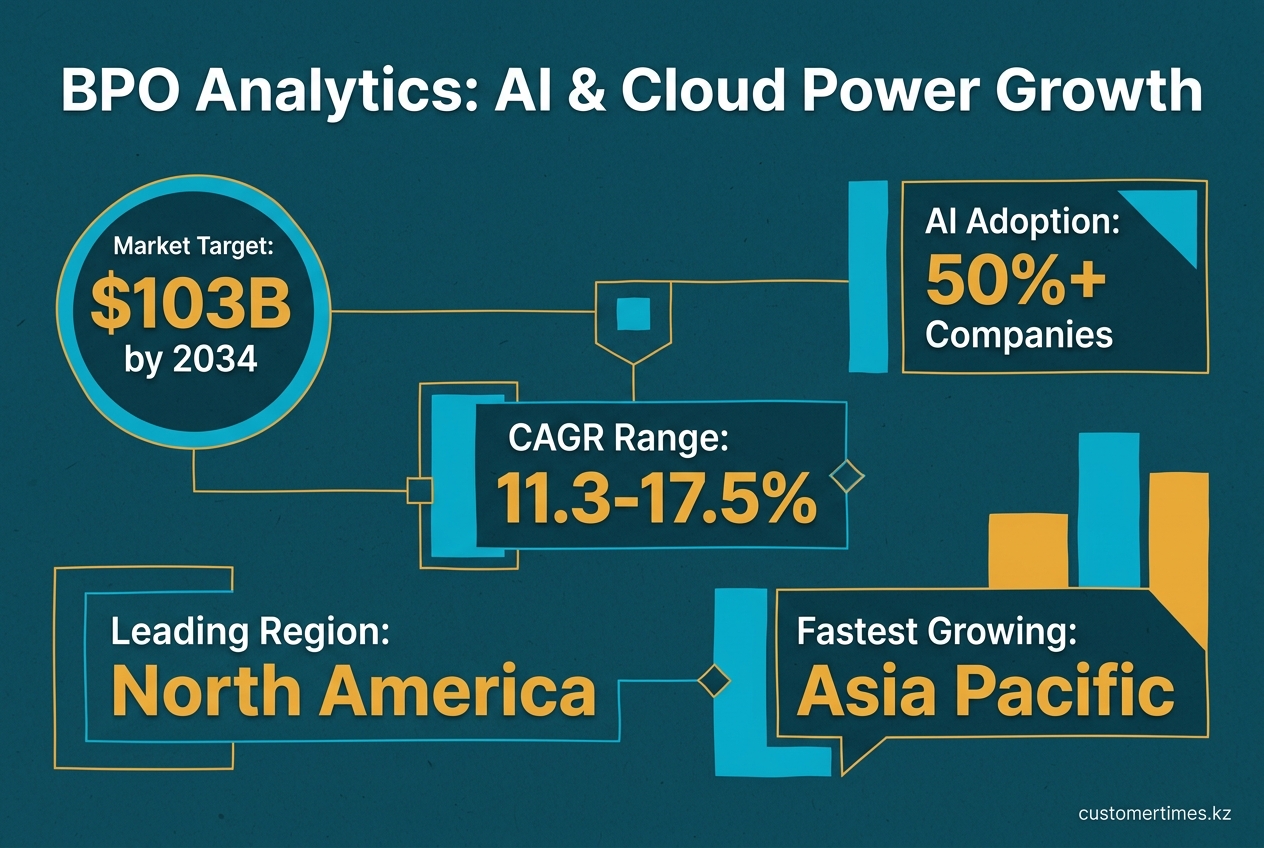
Fueled by AI and cloud adoption, the BPO business analytics market is set to reach $103B by 2034, driven by enterprise demand for data-driven insights. With over 50% of companies now using AI and the majority of spending flowing to cloud platforms, the sector is undergoing a profound transformation. Industry giants like Accenture and IBM are leading this charge, using advanced tech to optimize client outcomes. While North America leads in market share, Asia Pacific is emerging as a fast-growing contender. The key differentiator for BPO partners has become the ability to leverage a modern tech stack for the best, fastest results.
What is driving growth in the BPO business analytics market through 2034?
The BPO business analytics sector is poised for exponential growth, projected to reach between USD 82-103 billion by 2033-34. This surge is directly attributable to the widespread adoption of AI, machine learning, and cloud computing. Currently, more than half of all enterprises leverage AI-powered analytics, with cloud-hosted solutions dominating spending, particularly within the IT and telecom sectors and across North America.
The market is expanding at a double-digit pace. Projections for 2025 range from USD 33-67 billion, with forecasts for 2026 reaching USD 36.79 B (Grand View Research) and USD 44.09 B (Business Research Insights). With compound annual growth rates of 11.3-17.5 %, the market is on a clear trajectory to surpass the USD 82-103 B milestone before 2034. A projection from Polaris suggests an even more aggressive 2026 valuation of an implied USD 79.4 B.
| Source | 2025 Revenue | 2026 Revenue | CAGR Horizon | Long-Term Target |
|---|---|---|---|---|
| Grand View Research | 32.94 B | 36.79 B | 12.2 % (2026-33) | 82.35 B by 2033 |
| Business Research Insights | 39.61 B | 44.09 B | 11.3 % (2025-34) | 103.81 B by 2034 |
| Polaris | 67.49 B | ~79.4 B | 17.5 % (2026-34) | Not stated |
"Over half of enterprises now embed AI directly into BPO analytics workflows, turning raw data streams into predictive, prescriptive insight factories."
Tech Trifecta in Action: AI, ML, Cloud
Growth is primarily fueled by integrating artificial intelligence and machine learning for predictive insights, alongside widespread cloud adoption for scalable, cost-effective analytics. These technologies empower enterprises to transform raw data into actionable business intelligence, improving efficiency and decision-making without significant capital expenditure.
- Cloud Dominance: Cloud-hosted platforms are projected to capture 54.3% of all spending in 2025, mirroring the 52 % global adoption rate of cloud analytics. North America leads with over 35.9% market share, driven by its advanced 5G and high-bandwidth infrastructure.
- AI and ML Integration: Over half of all BPO contracts now require AI capabilities for tasks like sentiment analysis, demand forecasting, and anomaly detection. A key example is Teleperformance SE's platform upgrade, which uses generative-AI sentiment analysis to achieve double-digit reductions in customer churn.
- Industry and Segment Adoption: The IT and telecom industries show the fastest growth, with BFSI, healthcare, and retail following closely. Small and medium-sized enterprises (SMEs) are also a significant growth driver, as outsourcing provides immediate access to sophisticated BI tools without upfront capital investment.
Competitive Scoreboard: Top-10 Firms Control >50% of Revenue
| Tier-1 (2025) | Market Share | Flagship Moves |
|---|---|---|
| Accenture & IBM (tied) | 4% each | Multi-cloud analytics suites, outcome-based pricing |
| Genpact | 3% | AI-led finance & supply-chain analytics modules |
| TCS, Capgemini, Wipro, Cognizant, EXL Service, HCL, Infosys | 2-3% each | Industry-specific accelerators, near-shore delivery hubs |
"The top-three vendors (Accenture, IBM, Genpact) already lock in 48-55 % of the market; early AI scale-up is widening the gap."
Market leaders are solidifying their positions by focusing on three strategic pillars:
- Predictive Operations: Employing ML-driven forecasting to cut service-level agreement (SLA) violations by an estimated 60-80%.
- Outcome-Based Contracts: Shifting from FTE-based pricing to models where clients pay for measurable business outcomes, such as revenue growth or cost savings.
- Cloud-Native Technology: Building services on leading cloud platforms like Salesforce, Azure, and AWS, enhanced with proprietary AI layers.
Financial Impact at Client Sites
| KPI | Typical Gain | Anchor Example |
|---|---|---|
| Operational Cost | - 30-70% | AI-powered invoice processing ( - 50-70%) |
| Throughput | +40-80% | Agent augmentation (+40%) |
| Error Rate | - 50-70% | Automated claims entry ( - 50% denials) |
| Customer Satisfaction | +5-25% | Chatbot & sentiment analysis roll-outs |
Regional Lens: North America Leads, Cloud-First Asia Pacific Follows
- North America: Commands 36-40% of the market share. The region's dominance is underscored by large-scale deployments, with U.S. federal contracts alone comprising over 20% of IBM's analytics revenue.
- Asia Pacific: Holds a 29% share and is growing rapidly. Delivery hubs in India and the Philippines leverage cloud-agnostic platforms to service global financial institutions and other major clients.
- Near-Shore Hubs: Mexico and Eastern Europe are increasingly winning contracts where time-zone alignment and stringent data compliance (such as GDPR) are paramount.
Practical Takeaway for Decision Makers
When evaluating BPO analytics partners, organizations should prioritize the following actions:
- Demand Proof of AI ROI: Insist on a 90-day pilot program with clearly defined success metrics linked directly to revenue generation or cost reduction.
- Verify Data Sovereignty: Confirm that the provider's cloud infrastructure complies with all regional data residency and privacy regulations.
- Negotiate Outcome-Based Contracts: Structure agreements to link vendor fees to the achievement of measurable performance indicators, effectively shifting risk to the partner.
As the market matures, the selection criteria are evolving. The focus is shifting from the lowest-cost provider to the partner best equipped to convert data into faster, smarter, and more scalable business outcomes.