
Agentic AI: 79% of Firms Run Goal-Driven Agents; 192% ROI for US

Alexander Bazilevich is a CRM expert and Top Salesforce Partner with over 17 years of sales experience in the IT industry. He specializes in transforming corporate goals into profits through cross-functional collaboration and innovative business solutions, with deep expertise in business systems and IT products.
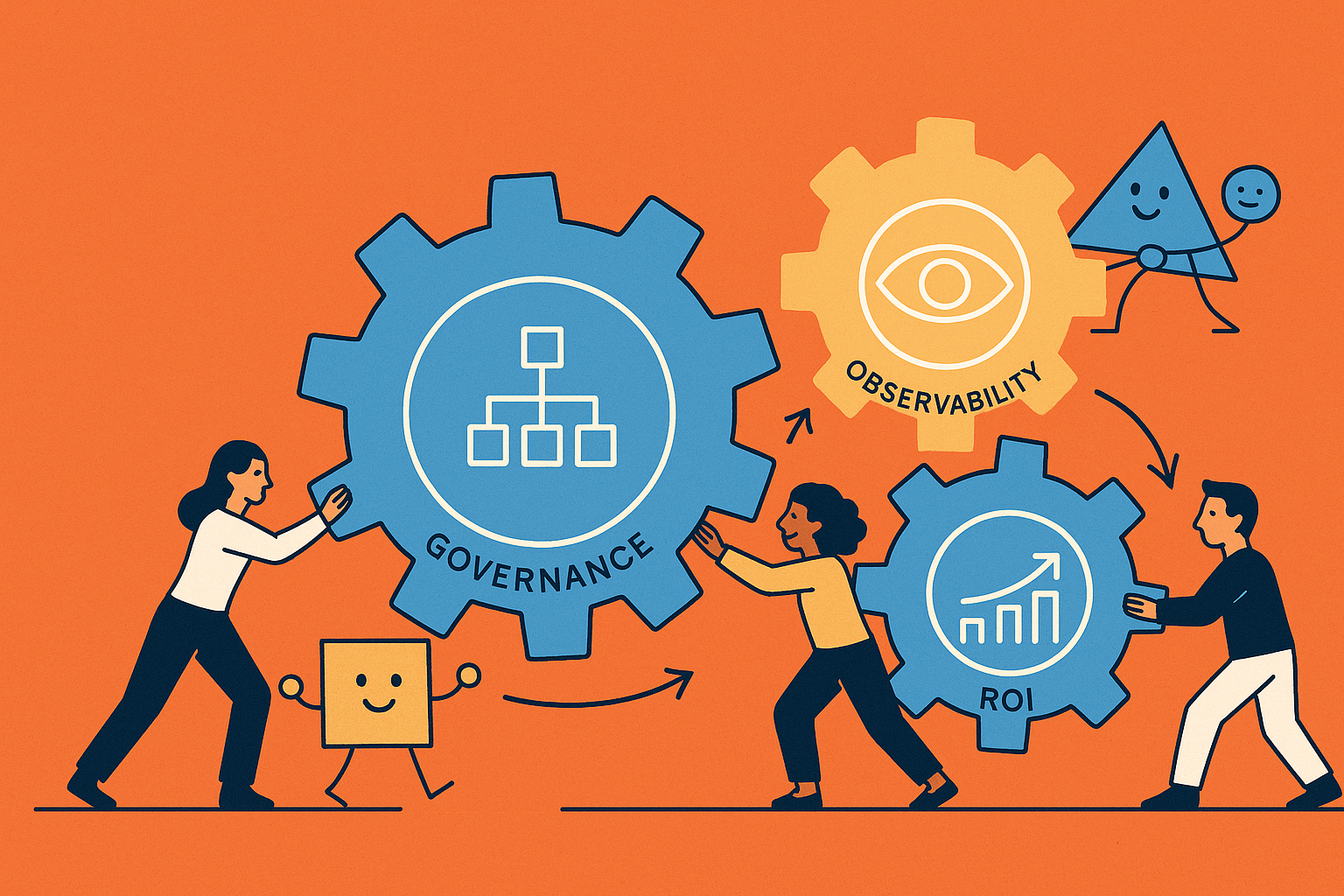
Agentic AI is transforming businesses in 2026. Learn how organizations are deploying AI agents for 171% ROI, governance, and scale.
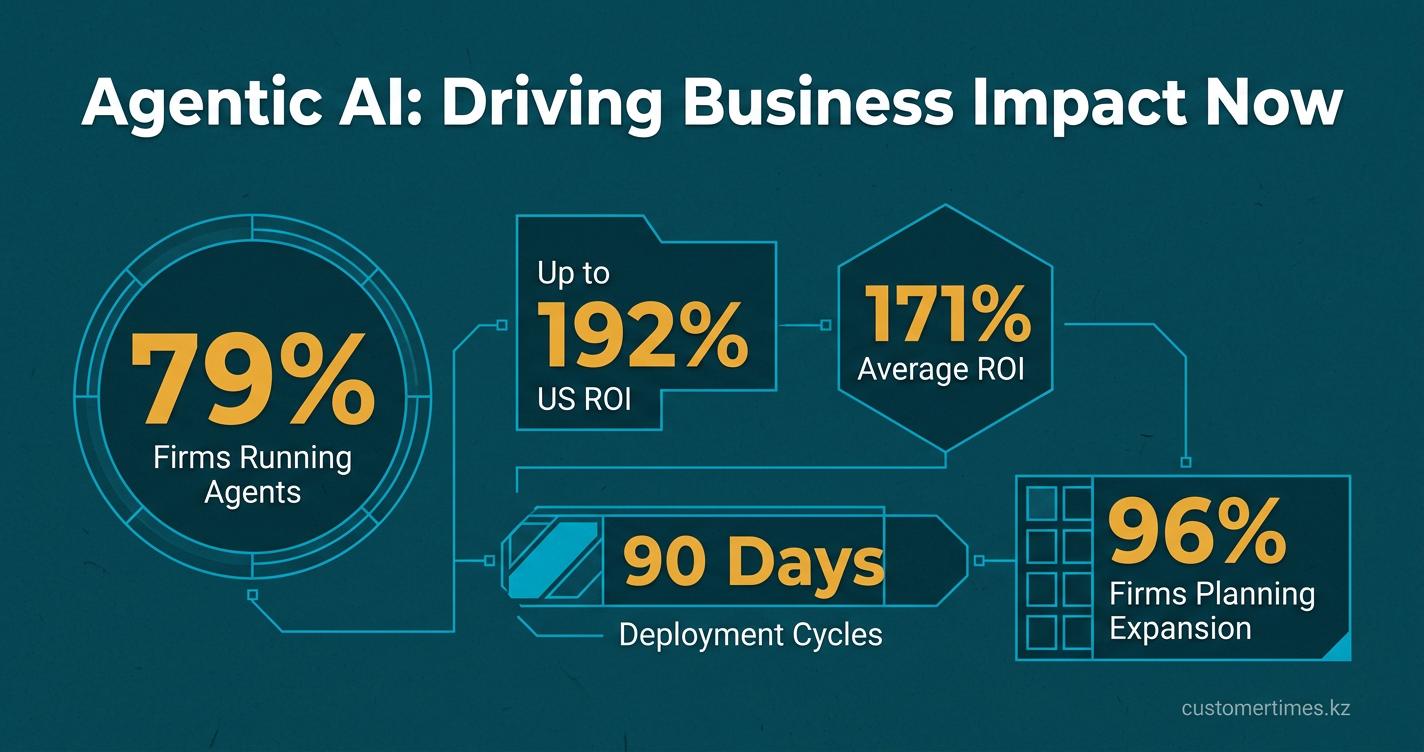
In 2026, the era of agentic AI has arrived: 79% of firms run goal-driven agents, with U.S. deployments achieving up to 192% ROI. This shift has elevated agentic AI from a buzzword to a board-level KPI. Across industries, CIOs now consider AI agents the default design pattern for any process involving data, decisions, and digital handoffs. As these digital workers solve complex problems and boost profits, companies are learning to manage them like a human workforce, focusing on strategic deployment, governance, and efficiency.
What is driving the rapid adoption of agentic AI in enterprises in 2026?
The rapid adoption of agentic AI in 2026 is driven by its proven business impact. With 79% of organizations already running goal-driven agents and 96% planning to expand their use, the key drivers are rapid deployment cycles, significant ROI reaching 192% in the U.S., and transformative process improvements in key sectors like aviation and banking, elevating it to a board-level imperative.
From Pilots to Revenue Engines
Enterprises are rapidly adopting agentic AI due to its proven ability to generate substantial returns on investment. With deployment windows shrinking to 90 days and ROI averaging 171%, these goal-driven agents are transforming core business processes, making them a top priority for strategic growth.
This transition is exemplified at London-Heathrow, where Salesforce-powered agents handle 70% of passenger queries autonomously, enabling 24/7 operations. This scale is achieved through two critical infrastructure layers:
| Layer | Purpose | What Changed in 2026 |
|---|---|---|
| MuleSoft Agent Fabric | Single registry for every agent, built or bought | Orchestrates multi-agent workflows, enforces risk thresholds, stores context in Data Cloud |
| Agentforce Observability | Live health & business KPIs | Session-level tracing, intent clustering, proactive failure alerts; integrates natively with Fabric |
These layers transform disparate bots into a governed, auditable agent mesh that businesses can confidently deploy for customer-facing operations.
Inside Agentforce Observability
This integrated observability platform provides deep insights into agent performance:
- Agent Analytics surfaces which intents drive the highest containment and identifies where drop-offs spike.
- Agent Optimization groups thousands of sessions by topic and sentiment to flag precise configuration tweaks that improve accuracy.
- Agent Health monitors latency, error rates, and escalation paths every 30 seconds, sending Slack alerts before customers are impacted.
Marketers now leverage this data to A/B test agent personalities, deploying new prompts in the morning and measuring the financial impact by lunchtime.
What the 2,000-Agent Club Looks Like
Leading platforms like DeepL power agentic workflows for 2,000 enterprise customers. Use cases include auto-translating quarterly reports for compliance and scanning 100-page contracts to produce risk-ranked clause maps in minutes. A survey of 5,000 executives reveals 69% expect agentic AI to "fundamentally transform" their operating model this year, a sharp increase from 42% in 2025.
"The question is no longer whether agents will touch a process, but how many agents will collaborate on it and who owns the governance layer."
- composite view from MIT Sloan Review survey of 2,000 enterprises, February 2026
Market Math
The market reflects this trend, with enterprise spending on agentic software following a 46% CAGR curve - from $2.58B in 2024 to $8.5B this year, and a projected $24.5B by 2030. Consequently, 43% of AI budgets now prioritize agentic capabilities. Furthermore, 88% of C-level leaders plan to increase this investment, citing that "the ROI arrives before the quarterly close."
Adoption Pattern Shift
Agentic AI's adoption rate is unprecedented. While traditional AI took eight years to reach 72% market saturation and generative AI took three, agentic AI achieved 35% in just 24 months, with another 44% of firms currently in deployment stages. This compression is enabled by ready-made orchestration platforms that allow companies to integrate agents with CRM, ERP, and legacy systems in weeks.
Verticals Where Agents Already Outperform Humans
In several key industries, autonomous agents are already delivering results that surpass human benchmarks:
| Industry | 2026 Agent Use-Case | Typical Outcome |
|---|---|---|
| Aviation | Baggage, rebooking, loyalty | 70% call deflection, 0.8s average response |
| FMCG | Perfect-store audits, inventory alerts | 29% revenue lift, 36% promo effectiveness gain |
| Banking | KYC document checks, credit memos | 31% faster decisions, 27% cost reduction |
| Pharma | Med-rep next-best-action, sample tracking | 5-7% script share increase |
Governance-First Beats Speed-First
A critical lesson from early deployments is that prioritizing governance over speed is essential for success. Firms that bypassed governance frameworks saw error rates exceed 8% and were forced to scale back. In contrast, organizations that embedded risk management, human-in-the-loop oversight, and kill-switches from the start maintain error rates below 1% and are confidently scaling from small pilots to 500-agent meshes.
What Ready-Made Integration Feels Like
The power of ready-made integration is evident in the case of a Central-Asian telecom provider that consolidated 14 legacy chatbots into a single Salesforce Agentforce mesh. MuleSoft Fabric automatically discovered existing APIs, applied a unified governance layer, and provided a single view of the customer. The transition was completed in four weekends, leading to an 18-point NPS increase the following quarter as customer experience improved dramatically.
Skills That Are Scarce on the Ground
This technological shift has created a demand for new, specialized roles, which command salary premiums of 30% over traditional automation positions:
- Agent orchestration architects who can balance autonomy vs. control
- Prompt engineers who understand regulatory wording, not just grammar
- Observability analysts who read trace logs like BI dashboards
- Domain translators who turn "check legal terms" into a four-step agent workflow
Infrastructure Checklist for 2026
To successfully deploy and scale agentic AI, enterprises must have the following core infrastructure components in place:
- An agent-ready data cloud (e.g., Lakehouse or Snowflake) with row-level security.
- An API fabric that exposes legacy services as secure REST endpoints.
- A real-time event bus (e.g., Kafka) so agents can react instantly to business changes.
- Credit-consumption metering linked to financial codes to track agent-specific costs.
Looking Ahead
The future of agentic AI lies in specialized, vertical solutions. Agent marketplaces are emerging within all major SaaS platforms, with Salesforce already offering 250 pre-trained agents. By 2027, vertical-specific agents are expected to outnumber general-purpose ones 5:1, as domain expertise is crucial for achieving over 95% accuracy and ensuring compliance.
"We are not buying software anymore; we are hiring digital labor and managing it like a workforce."
- Deloitte 2026 State of AI summary, based on 3,200 global respondents
Boards will increasingly demand headcount plans that integrate both human and digital workers. The companies poised to lead are those that are already embedding governance, observability, and cost transparency into every agent they deploy in 2026.