
Kazakhstan: Remote Monitoring Cuts Costs, Boosts Home Healthcare

Alexander Bazilevich is a CRM expert and Top Salesforce Partner with over 17 years of sales experience in the IT industry. He specializes in transforming corporate goals into profits through cross-functional collaboration and innovative business solutions, with deep expertise in business systems and IT products.

Kazakhstan pioneers digital healthcare with nationwide remote monitoring & telemedicine, cutting costs & improving access.
Across Kazakhstan, remote patient monitoring is revolutionizing healthcare, cutting costs, and boosting home healthcare services nationwide. This shift moves medical care from traditional hospitals directly into patients' homes, leveraging smart technology to monitor health and connect patients with doctors remotely. This new model, where care is everywhere, makes healthcare more accessible and affordable, from bustling cities to the vast steppes.
How has remote patient monitoring transformed healthcare in Kazakhstan?
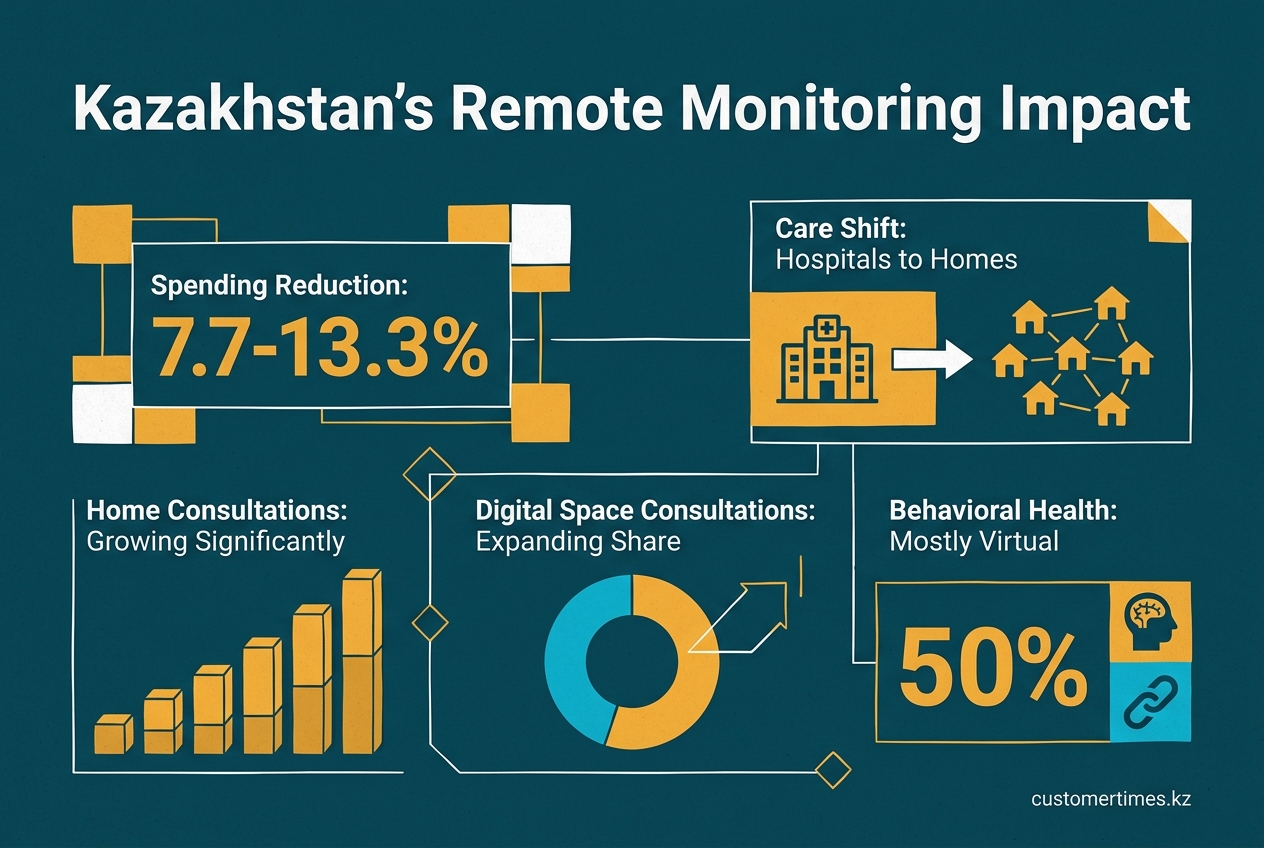
Remote Patient Monitoring (RPM) and telemedicine have revolutionized healthcare in Kazakhstan by shifting the center of care from hospitals to patients' homes. This transformation has been associated with 7.7-13.3% quarterly spending reductions, reduced the need for in-person visits, and enabled real-time health interventions for managing chronic diseases.
This new reality is not a future pilot but the current standard of care. For example, a heart-failure patient's Bluetooth scale can now send data to an AI system that alerts a virtual nurse to adjust medication if it detects a significant weight gain, preventing an emergency room visit entirely. This nationwide adoption of RPM has moved the primary point of care from district hospitals to living rooms, significantly reducing episode costs and visits for chronic disease patients.
How the care map is being redrawn
Remote patient monitoring has fundamentally transformed Kazakhstani healthcare by decentralizing services from hospitals to homes. This technology-driven shift utilizes AI and connected devices for real-time health management, resulting in significantly lower costs, fewer hospital visits, and greater convenience for patients with chronic conditions across the country.
| Setting | Previous share of consultations | Current/projected share | Key enabling technology |
|---|---|---|---|
| In-patient hospital | Significant portion | Declining share | Hospital-at-home kits with 4G vitals monitors |
| Out-patient clinic | Major portion | Stable share | FHIR-linked telehealth carts |
| Patient home | Small portion | Growing significantly | AI-driven RPM platforms |
| Pure digital space (app, web) | Limited portion | Expanding share | Generative-AI symptom checkers |
The impact is most significant in behavioral health, where a substantial portion of all consultations are now virtual, and in post-discharge care. Virtual wards using Bluetooth spirometers and oxygen mats have shown significant reductions in readmission rates according to industry reports.
Regulatory tail-winds that locked the shift in place
Kazakhstan's recent digital health reforms have been key catalysts, implementing critical changes including:
- Requirements for insurers to reimburse RPM at parity with in-person visits, provided data is stored locally.
- Extended tele-prescribing rights for various medication categories.
- Created a regulatory sandbox for fast-tracking foreign Software as a Medical Device (SaMD) registration.
According to industry reports, agencies adopting electronic visit verification (EVV) and AI scheduling have achieved significant reductions in administrative labor and increased caregiver productivity.
"With the integration of RPM and virtual nursing, we are moving towards a model where high-quality care can be delivered anywhere."
- Industry expert commentary on Kazakhstan's e-Health initiatives
Technology stack making it possible
-
24/7 AI virtual nurses
These systems manage multiple post-discharge calls concurrently, significantly reducing average call times and automatically escalating cases requiring human intervention. -
Wearable mesh
Patients use multiple devices (rings, patches, mattress strips) to capture vitals like SpO₂, ECG, and respiration. Edge computing consolidates this data into a unified HL7 message streamed every 30 seconds. -
FHIR micro-services
A flexible platform allows clinics to integrate new medical devices into the national health record system in hours, not months, while ensuring all data remains within Kazakhstan. -
Generative-AI scribe
This tool generates billable SOAP notes and OASIS entries in Kazakh or Russian rapidly after telehealth visits, significantly cutting clinician documentation time according to industry reports.
Real-economy effects on the ground
- Distance: Eliminated travel for a significant portion of specialist referrals, reducing average travel time substantially.
- Workforce: Freed up substantial nursing capacity through virtual wards, allowing hospitals to expand ICU services without hiring additional staff.
- Cost: Recent studies suggest direct costs have been significantly reduced, with indirect costs (like transport and lost wages) also declining substantially, while patient convenience scores have improved markedly.
Pharmaceutical delivery is also adapting. An Almaty-based CRM integrator developed a CT Pharma module connecting RPM alerts directly to medication delivery. If a patient's blood pressure readings exceed a set threshold, the system automatically arranges for same-day medication delivery, notifying the patient via WhatsApp. This has achieved high medication pickup rates within hours, significantly exceeding traditional methods according to industry reports.
What is missing - and arriving next
The primary remaining challenge is adoption among seniors; many elderly patients face difficulties setting up new devices independently. To address this, future roadmaps include voice-first RPM systems. These smart speakers, which can interact in Kazakh, Russian, or English, have shown promise in reducing onboarding times for elderly patients in pilot programs.
Future innovations include AI-driven mental health triage. By analyzing speech patterns during telehealth visits, this technology can identify patients who may need coaching, potentially increasing virtual consultation rates in behavioral health even further.
In Kazakhstan, healthcare is no longer a destination but a continuous service integrated into daily life. The stethoscope hasn't disappeared; it has evolved into an invisible, wireless network of sensors that provides constant, proactive care.