
DeepSeek V4-Pro: 8.6x Cheaper Than GPT-5.5 for AI Workloads
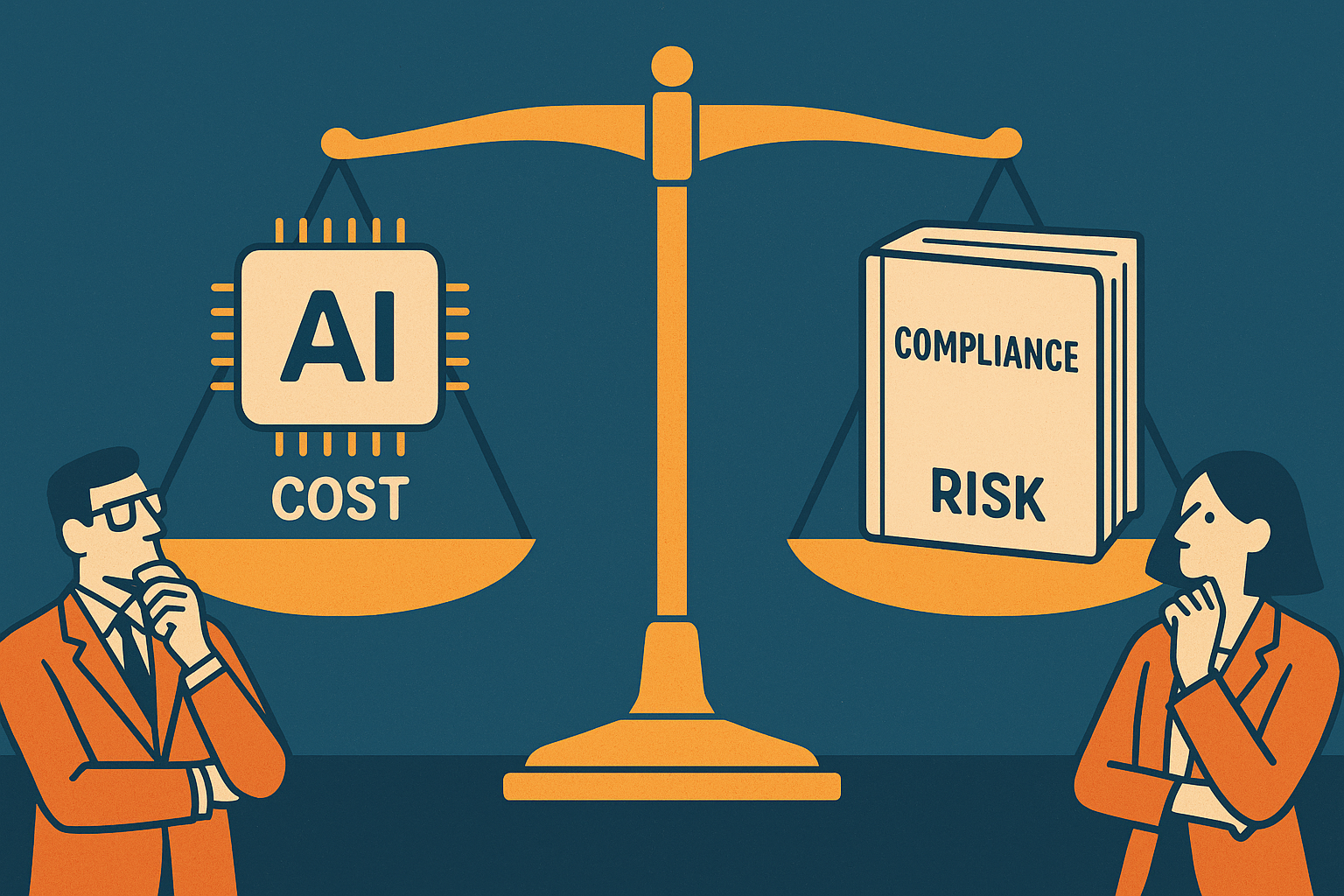
DeepSeek V4-Pro offers 8.6x cost savings over GPT-5.5. EU AI Act impacts all models. AI roles surge while tech hiring dips.
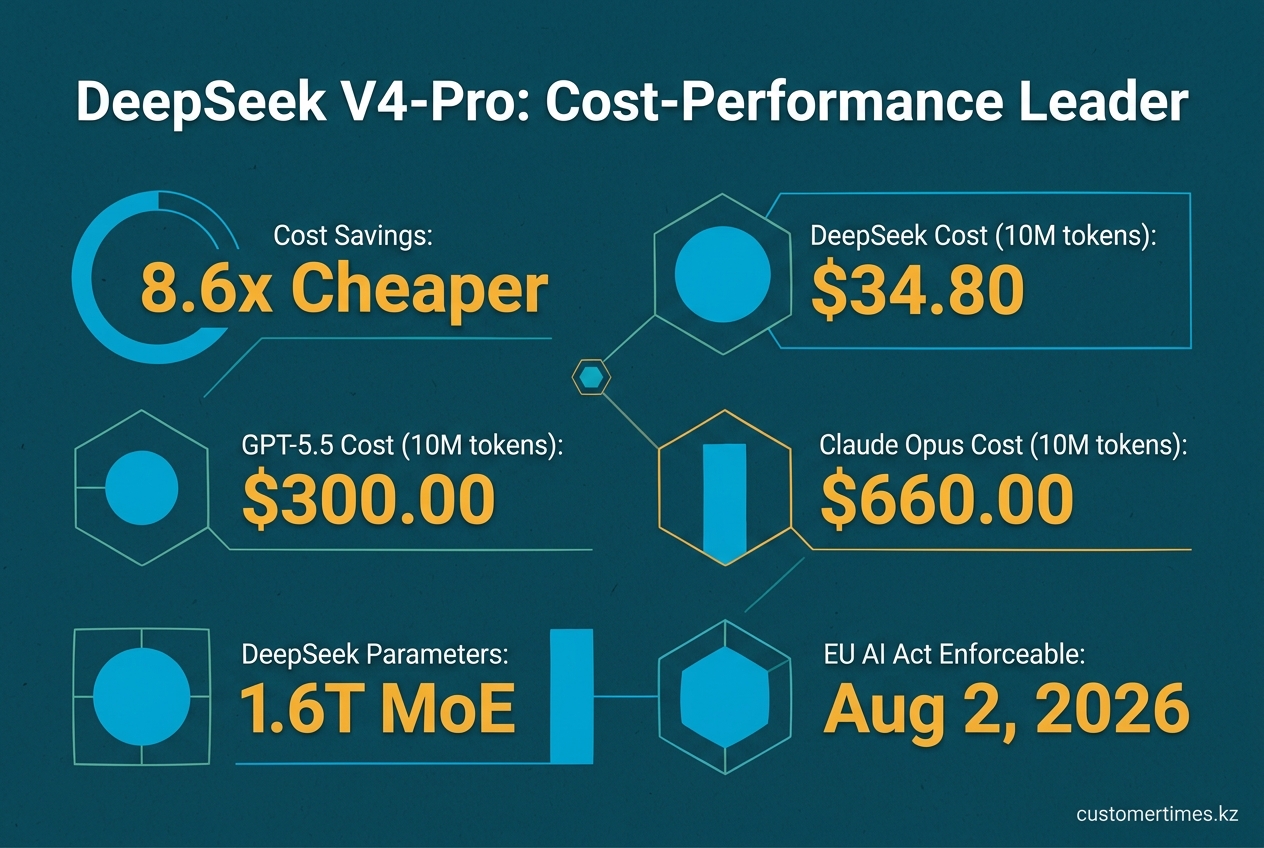
The recent release of DeepSeek V4-Pro makes it 8.6x cheaper than GPT-5.5 for AI workloads, resetting the price-performance standard for frontier models. A 10-million-token coding task costing $300 on GPT-5.5 is just $34.80 on DeepSeek V4-Pro, prompting procurement teams to revise Q3 budgets. Its open-weights, 1.6T parameter MoE architecture allows for self-hosting or managed endpoint access without per-seat licensing. As enterprises adopt hybrid AI strategies to manage costs and navigate the upcoming EU AI Act, the demand for AI-fluent professionals is surging.
What is the cost advantage of DeepSeek V4-Pro compared to GPT-5.5 and Claude Opus 4.7 for enterprise AI workloads?
DeepSeek V4-Pro provides a substantial cost advantage for enterprise AI workloads. For a workload of 10 million output tokens, DeepSeek V4-Pro costs just $34.80 per month, compared to $300 for GPT-5.5 and $660 for Claude Opus 4.7. This represents an 8.6x cost reduction against GPT-5.5 with comparable performance.
The model delivers this efficiency through its open-weights, mixture-of-experts (MoE) architecture, which keeps only 49 billion of its 1.6 trillion parameters active at once. This design dramatically lowers inference costs while supporting large-scale, production-level tasks without sacrificing performance or context capacity.
- Table 1. Monthly cost at 10 M output tokens (≈ 300k lines of code)*
| Model | Cost | Context | Licence |
|---|---|---|---|
| DeepSeek V4-Pro | $34.80 | 1 000 k | Open weights |
| GPT-5.5 | $300.00 | 922 k | Closed |
| Claude Opus 4.7 | $660.00 | 200 k | Closed |
Enterprise architects testing both models report that the 8-point performance difference on SWE-bench (80.6% vs. 88.7%) becomes negligible in production when factoring in the cost savings. Furthermore, DeepSeek's 1-million-token context window streamlines workflows by eliminating the need to chunk large documents, such as 200-page requirement PDFs, which competing models must process in multiple prompts.
"We cancelled a planned 36 k-dollar annual GPT-5.5 contract after a two-week side-run. DeepSeek gave the same pass rate on internal unit tests for one-twelfth the burn." - Director of Engineering, Fortune-500 retailer
EU AI Act enters enforceable phase
Beyond performance leaderboards, corporate risk officers are focused on compliance with the EU AI Act. Its high-risk provisions become enforceable on 2 August 2026, requiring any AI system affecting EU residents to maintain a comprehensive technical dossier. This includes conformity assessments, risk management, and human oversight. Non-compliance carries severe penalties of up to €15 million or 3% of global turnover per violation.
The Act's jurisdiction is based on user data, not company location, meaning US vendors serving EU customers are fully liable. For instance, an AI tool used in a German hospital requires full compliance, regardless of where its developer is based. While the final text provides limited exemptions for open-source models at the training stage, companies deploying them for high-risk applications remain fully responsible for downstream compliance.
"Architects are no longer asking 'Does GPT-x comply?' They are asking 'Does my configuration of any model comply when it recommends medication or screens résumés?'" - Partner, regulatory law firm
In response, cloud providers are introducing EU AI Act compliance blueprints that automate risk classification, output watermarking, and audit trail generation. While these tools add a 12-18% latency overhead, they provide a significant competitive advantage, as 78% of European enterprises now list "declared conformity" as a key criterion in RFPs.
Hiring market splits between AI titles and general tech
The labor market reflects a clear divergence. While general tech job postings are 34% below their 2020 baseline, roles mentioning "AI/ML" have surged 163% year-over-year to 49,200 in 2025. In response, companies are implementing a 15-25% salary premium for AI-fluent roles while freezing hiring in other tech areas.
- Table 2. Projected 2026 growth in U.S. postings*
| Function | Growth | Median salary delta |
|---|---|---|
| Data scientist / analyst | 414 % | +22 % |
| Cybersecurity analyst | 367 % | +18 % |
| Software engineer | 297 % | +12 % |
| QA / test engineer | 220 % | +6 % |
| Product manager (non-AI) | - 19 % | 0 % |
To manage tighter budgets, recruiters are adopting agentic workflows. AI-powered screening tools eliminate up to 60% of applicants before human review, and generative AI reduces the time to write job descriptions from 45 minutes to just 4 minutes. This automation paradoxically maintains high hiring velocity despite widespread headcount freezes.
What happens on the ground
Three patterns dominate mid-2026 enterprise roadmaps:
- Buy-and-Classify: Enterprises in sectors like retail and pharma are licensing closed models and wrapping them in classification layers. These layers route prompts to different risk buckets (e.g., high-risk, limited-risk) to apply appropriate controls for EU-facing interactions.
- Hybrid-Host: Financial institutions are using a hybrid approach, running low-latency, customer-facing chat on models like GPT-5.5 while using self-hosted DeepSeek V4-Pro for internal tasks like code generation to avoid metered, per-token costs.
- Build-and-Certify: Industrial companies developing new products are opting for open-weights models. They fine-tune these models on proprietary domain data and then submit the final system for an official audit to achieve EU certification before market launch.
One Central Asian systems integrator recently replaced 2,800 Salesforce licenses with a custom, DeepSeek-powered solution. This move is projected to save $312k over three years while ensuring compliance with regional data sovereignty laws. The deployment successfully passed both ISO 42001 and EU conformity assessments in June, a landmark achievement for an open-weights stack.
Concurrently, HR analytics firm Revelio offers an AI tool that flags job requisitions at risk of violating the EU AI Act's prohibited practices clause, which can trigger a €50k fine. This tool has helped early adopters catch 11% of non-compliant job posts before publication, protecting them from penalties that can reach 7% of annual revenue.
Industry leaders and regulators forecast a strategic shift by year-end. The central question will no longer be which AI model is the most intelligent, but which integrated solution - combining model choice, hosting strategy, and governance framework - enables businesses to innovate within their budgetary and compliance constraints.