
Salesforce Headless 360: API-First CRM for AI Agents

Alexander Bazilevich is a CRM expert and Top Salesforce Partner with over 17 years of sales experience in the IT industry. He specializes in transforming corporate goals into profits through cross-functional collaboration and innovative business solutions, with deep expertise in business systems and IT products.
Salesforce launches Headless 360, an API-first CRM re-write for an agent-rich world. Automate workflows, integrate AI, and boost efficiency.
Salesforce Headless 360 is an API-First CRM for AI Agents that operates without a traditional website or dashboard. By shifting all control to APIs, it empowers both people and automated agents to perform tasks with incredible speed from platforms like Slack or WhatsApp. This composable model allows businesses to connect disparate tools, manage larger workloads, and use smart agents to resolve problems proactively. This evolution transforms Salesforce into a platform defined by speed and working together in new ways, rather than manual UI navigation.
What is Salesforce Headless 360 and how does it change CRM in 2026?
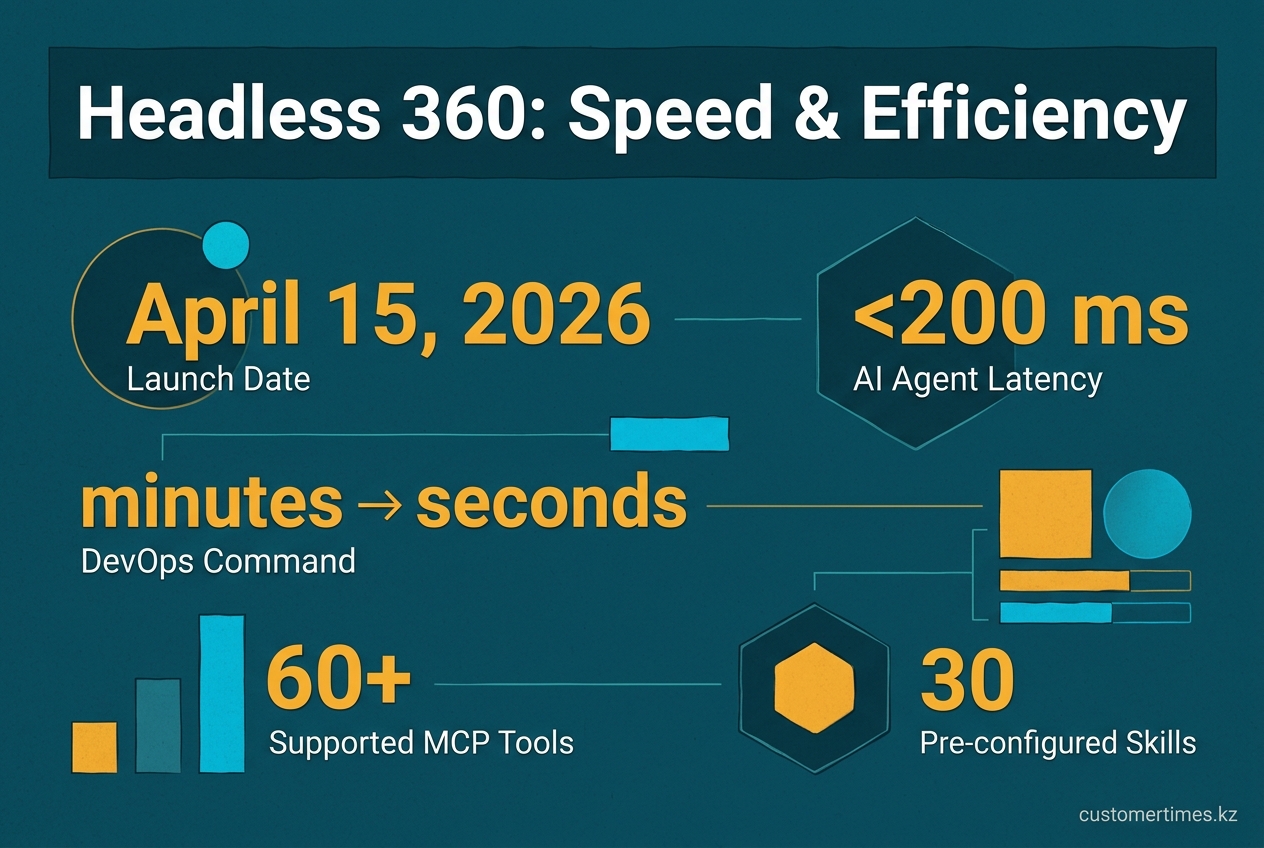
On April 15, 2026, Salesforce launched Headless 360, a complete, API-first reimagining of its CRM. This platform eliminates the graphical user interface, converting all CRM logic - including data, workflows, approvals, and AI predictions - into callable API endpoints. The outcome is a truly conversational platform designed for an agent-driven ecosystem, where interactions are spoken or typed, not clicked. This architecture enables real-time automation, rapid deployments, and frictionless integration with any front-end experience.
What "headless" actually means in 2026
In this context, "headless" means the core CRM functionality is completely detached from a specific user interface. Instead of a browser-based application, all data and workflows are exposed as APIs. This allows AI agents, developers, and integrated tools to interact with Salesforce directly for faster, more flexible operations.
While traditional Salesforce operates within the Lightning UI, Headless 360 detaches that front-end layer, exposing core capabilities through more direct and efficient interfaces:
| Interaction style | Old path | New path | Latency |
|---|---|---|---|
| Human click-through | Lightning tabs | none | seconds-minutes |
| AI agent call | custom code | MCP tool | <200 ms |
| DevOps command | web + CI screens | CLI sentence | minutes → seconds |
On launch, the platform supports over 60 MCP tools and 30 pre-configured coding skills, allowing AI agents to read objects, update records, and deploy metadata using tools like Claude Code, Cursor, or even a simple cURL command. Because every function is an API, development is simplified; a skill built to resolve a customer case in Slack can be reused instantly in WhatsApp or a voice assistant without any changes.
Real-time workflows, no humans in the loop
By integrating Agentforce Vibes 2.0 and a streaming Data 360 layer, Headless 360 enables fully autonomous, real-time workflows. For example, when an IoT sensor detects an equipment failure, an AI agent can instantly correlate the alert with CRM contract data, create a priority service case, dispatch a field technician, and notify the customer - all before a human is even aware of the issue.
Early adopters report significant increases in workload capacity without hiring additional staff and notable reductions in DevOps cycle times. This efficiency stems from natural-language deployments via the DevOps Center MCP, where a simple command like "Send billing features to staging" replaces complex manual processes and Jira tickets.
Composable by design, not by retrofit
Headless 360 is inherently composable, built by deconstructing the Salesforce monolith into interchangeable modules like Agent Fabric, AgentExchange, and the Experience Layer. Each module is published with clear OpenAPI and MCP contracts. This allows enterprises to easily insert a custom microservice, replace the native recommendation engine, or render CRM data in an Apple Vision Pro app by calling a single API contract. This model eliminates middleware dependencies and UI lock-in, dramatically lowering prototyping costs and future-proofing development for devices that don't yet exist.
From keynote to production in 12 days
Early success stories highlight the platform's rapid time-to-value:
- Engine, a B2B travel platform, developed and deployed "Ava," a customer service agent, in just 12 calendar days. Ava now handles a significant portion of support cases autonomously across Slack, email, and chat, with all interactions summarized back into Salesforce.
- SaaStr, a media and events company, integrated headless agents in under 20 minutes. This resulted in a substantial increase in sponsorship revenue from AI-qualified leads compared to their previous benchmarks.
These examples show how companies are using Slack as the primary user interface and Data 360 as the single source of truth, effectively transforming messaging platforms into the modern CRM desktop.
Market pulse and what happens next
The Headless CMS Software Market is projected at USD 20.93B by 2033, CAGR 21.6% (2026-2033); Headless Commerce Market at US$ 7.24B by 2033, CAGR 22.6% (2026-2033). As composable architectures become standard for AI-driven experiences, Salesforce's introduction of Headless 360 solidifies this trend, shifting focus from UI-based seat licenses to ROI generated by API-first agent interactions. The new competitive advantage is not just owning data, but enabling agents to act on it instantly without a traditional login.
This shift will likely spawn a new ecosystem of "agent-as-a-service" startups built on Headless 360 APIs. Concurrently, internal IT teams will need to redirect front-end development budgets toward conversational UX design and AI governance. Businesses currently reliant on the Lightning UI should begin exploring an API-first strategy immediately, as the skills required to manage data today will be essential for powering the augmented reality and AI-native services of tomorrow.