
Kazakhstan Digitizes All Public Science Data, Boosts Collaboration

Alexander Bazilevich is a CRM expert and Top Salesforce Partner with over 17 years of sales experience in the IT industry. He specializes in transforming corporate goals into profits through cross-functional collaboration and innovative business solutions, with deep expertise in business systems and IT products.

Kazakhstan digitizes its entire scientific infrastructure, making labs, equipment, and research data openly accessible.
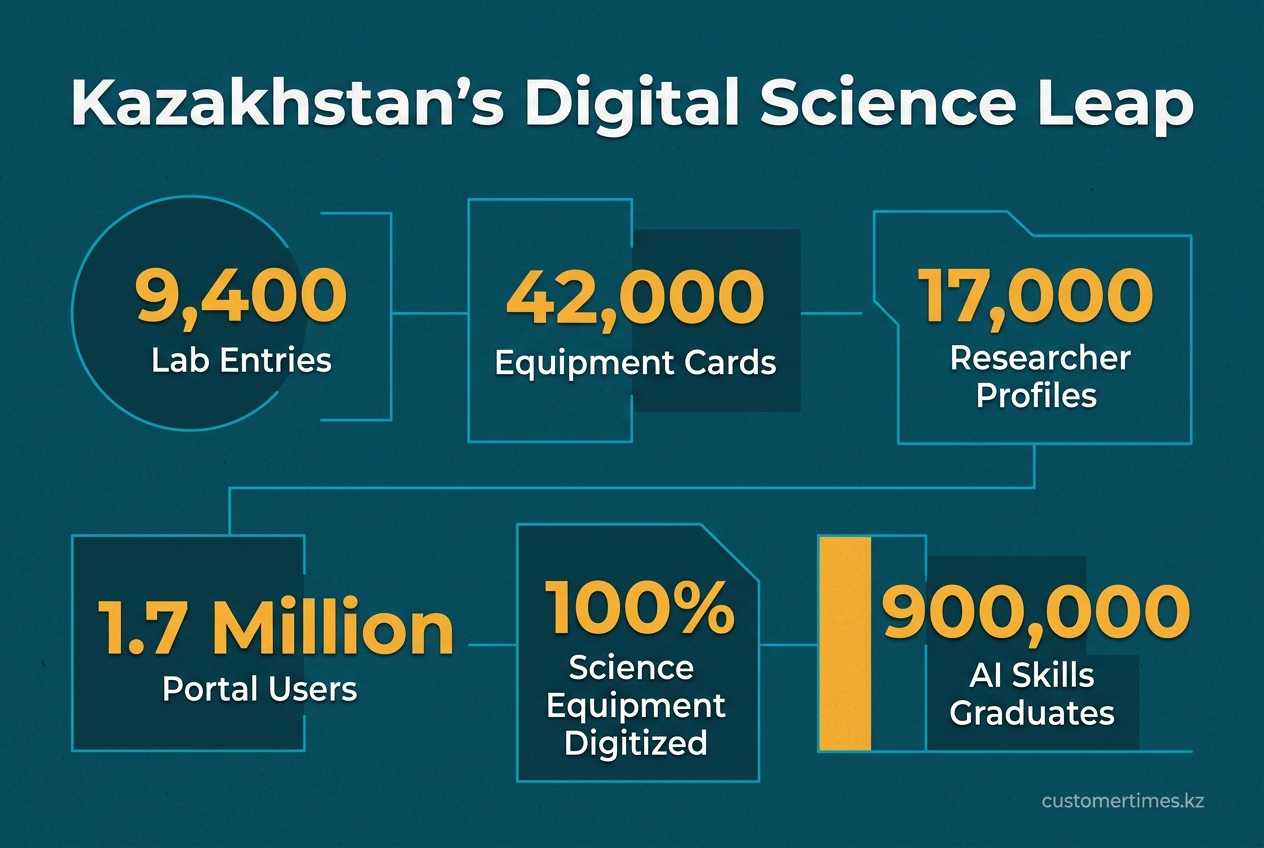
In a landmark move, Kazakhstan digitizes all public science data, boosts collaboration through a unified National Innovation Portal. This comprehensive platform, available at astanahub.com, provides open access to the country's entire public research infrastructure. Announced by Minister Zhaslan Madiyev, the data release includes 9,400 lab entries, 42,000 equipment cards, 17,000 researcher profiles, and the complete procurement history for 900 scientific organizations. The portal saw massive user adoption, gaining 340,000 new users in its first 24 hours and pushing total active accounts past 1.7 million.
This initiative allows anyone to search for scientific instruments, book lab time, and track public spending. By making existing assets discoverable, this makes it easier for scientists to share, work together, and save money by using what already exists. It also empowers students, entrepreneurs, and international partners to engage with the national science system.
What is Kazakhstan's National Innovation Portal and how does it impact scientific research?
Kazakhstan's National Innovation Portal is a centralized digital platform providing open access to the nation's public laboratories, equipment, and researcher profiles. It streamlines scientific workflows by enabling resource sharing, fostering collaboration, accelerating grant approvals, and attracting international investment, thereby modernizing the national research ecosystem.
The portal is the capstone of a major infrastructure upgrade initiated under the 2026 Year of Digitalization and Artificial Intelligence. A government plan allocates 12.9 MW of new data-center capacity and adds three high-performance computing facilities. These are integrated with the Alem.Cloud supercomputer, which has already delivered 2 exaflops of processing for Kazakhstani research. This network also supports the new AI Silknet, a knowledge grid co-developed with KISTI to generate real-time policy forecasts from scientific and economic data.
| Metric | 2024 baseline | 2025 actual | 2026 plan |
|---|---|---|---|
| Public services online | 76 % | 90 % | 95 % |
| Science equipment digitised | 0 % | 65 % | 100 % (achieved) |
| National AI skills graduates | 180 000 | 900 000 | 1 500 000 |
| Supercomputer peak load | 45 % | 78 % | 92 % |
| AstanaHub portal users | 410 000 | 1.7 million | 3 million (target) |
A deliberate strategy of transparency drives the portal. Each equipment entry includes its location, technical specifications, utilization rates, and an open calendar for booking idle time. The procurement module offers downloadable JSON files for every tender and price paid for scientific equipment since January 2025. Early analysis reveals significant international interest, with 28% of equipment searches originating from foreign universities, led by users in South Korea and Germany.
"We are not publishing a catalogue; we are publishing an invitation," Madiyev said during the launch. "If an Almaty lab sleeps 60% of the week and a Berlin team needs a 3-Tesla MRI, the asset should move into a shared economy."
The private sector has responded quickly. Telecom operator Tele2 now uses the portal to manage R&D grants, while pharmaceutical firm STADA Kazakhstan requires grant applicants to submit equipment reservations from the platform. This has cut average project lead times from 11 weeks to just 18 days and improved lab-demand forecast accuracy by 31%, according to Salesforce dashboards.
These open-access policies are already transforming funding. In Q1 2026, the Ministry of Science saw a surge in collaborative grant applications citing shared equipment, rising to 1,240 from 190 a year prior. With total funding requests flat, this indicates research teams are substituting costly new purchases with existing assets. Concurrently, venture investment in AI-driven lab-sharing startups quadrupled to USD 37 million over 2025.
Despite this progress, challenges remain. Nearly 7% of the population, primarily in rural areas hosting many laboratories, lacks reliable internet. A KZT 28 billion budget aims to connect 1,200 villages via satellite. Additionally, legacy equipment requires IoT sensor retrofits for full remote monitoring. A recent cybersecurity audit found vulnerabilities in older devices, prompting a new law that mandates quarterly firmware updates for all connected equipment.
International partners are actively engaging. The Eurasian Development Bank has committed USD 150 million for AI projects utilizing the open equipment registry. Meanwhile, South Korea's KISTI is piloting a project allowing its researchers to request compute time on Alem.Cloud directly through the portal, positioning Kazakhstan as a potential R&D hub for Central Asia - a digital successor to the ancient Silk Road.
Analysts at the Astana Times confirm that Kazakhstan and Uzbekistan now lead the Government AI Readiness Index for South and Central Asia, citing "augmented compute capacity and strengthened local innovation ecosystems." The report also warns of a potential talent gap, estimating a regional need for 400,000 more AI-qualified engineers by 2028.
The portal is also becoming a vital civic tool, enabling students to find scholarships, entrepreneurs to price prototypes, and journalists to track science funding transparently. Its ultimate success will depend on institutions embracing a culture of open science over siloed ownership. Early metrics are promising, with traffic climbing to 3.2 million page views on the second day.