
Kazakhstan: 2026 for AI, Digitalization; Seeks $1B/Year Investment

Alexander Bazilevich is a CRM expert and Top Salesforce Partner with over 17 years of sales experience in the IT industry. He specializes in transforming corporate goals into profits through cross-functional collaboration and innovative business solutions, with deep expertise in business systems and IT products.

Kazakhstan aims to become a Eurasian computing and data hub by 2030, with a focus on AI, digital transformation, and human capital.
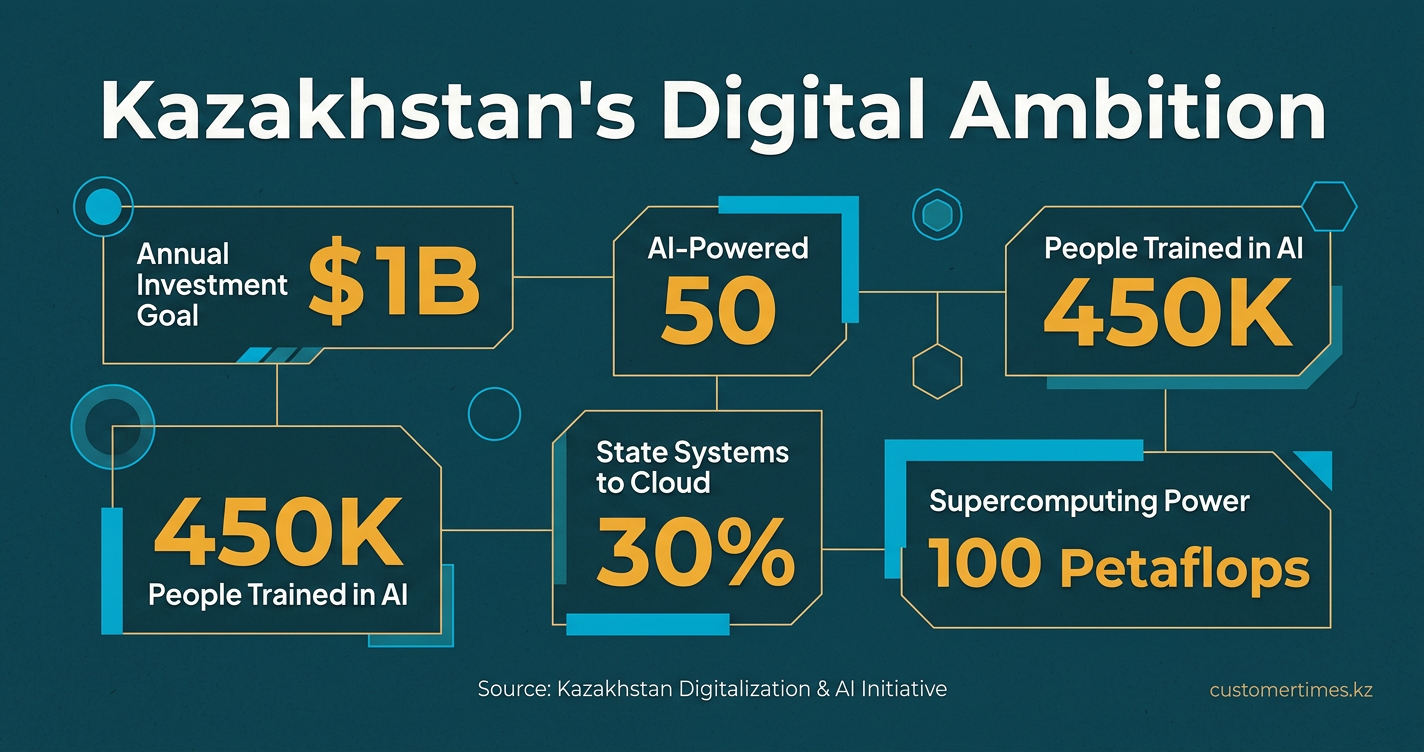
Kazakhstan has designated 2026 the Year of Digitalization and Artificial Intelligence, seeking over $1 billion a year in investment to become a premier Eurasian tech hub. On April 3, Prime Minister Olzhas Bektenov met with delegations from the World Bank, IMF, and other multilateral development banks to secure funding and expertise for national priorities, including AI-driven innovation, infrastructure, and human capital development. This initiative aims to launch 50 AI-powered government services, train nearly half a million people in AI, and establish a powerful supercomputing center by the end of the decade.
What are Kazakhstan's main priorities and targets for digitalization and artificial intelligence by 2026?
Kazakhstan's strategy focuses on delivering 50 AI-powered public services, training 450,000 people in AI skills, and migrating 30% of state systems to a national cloud. Key goals also include deploying industrial AI solutions, establishing a supercomputing cluster, and implementing comprehensive nationwide cybersecurity upgrades.
The government's eight-pillar action plan, approved in January, sets measurable 2026 targets for investors:
| Priority block | 2026 KPI | Lead agency |
|---|---|---|
| GovTech | 50 AI-powered public services on line | Ministry of AI & Digital Dev. |
| Human capital | 450 000 pupils and teachers trained under AI-Sana | Ministry of Education |
| Regulation | 90 % of AI, data and cyber laws adopted | Parliament |
| Digital economy | 1 000 000 citizens with new digital skills | Atameken & Astana Hub |
| Infrastructure | 30 % of state systems migrated to QazTech cloud | QazTech, KTZ |
| Sectoral AI | Industrial datasets for energy, mining, agro, logistics | Ministry of Industry |
| Smart cities | Al-Farabium super-computing cluster live | Alem.AI |
| Cybersecurity | Level-3 security operations centre nationwide | KPSD |
"AI is no longer a sector - it is infrastructure, like rail or copper wire. Our goal is to move from a 'digital state' to an 'intelligent state' by 2027."
Deputy PM Zhaslan Madiyev, Foreign Investors' Council round-table, 3 April 2026
Multilateral banks are already key backers of Kazakhstan's infrastructure, and the April talks focused on integrating AI components into these projects. For example, the World Bank's $846 million guarantee for the Mointy-Kyzylzhar rail project will now include fiber optic ducts and real-time freight analytics platforms. Under its 2026-2031 Country Partnership Framework, the Bank is prepared to offer up to $1 billion annually. Bektenov has requested the first $150 million tranche be used for the "data-factory" style modernization of tax, customs, and social fund systems.
The AI-Farabium super-computing cluster, a 100-petaflop, liquid-cooled facility powered by 98% low-carbon electricity, is a core asset in this strategy. Already used by local startups, the government is proposing a $220 million, five-fold expansion co-financed by the EBRD and ADB. This would also create a sovereign cloud node to keep sensitive information within national jurisdiction, complying with the new Personal Data Law.
Global consultants estimate that AI could add US $22 trillion to world GDP by 2030; Kazakhstan wants 1 % of that windfall, equal to its current annual GDP.
Prime Minister Olzhas Bektenov, Digital Qazaqstan Forum, 12 March 2026
Industrial AI represents the most direct path to economic growth. The Ministry of Industry presented "digital twin" models for copper and coal facilities, demonstrating how predictive maintenance can cut downtime by 18% and energy use by 7%. In response, the EDB and IDB have proposed a tentative $300 million facility for IoT sensors and analytics in the mining sector, potentially qualifying as a green bond.
While the national AI-Sana training program is currently funded domestically, Prime Minister Bektenov has asked the IMF to help design a variable tax credit. This incentive would reward companies for certifying employees in AI and data science, potentially mobilizing an additional $50 million in private training investment while adhering to fiscal deficit limits.
The strategy also includes advanced manufacturing. The QazTech roadmap calls for five "print-to-order" hubs for railway and energy spare parts by 2028. The Asian Development Bank's private-sector arm is considering a $40 million equity stake in the first hub, marking the bank's first 3-D printing investment in Central Asia.
With negotiations continuing in Washington, Kazakhstan is moving decisively. A new Ministry of Artificial Intelligence and Digital Development is planned from July 2026, and a multi-bank AI cooperation protocol will be finalized at the Foreign Investors' Council meeting in June. The message is clear: Kazakhstan's Year of Digitalization is open for business, and its algorithms are ready to power a new era of growth.