
Kazakhstan Capital Astana Runs on City-Wide AI Nervous System

Alexander Bazilevich is a CRM expert and Top Salesforce Partner with over 17 years of sales experience in the IT industry. He specializes in transforming corporate goals into profits through cross-functional collaboration and innovative business solutions, with deep expertise in business systems and IT products.

Astana becomes a smart city with a unified AI platform, optimizing traffic, energy, and public safety, and offering a unique AI learning hub.
Astana Launches City-Wide AI Nervous System, Redefining Urban Management
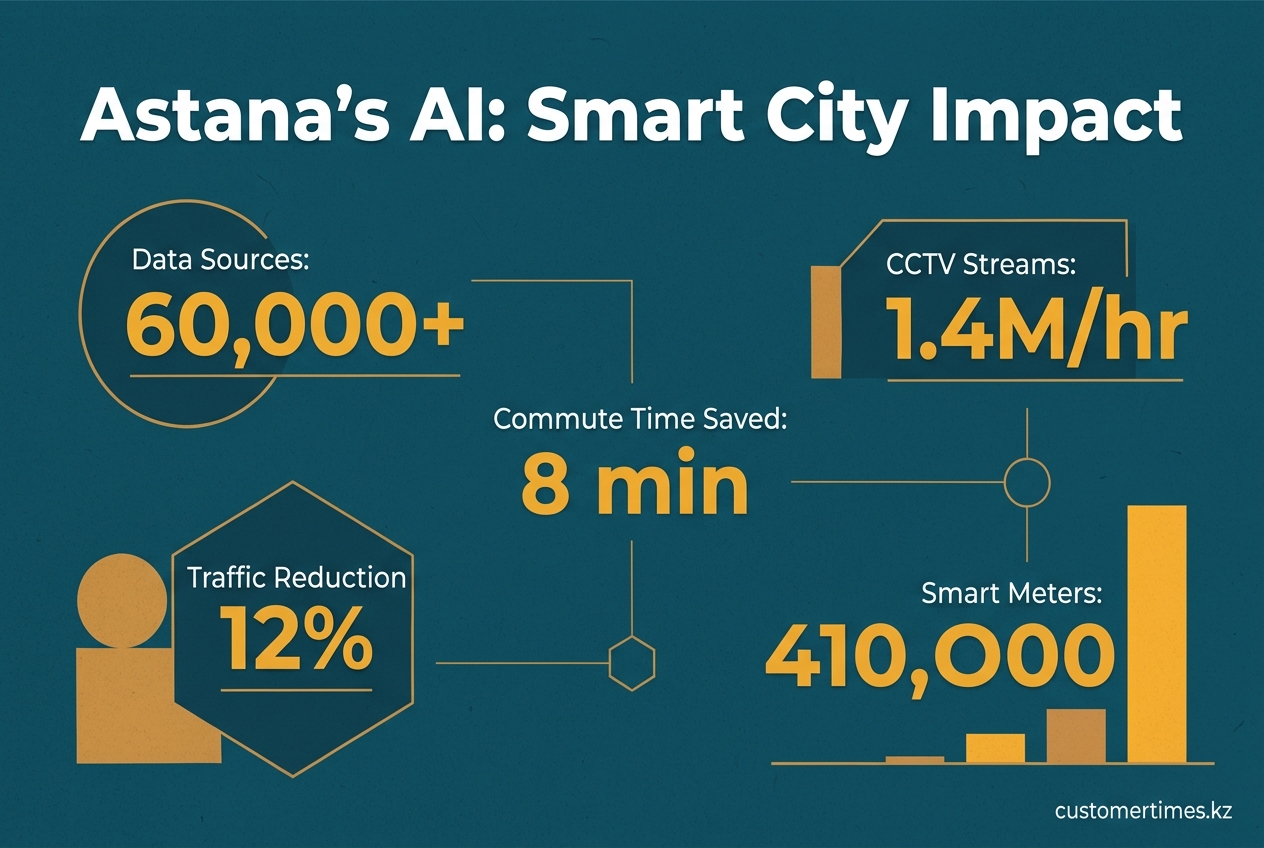
On April 24, 2026, Astana's city-wide AI nervous system was officially launched by President Kassym-Jomart Tokayev, establishing the Kazakhstan capital as a global leader in smart city innovation. This single, unified AI platform connects and controls the entire city, gathering real-time data from over 60,000 cameras and sensors. It optimizes traffic flow, enhances public safety, and promotes efficient energy consumption. Citizens benefit from a safer, more streamlined urban experience with real-time updates delivered via chatbots. The project's futuristic hub, Alem.ai, also serves as a center for technology education and startup incubation.
How does Astana's unified AI platform improve city life?
Astana's unified AI platform revolutionizes urban living by integrating vast data streams to anticipate city needs, streamline traffic, bolster public safety, and optimize utility management. Through real-time chatbot alerts, it delivers a safer, more efficient, and highly responsive environment for its citizens.
The core of the project is a unified AI platform developed by Presight. It processes live data from over 60,000 cameras, 15 government databases, and a wide array of sensors monitoring everything from traffic to air quality. All data is anonymized, encrypted, and stored locally within Kazakhstan to comply with data residency regulations.
"The platform does not simply collect data; it predicts what the city will need in the next 15-30 minutes and pushes recommendations to police dispatchers, ambulance crews, traffic engineers and utility teams," Presight CEO Thomas Pramotedham explained during the launch demo.
Within three days of going live, the system demonstrated immediate impact by rerouting 12% of morning traffic away from choke points on Turan and Kunayev avenues. According to the municipal Situation Centre, this action reduced the average commute time by 8 minutes.
Where the numbers come from
| Data source | Feeds per hour | Typical latency |
|---|---|---|
| CCTV streams (with face & plate recognition) | 1.4 million | <200 ms |
| Traffic-light controllers | 1,086 | 1 s |
| Public-transport GPS beacons | 3,200 buses & taxis | 5 s |
| Power-grid smart meters | 410,000 | 15 s |
| Environmental sensors | 92 | 30 s |
The platform improves city life by analyzing real-time data from thousands of sources to predict urban needs. It optimizes traffic flow, enhances public safety by pre-positioning services, reduces utility waste, and delivers timely alerts to citizens, creating a safer, more efficient, and responsive urban environment.
This core technology is being offered as a white-label service to other major Kazakhstani cities, including Almaty, Shymkent, and Karaganda, with a US$500-700 million budget for nationwide expansion. New cities will integrate their existing systems using MuleSoft-compatible APIs, a proven method in the region.
Eight floors of future
The project's headquarters, the Alem.ai glass cube, functions as a self-contained smart district.
- Floors 1-2 (Public): Feature an AI museum, a children's robotics zone, and a café with a robotic barista.
- Floors 3-4 (Education): Host the TUMO Centre for Creative Technologies, where teenagers train computer-vision models using the city's GPU cluster.
- Floors 5-8 (Innovation): House startups, Presight engineers, and the Digital Ministry's rapid-response team.
A key national goal is to train one million citizens in AI fundamentals by 2030. This includes training 5,000 data analysts and prompt engineers annually to maintain and enhance the smart city platform.
Early wins that officials talk about
Initial results demonstrate the platform's immediate, measurable impact:
- Improved Safety: Astana climbed 24 places to 81st on Numbeo's 2026 safest-cities index, an improvement attributed to AI algorithms that proactively position police patrols.
- Reduced Utility Theft: Real-time anomaly detection from smart meters led to a 7% drop in electricity theft.
- Faster Commutes: Adaptive traffic lights using reinforcement learning increased peak-hour traffic speeds on Yesil River bridges from 18 km/h to 26 km/h.
"We do not chase sci-fi; every model must show a hard kpi in 90 days or it is switched off," deputy akim Asset Shomanov told municipal staff during the first weekly dashboard review.
What happens next
The platform's evolution is ongoing, with several key expansions planned. Before winter, 2,000 heating-pipe sensors will be installed to feed temperature and pressure data into the system. AI models will then identify opportunities to safely lower boiler temperatures by 1-2°C, potentially saving enough gas to heat 18,000 additional apartments.
A city-wide Internet of Things (IoT) network is also expanding. Low-power IoT gateways, deployed by France's Actility and local partner ASTEL, will allow devices like smart bins, parking barriers, and park sprinklers to join the network.
For the commercial sector, the city will provide access to anonymized data lakes covering traffic, footfall, and air quality. This will enable businesses to create their own micro-services, with Astana aiming to replicate the 29% revenue increases and 36% marketing efficiency gains seen in similar regional projects.
Citizens experience these upgrades seamlessly without new apps. All notifications, from bus arrival times to air quality warnings, are integrated into the existing eGov and ONAI chatbots, making the city feel more responsive and intuitive.