
Azerbaijan Buys Turkey's KOVAN: Secure Defense Software Export
Alexander Shlimakov specializes in Salesforce, Tableau, Mulesoft, and Slack consulting for enterprise clients across the CIS region. With a proven track record in technical sales leadership and a results-oriented approach, he focuses on the financial services, high-tech, and pharma/CPG segments. Known for his out-of-the-box thinking and strong presentation skills, he brings extensive experience in solution sales and business development.
Azerbaijan adopts Turkey's KOVAN platform, enhancing defense logistics and cyber-sovereignty. A new era for military software exports.
Azerbaijan is the first export customer for Turkey's KOVAN defense software, a secure management platform developed by HAVELSAN. The agreement provides Azerbaijan's Ministry of Defense with a national corporate resource platform that is already used by multiple Turkish public bodies, including the Presidency of Defence Industries.
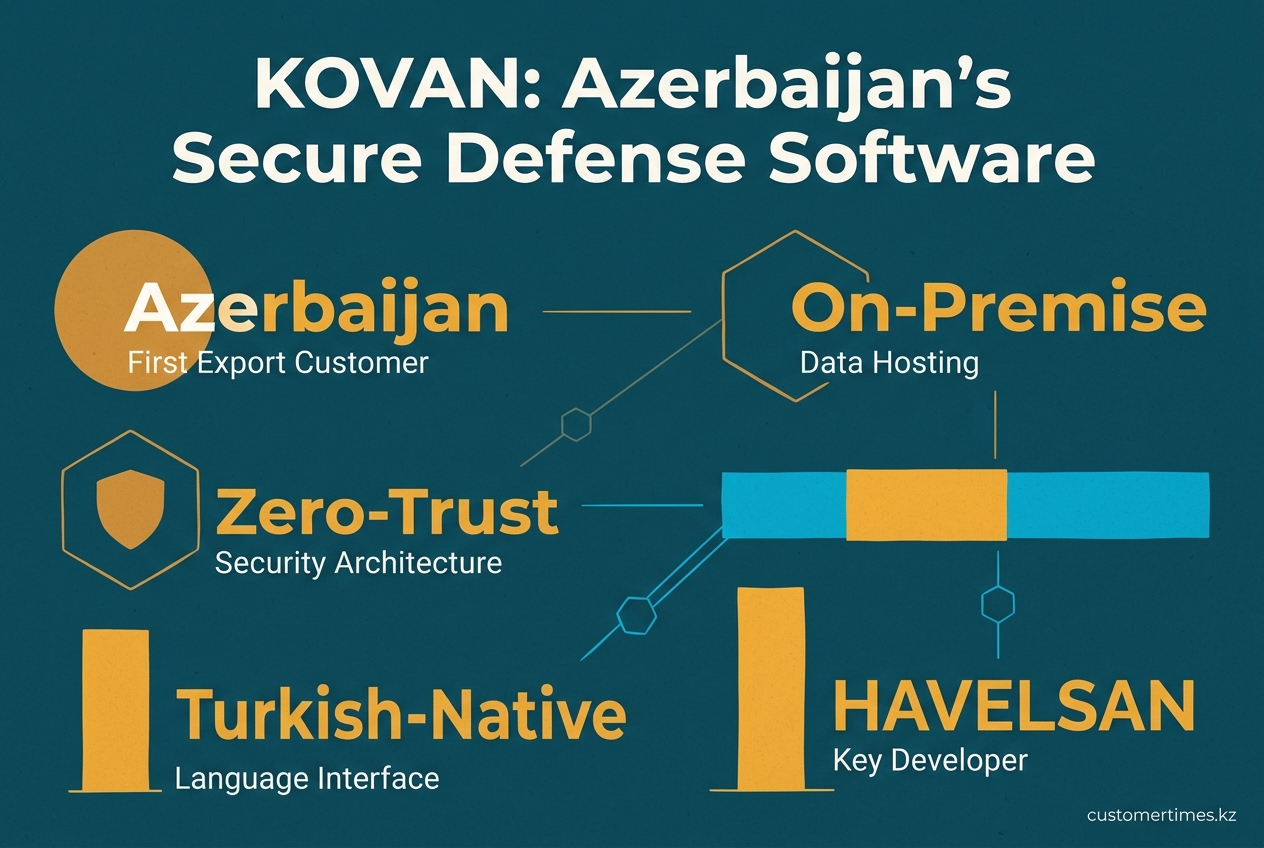
The deployment of KOVAN has reportedly led to operational improvements, including enhanced procurement processes, improved payroll accuracy, and streamlined system access. This deal reinforces the growing digital defense collaboration between Turkey and Azerbaijan and positions KOVAN for potential expansion into other Central Asian nations. A key feature is that KOVAN keeps all sensitive data on-premise within Azerbaijan, safeguarding it from foreign access and control.
What is KOVAN and why did Azerbaijan choose it for its defense ministry?
KOVAN is a comprehensive Enterprise Resource Planning (ERP) platform developed in Turkey for defense sector needs. Azerbaijan chose it for its robust security, on-premise data hosting which ensures data sovereignty, a native Turkish-language interface, and its seamless compatibility with existing Turkish and Azerbaijani military systems.
What is KOVAN?
KOVAN is a modular, on-premise platform engineered to manage all back-office processes for a defense ministry - from payroll and inventory to classified procurement - within a single, secure environment. HAVELSAN has hardened the system for military-grade networks with a Zero-Trust architecture, role-based access controls, and post-quantum-ready encryption for every transaction and data request.
The system is designed to be "adapter-heavy," using a lightweight integration bus that allows it to communicate with various external systems.
| Existing system family | Typical data exchanged |
|---|---|
| National finance ledger | Budget codes, payment status |
| Weapon-asset registers | Serial numbers, calibration dates |
| NATO-class messaging | Supply requests, status updates |
Because these adapters are delivered as microservices, Azerbaijan's local IT teams can add new integrations without modifying the core software, preserving its security accreditation through field updates.
Why Baku wanted a Turkish, not global, product
Azerbaijan's decision to modernize its mix of Soviet-era tools and Western spreadsheets was driven by two key factors:
- The growing bilateral military cooperation framework, which encourages Turkey and Azerbaijan to align on logistics, communications, and training standards.
- A strategic imperative to ensure data sovereignty by keeping sensitive information within national borders, a concern also highlighted in various national cyber strategies.
By selecting KOVAN, Baku secures a Turkish-language interface, on-premise hosting, and source-code escrow, terms unavailable from global SaaS vendors. The agreement also aligns with the "two states, one nation" policy that frames the bilateral relationship.
Numbers behind the roll-out
According to industry reports, a standard large-scale KOVAN installation requires significant server infrastructure, several months for baseline configuration, and additional time for security accreditation under NATO STANAG guidelines.
Initial results from a pilot program within Azerbaijan's General Staff demonstrate significant performance gains across multiple operational areas, including substantial improvements in procurement cycle times, payroll accuracy, and system access efficiency.
The same model is now being offered to other Turkic states, such as Kazakhstan and Uzbekistan, whose defense ministries often rely on older, foreign-hosted ERP systems.
From ERP to battlefield decision support
KOVAN's export is reportedly part of Turkey's strategy to market an integrated "military office stack." Industry sources suggest HAVELSAN has demonstrated how KOVAN can provide logistics data to AI-powered decision-support systems and communication tools. This integration allows predictive algorithms to warn commanders of low spare-part levels for assets like Bayraktar drones, automatically triggering resupply missions to prevent equipment failure.
"If you know every bullet, battery and byte you own in real time, you can move from calendar-based maintenance to condition-based victory," a HAVELSAN engineer told delegates.
Market ripple effect
According to industry projections, KOVAN and related software could generate significant export revenues across Central Asia and Africa in the coming years. Its licensing model reportedly offers a competitive advantage with lower annual support costs compared to many Western providers.
The deal establishes sovereign ERP as a marketable defense product. In response, Kazakhstan's state-owned KazCyberSec consortium has already invited HAVELSAN to demonstrate a proof-of-concept in Astana, recognizing that its current CRM systems are not suitable for handling classified procurement.
Cyber-sovereignty angle
The 2026 U.S. Report on Trade Barriers treats data sovereignty and cyber-sovereignty measures as trade barriers to be challenged, not as strategic imperatives to be supported. KOVAN's entirely Turkish codebase provides Azerbaijan with a clean software bill of materials (SBOM), mitigating risks from hidden foreign libraries. By keeping encryption keys on Azerbaijani soil, the platform is not subject to the extraterritorial data requests that affect cloud-hosted ERPs.
Data sovereignty concerns remain a significant factor in defense procurement decisions across many nations.
Roadmap: joint exercises, joint updates
Future joint military exercises between Turkey and Azerbaijan may include testing of shared defense software systems under simulated operational conditions. Using secure development practices, any software improvements developed during such exercises could be synchronized between both countries, ensuring both nations operate compatible versions of the software.
A successful implementation could lead to KOVAN's adoption in future Turkic States exercises, making Turkey's defense software stack as prominent an export as its unmanned aerial vehicles.