
EHR Market Hits $57.9B by 2033: Web-Based, AI Lead Growth

Alexander Bazilevich is a CRM expert and Top Salesforce Partner with over 17 years of sales experience in the IT industry. He specializes in transforming corporate goals into profits through cross-functional collaboration and innovative business solutions, with deep expertise in business systems and IT products.

EHR market to hit $57.9B by 2033, driven by web-based systems, AI integration, and North American dominance. Growth at 6.7% CAGR.
The global Electronic Health Records (EHR) market is projected to reach US$ 57.9 billion by 2033, expanding from US$ 36.8 billion in 2026 at a 6.7% compound annual growth rate (CAGR). This growth is primarily fueled by the dominance of web-based systems, widespread AI integration, and sustained demand from North America, with Europe and Asia rapidly advancing. While challenges like cybersecurity and complex regulations persist, the drive to reduce clinician burnout and improve efficiency ensures the EHR market's continued expansion and innovation.
What is the growth outlook for the global Electronic Health Records (EHR) market?
The global EHR market is forecast to experience robust growth, with its value increasing by over US$ 21 billion between 2026 and 2033. This expansion is supported by a steady 6.7% compound annual growth rate, driven by technological advancements and increasing adoption in healthcare systems worldwide.
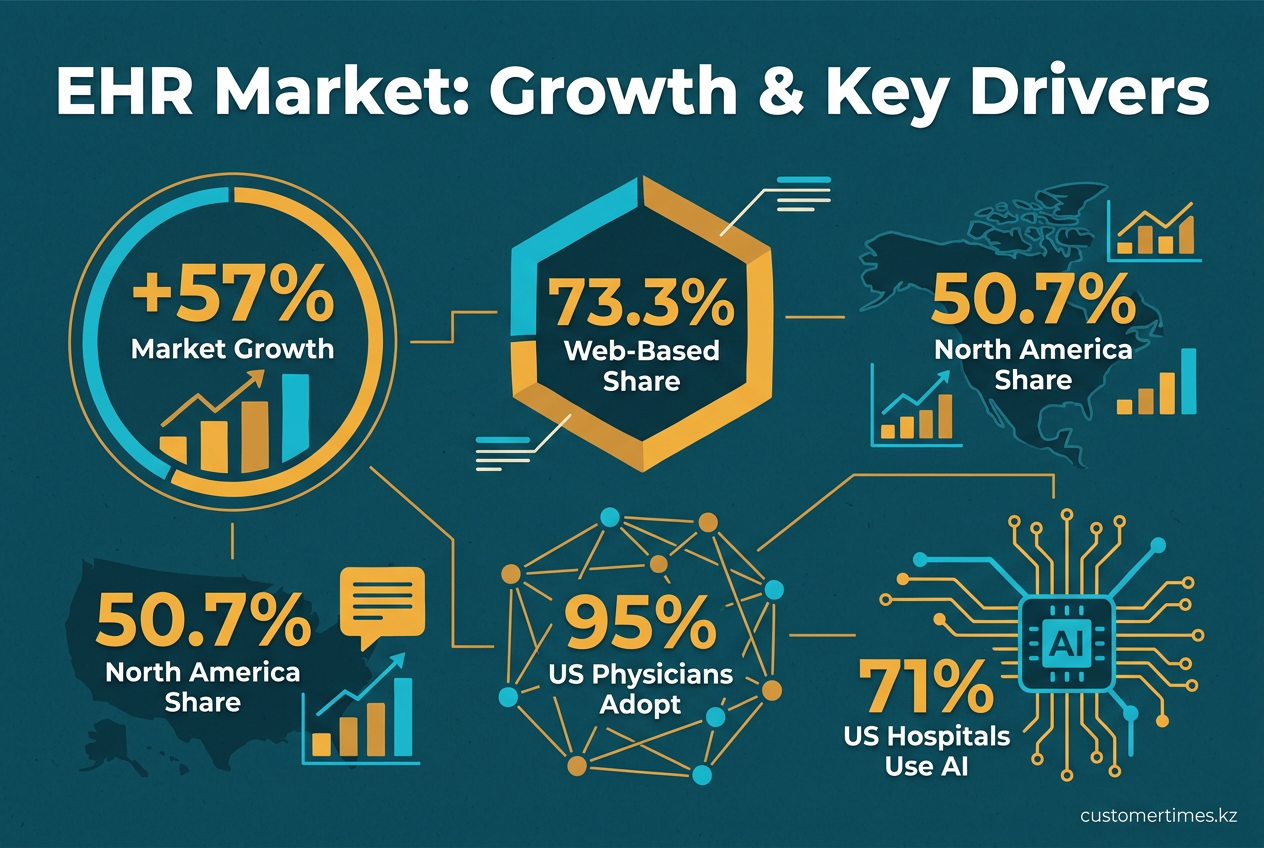
Web-based EHR systems are now the industry standard. By 2025, this segment secured 73.3% of new contracts, a market share expected to remain above two-thirds through 2033.
| Metric | 2026 | 2033 | CAGR |
|---|---|---|---|
| Market size (mid-point) | US$ 36.8 bn | US$ 57.9 bn | 6.7 % |
| Web-based share | 56-73 % | steady | - |
| North America share | 44-51 % | 43-48 % | - |
Regional scoreboard
- North America: With 50.7% of global revenue, North America leads due to early federal incentives, near-universal adoption (95% of office-based physicians), and the market dominance of Epic and Oracle Cerner.
- Europe: Accounting for 22-24% of the market, Europe's growth is accelerated by a European Commission mandate to digitize all medical records by 2026 and a new, interoperable EHR exchange format.
- Asia Pacific: This is the fastest-expanding region. India's growth rate is projected to exceed China's as its internet penetration surpasses 70% and governments implement national e-health roadmaps.
- Other Regions: Latin America and the Middle East & Africa are smaller markets but show double-digit annual growth as cloud hosting becomes more affordable and governments link subsidies to digital reporting.
Technology engines
Artificial intelligence has shifted from pilot programs to a core, "agentic" layer within the EHR workflow. In mid-2025, Epic launched an AI-powered ambient scribe with Microsoft to auto-generate clinical notes, while Oracle Health introduced a cloud stack for real-time predictive modeling. Consequently, 71% of U.S. hospitals now use at least one native AI tool within their EHR, and physician adoption of health AI soared from 38% in 2023 to 66% in 2025. This trend is reflected in spending, as healthcare AI investments hit US$ 1.4 billion in 2025, with automation for prior authorizations growing tenfold.
Competitive heat map
- Epic Systems - Owns 40% U.S. hospital share and is expanding its AI co-pilots and scheduling agents.
- Oracle Cerner - Pursuing a cloud-first interoperability strategy, focusing on federal VA modernization contracts.
- athenahealth - Launched its Intelligent Interoperability engine and 24/7 AI patient engagement bots.
- GE Healthcare & Philips - Focus on imaging-centric AI that writes structured findings into the EHR, cutting radiologist keystrokes by 40%.
- Regional pack - Vendors like CompuGroup, ModMed, Netsmart, and DrChrono target small-to-mid-sized practices with SaaS bundles.
Market drivers at a glance
- Regulatory Push: Government mandates, such as Medicare quality adjustments in the U.S. and EU privacy regulations, compel providers to upgrade legacy systems.
- Clinician Burnout: AI-driven tools like ambient documentation are proven to reduce after-hours charting by an average of two hours per week.
- Revenue Cycle Optimization: Real-time coding validation tools integrated into EHRs help recover 2-4% of revenue previously lost to claim denials.
- Cybersecurity Savings: Hospitals with certified cloud EHRs can secure 10-15% lower cybersecurity insurance premiums.
Deployment models in 2026
| Model | Share | Typical buyer | Key benefit |
|---|---|---|---|
| Multi-tenant cloud | 58% | Independent practices | Zero-maintenance |
| Private hosted cloud | 22% | Mid-size health systems | Custom rules engine |
| On-premise legacy | 20% | Large academic centres | Full data custody |
Interoperability has evolved from a feature into an operational necessity. A 2026 framework from Black Book warns that providers unable to exchange data seamlessly face penalties that could reduce fee-for-service revenue by up to 7% under new federal data-blocking rules.
AI outlook
The global healthcare AI market is set to explode from US$ 36.7 billion in 2025 to US$ 505.6 billion by 2033, a staggering 38.9% CAGR. This growth directly boosts EHR sales, as most buyers bundle analytics modules with their core contracts. Early adopters of integrated AI report significant benefits:
- 31% faster clinical decision-making
- 29% higher revenue from AI-optimized scheduling
- 27% fewer IT support tickets due to agentic self-service portals
Challenges still on the table
- Governance Gaps: 57% of hospital executives admit they are "not very familiar" with AI governance, creating significant audit and compliance risks.
- Vendor Lock-In: Concerns are growing as proprietary AI models are built on top of patient data, making it difficult to switch EHR providers.
- Cybersecurity Threats: Attacks against healthcare organizations doubled in 2025. Ransomware can disable cloud-based EHRs for days without robust offline backups.
Despite these hurdles, executive demand for AI remains strong. With two-thirds of leaders aged 18-34 viewing predictive analytics as the top solution for clinician burnout, EHR budgets will continue to allocate double-digit percentages to AI advancements.