
Thermo Fisher, NVIDIA Partner for AI-Driven Labs
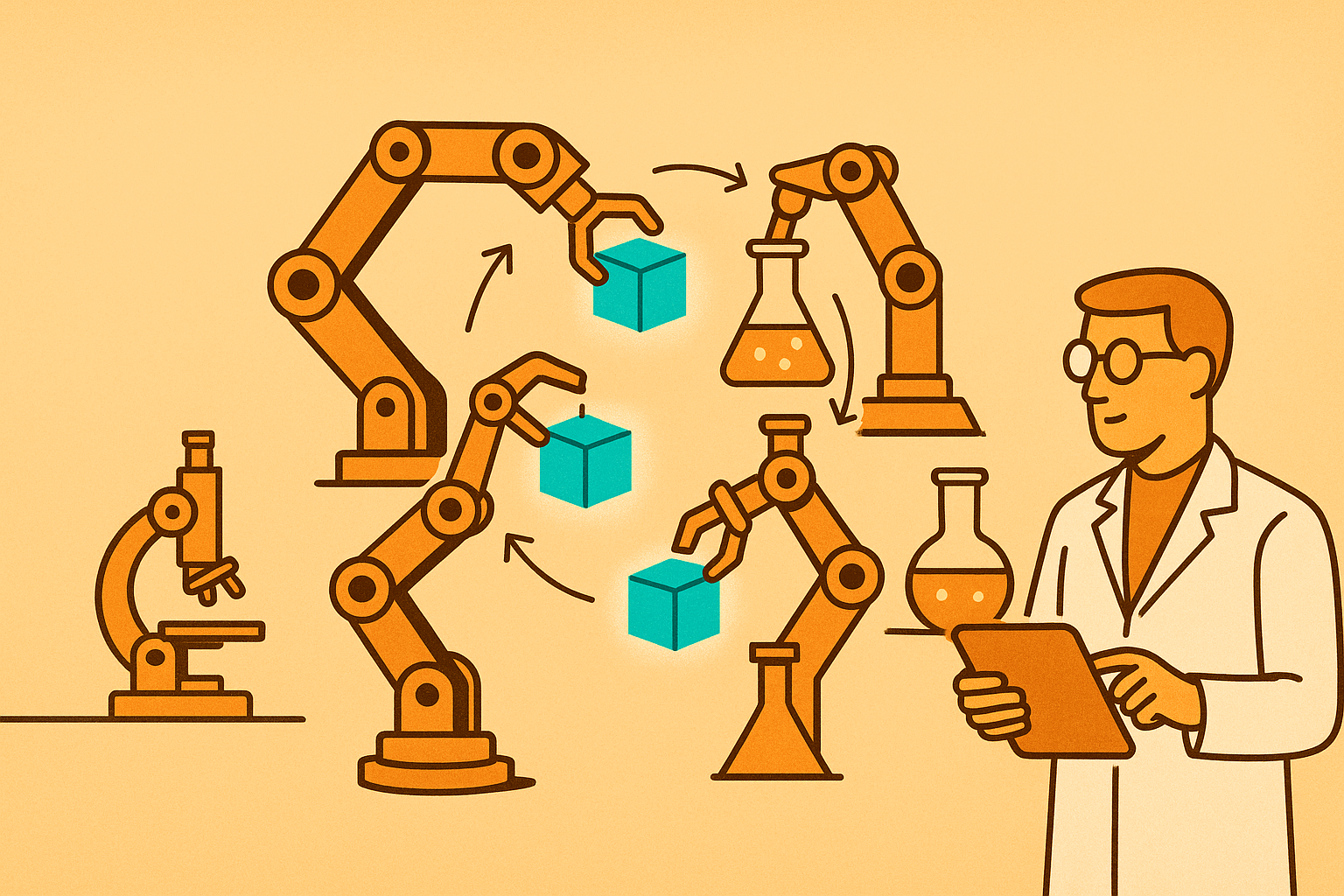
Thermo Fisher & NVIDIA partner to create self-driving labs using AI. Boosts drug discovery, reduces errors, and speeds up research.
Thermo Fisher, NVIDIA Partner for AI-Driven Labs
Thermo Fisher and NVIDIA Partner to Launch AI-Powered Self-Driving Labs
Announced at the J.P. Morgan Healthcare Conference, the news that Thermo Fisher, NVIDIA partner for AI-driven labs marks a new era in scientific research. This collaboration embeds NVIDIA's complete AI stack - from DGX Spark supercomputers to BioNeMo models - directly into Thermo Fisher's world-class scientific instruments. The result is a network of self-driving labs where AI agents autonomously design, execute, and optimize experiments 24/7, dramatically accelerating the pace of drug discovery.
What is the Thermo Fisher and NVIDIA partnership announced in 2026 and how does it impact drug discovery labs?
The 2026 partnership between Thermo Fisher Scientific and NVIDIA revolutionizes drug discovery by integrating NVIDIA's end-to-end AI platform into Thermo Fisher's laboratory instruments. This creates fully autonomous, "closed-loop" lab ecosystems where AI agents manage the entire experimental workflow - from protocol design to execution and optimization - leading to significant gains in throughput and a sharp reduction in experimental errors.
"We are entering the era of 'lab-in-the-loop' science where the trinity of AI, agents and instruments will be able to scale scientific discovery at an industrial pace."
Kimberly Powell, VP Healthcare, NVIDIA
What "closed-loop" really means in 2026
This strategic partnership integrates NVIDIA's artificial intelligence technologies directly into Thermo Fisher Scientific's laboratory instruments. The goal is to create automated, self-driving labs that use AI to design, run, and optimize experiments, thereby increasing the speed and reducing the cost of drug discovery and scientific research.
While classic lab automation moves liquids, this new closed-loop automation moves knowledge. Inside an Attune CytPix flow cytometer, sensors stream data to an onboard DGX Spark, where a NeMo vision agent analyzes every cell in real time. If the agent detects drift - such as a clogged nozzle or reagent shift - it automatically pauses the run, recalibrates the system, and restarts without human intervention. Early-access sites report 91% fewer deviations and a three-fold increase in daily sample throughput.
| Bottleneck addressed | Manual legacy step | AI-mediated step | 2026 delta |
|---|---|---|---|
| Sample prep | Tech dilutes by hand | Robot guided by AI gravimetric verification | 6→0 operator touches |
| Instrument QC | End-of-run audit | Real-time anomaly score | 24 h→30 s feedback |
| Data interpretation | Scientist exports FCS file | BioNeMo annotates populations in situ | 2 days→5 min |
| Next-experiment design | PI reads paper, plans variant | Nemotron suggests 50 conditions overnight | 1 week→1 night |
Pharma R&D feels the change first
Pharmaceutical R&D groups are the primary beneficiaries and earliest adopters of this technology. For a typical lead-optimization campaign that can cost over $5 million, the integrated AI agents can proactively predict molecule affinity, solubility, and off-target liabilities. This predictive power prunes discovery lists down to the most viable candidates. Pilot programs at L'Oréal's biological testing unit and STADA's CNS group have already demonstrated that AI-driven cytometry can replace 40% of their in-vivo toxicology studies without compromising predictive accuracy.
Hardware is only half the story
The partnership's success relies on more than just hardware. NVIDIA's open-source Clara and Cosmos models enable the creation of "digital twins" - hyper-realistic virtual replicas of lab instruments. Within NVIDIA's Omniverse simulation platform, AI robots can train for millions of cycles on complex tasks like swapping plates or rerouting tubing without risking damage to physical equipment. Multiply Labs leveraged this exact toolchain to slash cell-therapy manufacturing costs by 70% while achieving a 100-fold throughput increase. Thermo Fisher now includes a digital twin with every new instrument, allowing the AI to master repairs virtually before a technician is ever needed.
"Artificial intelligence coupled with laboratory automation will transform how scientific work is performed... ultimately accelerating discoveries that can have significant human impact."
Gianluca Pettiti, EVP, Thermo Fisher Scientific
Integration roadmap for 2026-2027
- Q1 2026 - Attune CytPix with embedded DGX Spark available for EA partners
- Q2 2026 - BioNeMo APIs opened to third-party LIMS vendors (first hooks into TetraScience and Scitara)
- Q3 2026 - Orbitrap mass specs gain real-time AI de-replication for natural-product screening
- Q1 2027 - Full "cloud-to-edge" stack commercial; pay-per-use AI agent licensing kicks in
Challenges that still bite
Effective data harmonization is the most significant challenge to implementation. With a single instrument run generating over 50 GB of data, unstructured metadata makes it impossible for the AI to correlate cause and effect. To overcome this, Thermo Fisher requires every site to pass a 21-point metadata audit before activating the AI. The company supports this by shipping each instrument with a pre-configured "data lake bundle" (including an S3-compatible store and Kafka pipelines). While the audit may take up to six weeks, passing it reduces downstream analysis errors to below 0.3%.
The financial case is surprisingly straightforward. A top-20 pharmaceutical company reported that each 1% drop in late-stage drug attrition saves $100 million in net present value. Their pilot of the Thermo Fisher-NVIDIA system projected a 4% attrition reduction due to earlier, AI-powered safety assessments, resulting in an average payback period of just 7.3 months.
What happens next
The roadmap extends to "scientist-in-the-loop" workstations, where researchers can use VR and haptic gloves to interact directly with AI-managed experiments in real time. In parallel, NVIDIA's academic outreach program is distributing 650 open models and 250 curated datasets to universities, ensuring the next generation of scientists is trained on intelligent instruments that self-optimize and accelerate discovery.