
Pharma's $2B+ AI Infrastructure Boom: 5,700+ GPUs Deployed

Alexander Bazilevich is a CRM expert and Top Salesforce Partner with over 17 years of sales experience in the IT industry. He specializes in transforming corporate goals into profits through cross-functional collaboration and innovative business solutions, with deep expertise in business systems and IT products.
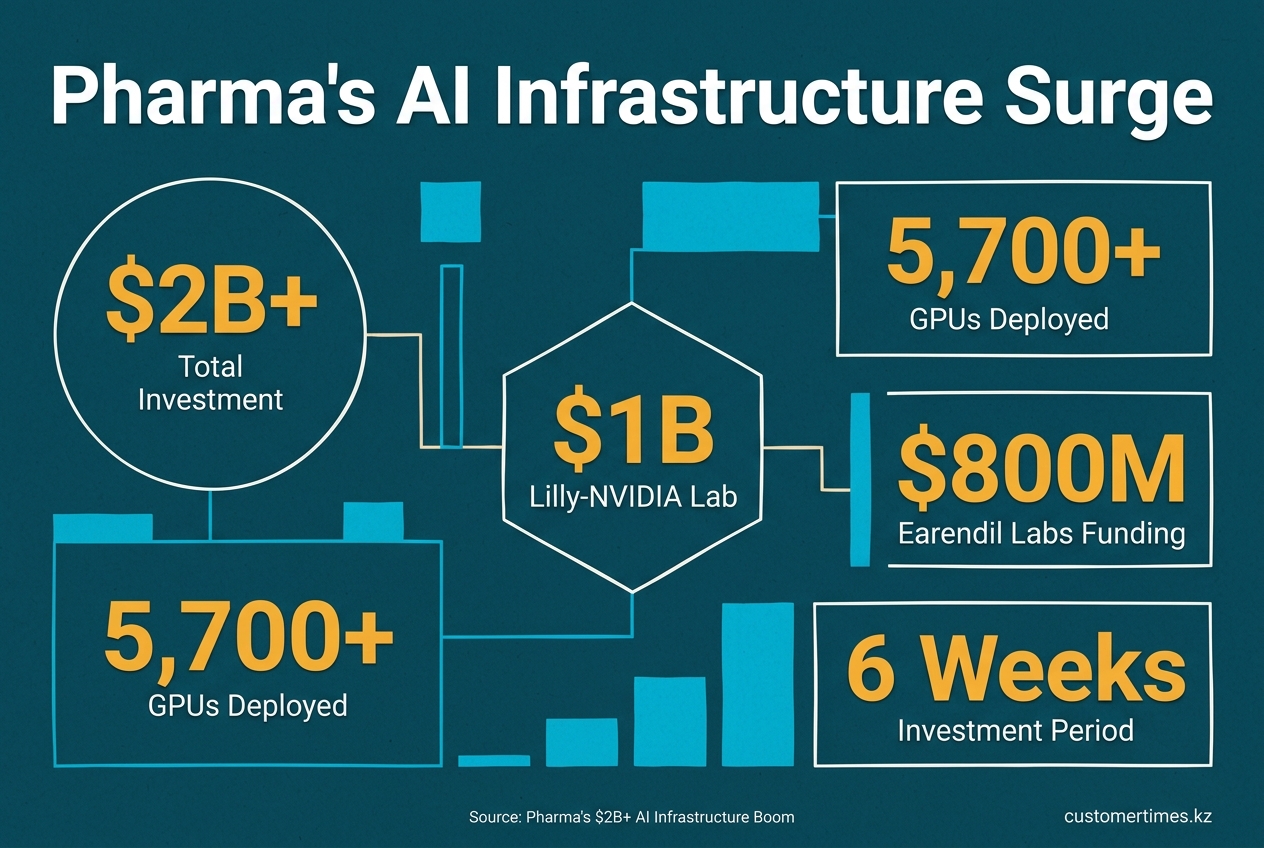
Pharma's AI infrastructure surged in early 2026 with $2B+ in capital and 5,700+ GPUs. Lilly, Roche, and Sanofi lead the AI factory boom.
The pharmaceutical industry's commitment to artificial intelligence solidified in early 2026, as major drugmakers invested over $2 billion to acquire more than 5,700 top-tier GPUs. This spending spree is rapidly transforming the concept of an "AI factory" from a buzzword into a reality, with companies like Lilly, Roche, and Sanofi leading the charge to accelerate drug discovery and make AI a must-have tool in medicine.
What are the latest major developments in AI infrastructure for the pharmaceutical industry in 2026?
The opening months of 2026 saw Pharma's $2B+ AI infrastructure boom: 5,700+ GPUs were deployed and over $2 billion was committed in just six weeks. This investment surge, led by major deals from Lilly, Roche, and a Sanofi-backed startup, is building powerful AI factories to fundamentally accelerate drug discovery and development.
1. Lilly + NVIDIA - the billion-dollar co-lab
Major developments are centered on building 'AI factories.' Lilly and NVIDIA launched a $1 billion co-innovation lab, Roche created the industry's largest on-premise GPU farm, and AI-native biotech Earendil Labs raised nearly $800 million with backing from Sanofi to advance its antibody design platform.
On January 12, 2026, Eli Lilly and NVIDIA launched the largest joint AI facility in biopharma history. The South San Francisco-based co-innovation lab is funded by a $1 billion, five-year budget, split equally between the partners. This investment secures elite talent, advanced silicon, and a continuous data feedback loop that connects wet-lab robotics directly to an NVIDIA DGX SuperPOD, which Lilly insiders call "the biopharma industry's most powerful AI factory".
- Technology Stack:
- Compute core: DGX B300 systems, future Vera Rubin architecture, and BioNeMo model hub
- Software twin: Omniverse replicas of every reactor, filler, and QC room so process changes can be stress-tested in VR before touching steel
- Edge AI: RTX PRO servers inside the pilot plant stream real-time yield predictions to operators' tablets
"Every extra day in development costs patients and shareholders. The lab's mandate is to compress those days into minutes."
- joint briefing at JPM 2026, quoted in NVIDIA blog
The lab's work spans the entire value chain, using generative chemistry to design new molecules, protein-folding simulations to rank candidates, and reinforcement learning to optimize manufacturing processes in real time. The partnership expects to announce its first key milestone in Q3 2026, when an AI-designed molecule for metabolic disease is slated to enter toxicology studies.
2. Roche - the biggest on-prem GPU farm in pharma
Six weeks later, Roche expanded its AI capabilities by adding 2,176 NVIDIA Blackwell GPUs to its existing infrastructure. Revealed at NVIDIA GTC 2026, this brings its total to over 3,500 GPUs across its global sites in Basel, Mannheim, and South San Francisco. This move gives Roche the largest publicly disclosed hybrid-cloud AI footprint in the pharmaceutical sector.
- Primary Use Cases:
| Domain | GPU use-case | Expected saving |
|---|---|---|
| gRED research | In-silico affinity maturation, 250 k antibodies screened overnight | 6-8 weeks per lead |
| Pharma technical development | Omniverse digital twin of new GLP-1 plant in North Carolina | 15% capital deferral, 10% energy cut |
| Diagnostics | Pathology slide embedding with 50 B-parameter vision model | 30% reduction in second reads |
Roche designates the system as an "AI factory" for its structured, 24/7 workflow: daytime hours are for hypothesis generation, nights are for large-scale simulations, and weekends are dedicated to retraining models with new experimental data. Aviv Regev, head of Genentech Research, told analysts the ambitious goal is to achieve "one new IND every three weeks by 2028," effectively doubling its 2024 output.
3. Earendil Labs - the platform play backed by Sanofi
While industry giants invest in hardware, AI-native biotechs are monetizing their platforms. On March 20, 2026, Earendil Labs, based in Beijing and incorporated in Delaware, closed a $787 million private placement. The round, co-led by Dimension Capital and Sanofi, pushed its total capital raised in the past year to over $1 billion.
Sanofi has deepened its relationship with Earendil through two significant deals:
| Deal | Up-front | Bio-dollar ceiling | First assets |
|---|---|---|---|
| Apr 2025 | $125 M | $1.72 B | HXN-1002/1003 bispecifics for IBD |
| Jan 2026 | $160 M | $2.56 B | Additional autoimmune targets |
With a combined potential of $4.28 billion in milestone payments, Earendil is now Sanofi's largest external AI partner, complementing its own in-house AI-factory programme.
Earendil's competitive advantage is its speed. The company's large-language antibody design platform can advance a drug candidate from target sequence to an IND-ready package in just 18 months - about half the industry average. This claim is supported by a Phase 2 anti-TL1A antibody, which is on track to begin patient dosing in Q4 2026.
4. The wider assembly line - GSK, Mitsui, and regional clouds
These high-profile investments from Lilly, Roche, and Earendil signal a broader industry-wide shift.
- GSK has doubled its GPU footprint in Stevenage and is hiring 200 AI engineers to implement its "biology-foundry" workflow in vaccines and oncology.
- Japan's Mitsui is launching a 2,000-GPU sovereign cluster with select partners, catering to Asian pharma clients concerned with data residency.
- Pfizer, Novartis, and AstraZeneca have each publicly allocated over $500 million for new AI infrastructure spending in 2026-2027.
Market forecasts predict the global pharma AI compute market will exceed $7 billion by 2028, a significant increase from $2.3 billion in 2024. The primary driver is GPU demand, with a mid-sized pharma company now requiring approximately 500 A100-equivalent GPUs to stay current with leading AI models - double the need from 2023.
"Silicon is the new pipette. If you do not control your own AI factory, you rent time on someone else's discovery engine."
- investor note, Citeline Scrip, March 2026
5. What happens next
This rapid technological adoption is attracting regulatory attention. In February 2026, the FDA's Emerging Technology Program introduced an AI-manufacturing track to provide early guidance on process changes validated by digital twins. Similarly, the EMA is now piloting a "continuous learning" dossier, which allows AI-generated stability data to supplement traditional records, provided a clear GPU audit trail is maintained.
With massive hardware investments made and operational costs rising, the industry is now under pressure to demonstrate a clear return: shorter drug development timelines, lower clinical trial attrition rates, and measurable patient impact. The first test will come soon, with efficacy read-outs from AI-designed drug candidates anticipated before the end of 2026.