
Salesforce RevOps: 8 Steps for a 2026-Ready Architecture

Alexander Bazilevich is a CRM expert and Top Salesforce Partner with over 17 years of sales experience in the IT industry. He specializes in transforming corporate goals into profits through cross-functional collaboration and innovative business solutions, with deep expertise in business systems and IT products.
Transform Salesforce into a 2026-ready RevOps spine. Learn to govern revenue events for better forecasting, commissions & AI.
To build a 2026-ready Salesforce RevOps architecture, teams must stop treating Sales Cloud as just "the CRM." Many organizations still run forecasting in spreadsheets, pay commissions from manual exports, and audit deals only after the quarter closes.
For success through 2026, companies must establish Salesforce Sales Cloud as the definitive system for all sales and revenue information. This requires mapping every process, adopting built-in tools for forecasting and commissions, and enforcing rigorous data hygiene. When all deals, quotes, contracts, and renewals are tracked in one place, teams grow faster and make smarter decisions because everyone trusts the same set of numbers.
What are the key steps to build a 2026-ready RevOps architecture in Salesforce Sales Cloud?
To build a 2026-ready RevOps architecture in Salesforce Sales Cloud:
- Establish a single system of record for all revenue events.
- Map the full customer lifecycle and automate with governance.
- Use role-based forecasting inside Salesforce.
- Integrate commission and compensation processes.
- Maintain data quality and governance for AI readiness.
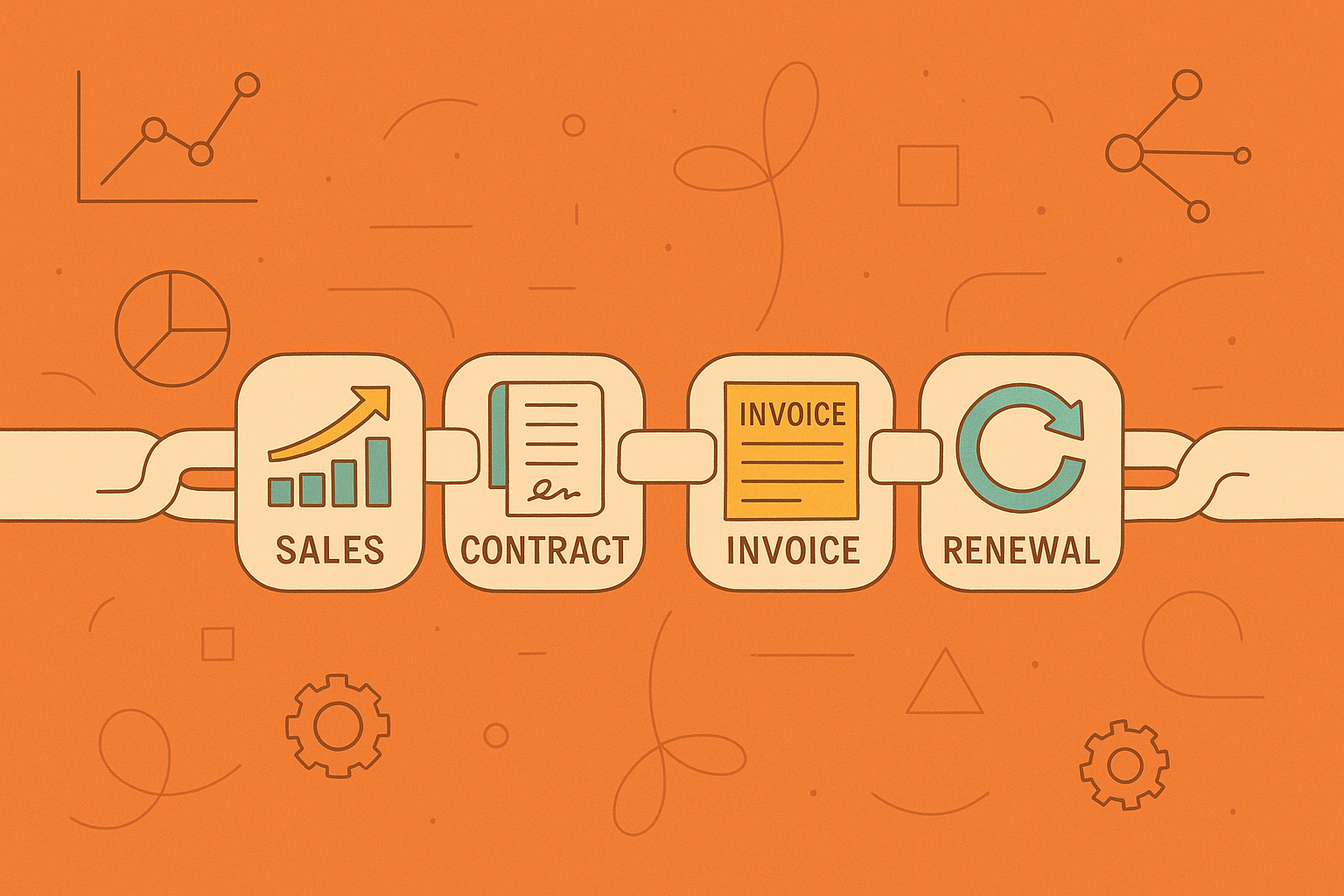
A future-proof RevOps architecture transforms your platform into an operational spine. Every revenue event - from lead to quote, contract, invoice, and renewal - is captured, governed, and settled without ever leaving the system.
1. Start with a single system of record
Building a 2026-ready RevOps architecture in Salesforce requires making it the single system of record for all revenue events. This involves mapping the entire customer lifecycle, integrating native forecasting and compensation tools, automating processes with strong governance, and ensuring high-quality data to prepare for AI.
As RevSolutions notes, leading organizations ensure that quoting, contracting, billing, renewals, and forecasting "all live in Salesforce, not across multiple tools." Start by mapping native Salesforce objects to their RevOps functions:
| Object | What it owns in RevOps |
|---|---|
| Lead | Pre-pipeline interest, source, first-touch data |
| Account/Contact | Buying centers, personas, consent |
| Opportunity | Pipeline value, stage, close date, forecast category |
| Quote/Order | Commercial terms, SKUs, discount audit trail |
| Contract | Subscription length, ramp, amendment history |
| Campaign | Attribution, cost, influence |
Use middleware like MuleSoft or a low-code hub to sync ERP billing data. This allows finance to retain control of the general ledger while RevOps maintains the source of commercial truth.
2. Design the lifecycle before you automate
Before automating, document every handoff with clear entry and exit gates and field-level SLAs. Without this discipline, AI recommendations devolve into a garbage-in, garbage-out scenario.
- Use validation rules to block stage progression until next steps, amounts, and primary contact roles are complete.
- Implement approval processes for discounts that exceed thresholds or for multi-year prepayments.
- Store the rationale for forecast adjustments in rich-text fields so that forecasts reflect manager judgment, not just rep optimism.
3. Forecast inside the hierarchy, not beside it
Salesforce's role-based forecast hierarchy empowers district managers to apply their judgment directly to rollup categories, eliminating the need for offline spreadsheets.
Best practices include:
- Mirroring the organizational chart in the role hierarchy.
- Locking the forecast category once a deal's stage is set to "Commit."
- Requiring a manager's comment for any significant adjustment.
- Using Flow to surface alerts for stale opportunities.
"Salesforce provides strong forecasting capabilities, but those capabilities only work when pipeline governance exists." - PC Tech Mag
4. Compensation must read governed data
External commission engines frequently miss amendments, co-term renewals, or clawbacks because their data is sourced from stale trigger files.
The recommended pattern is:
- Maintain opportunity, order, and renewal data as the golden source within Salesforce.
- Publish "commission events" to a compensation platform via a secure API.
- Return the payout status to Salesforce so reps can view earned vs. paid commissions on their CRM dashboard.
This approach consolidates attainment, quota, and crediting into a single visibility layer and eliminates shadow spreadsheets.
5. Data quality as managed service
RevOps teams that neglect deduplication rules often spend a significant portion of their quarter-end manually cleaning up renewal opportunities. Prioritize data integrity from the start.
Implement these controls:
- Duplicate rules based on Account Name and Billing State.
- Picklist standards mapped to a data dictionary in a knowledge base like Confluence.
- An enrichment SLA with a data provider like ZoomInfo or Cognism to maintain hierarchy.
- Change-data-capture streams that feed a data lake for downstream business intelligence.
Bad data in a single source of truth is more dangerous than siloed data because it erodes trust across the entire organization.
6. Governance is the pre-req for AI
According to industry reports, a growing number of revenue teams will use AI-supported processes. However, these models are useless when close-date hygiene is poor or stage definitions vary by rep. Strong governance is the prerequisite for reliable AI.
Start with three fundamental controls:
| Control Area | Tooling Example |
|---|---|
| Field ownership | Permission sets by object/record type |
| Lifecycle audit | Field history + Flow to post changes to Slack |
| Release process | Scratch orgs + Git for versioning flows |
Once this foundation is stable, you can safely layer intelligence from tools like Einstein Forecasting, Data Cloud segments, and next-best-action recommendations.
7. Consolidate the stack but keep domains clear
Enterprises are increasingly sunsetting point solutions in favor of Salesforce Revenue Cloud. However, clear boundaries are still essential, as finance depends on its ERP for revenue recognition and tax.
A practical separation of concerns looks like this:
- Salesforce owns: pipeline, quote, contract, order, renewal, activities
- ERP owns: invoice, payment, deferred revenue, FX, audit journal
- Compensation tool owns: quota, crediting, splits, clawback, attainment
- Middleware owns: orchestration, retries, error alerting
Treat integrations as a product with their own inventory diagrams, runbooks, monitors, and quarterly health reviews.
8. Enterprise proof points
Leading enterprises have demonstrated significant returns from this unified approach.
A Tele2 project in Central Asia unified its CRM, Tableau BI, and Slack, enabling self-service forecasting dashboards that cut the monthly close process from six days to just four hours.
FedEx achieved substantial ROI after connecting Data Cloud to reactivation campaigns within Sales Cloud.
Across all segments, aligned RevOps organizations grow faster and forecast with greater accuracy than their siloed competitors.
9. Quick-start checklist for architects
- [ ] Define opportunity stage exit criteria in a shared glossary.
- [ ] Create validation rules to enforce required fields for each stage.
- [ ] Build a role-based forecast hierarchy that matches the sales management structure.
- [ ] Enable field history tracking for Amount, CloseDate, Stage, and ForecastCategory.
- [ ] Route commission events to a compensation platform nightly and log the status back to Salesforce.
- [ ] Document a system RACI: who owns each field, object, lifecycle, and KPI.
- [ ] Configure Slack or Teams alerts for all integration failures.
- [ ] Schedule a quarterly data stewardship review with sales operations and finance.
"The real job of RevOps is to convert go-to-market intent into executable motion - definitions, rules, ownership, data, incentives, tools and cadence working together." - Antoine Buteau
Build the architecture once and govern it relentlessly. A well-governed Salesforce instance can scale from a ten-person startup to a multi-region, multi-product enterprise without rebuilding its revenue backbone.