
Kazakhstan, Kenya Launch New Asia-Africa Trade Corridor

Alexander Bazilevich is a CRM expert and Top Salesforce Partner with over 17 years of sales experience in the IT industry. He specializes in transforming corporate goals into profits through cross-functional collaboration and innovative business solutions, with deep expertise in business systems and IT products.
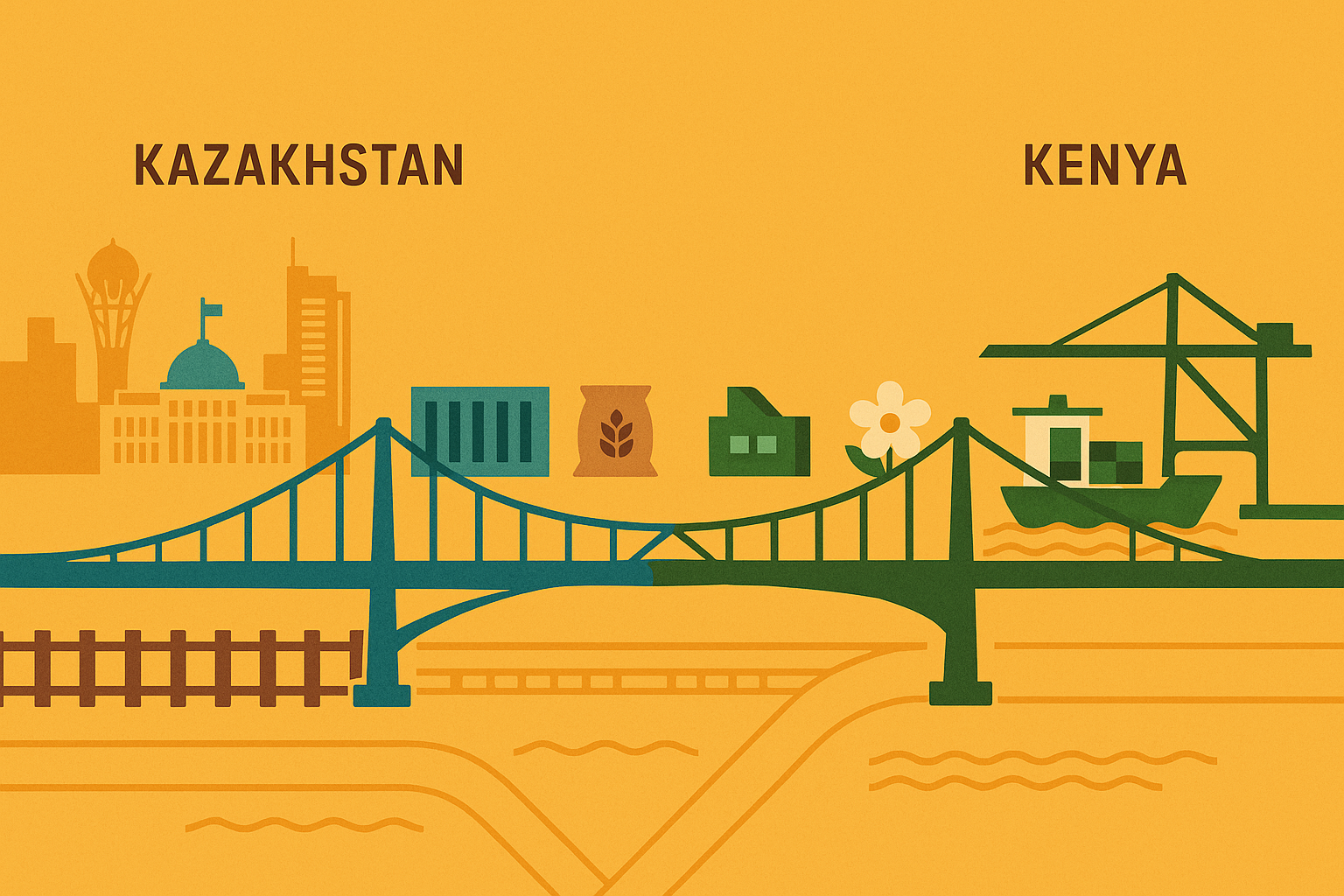
Kazakhstan and Kenya forge an economic "bridge," linking Central Asian corridors with East African ports for trade & tech.
On May 20, 2026, Kenya and Kazakhstan signed agreements on transport, ICT/e-government, mining, finance, tourism, and other areas, and discussed stronger links between their transport/logistics corridors. This "economic bridge," unveiled at the inaugural Kazakhstan-Kenya Business Forum in Astana, aims to expedite and simplify the movement of goods like grain, tea, and critical minerals. By integrating financial and digital systems, the partnership is projected to reduce costs, create employment, and help both regions grow quickly. Pilot shipments are anticipated to demonstrate the corridor's efficiency.
What is the Kazakhstan-Kenya economic corridor and how will it impact trade?
The Kazakhstan-Kenya economic corridor is a strategic trade initiative designed to connect Central Asia's Middle Corridor with Kenyan maritime ports. This integration will significantly accelerate shipping times between Asia and Africa, boost exports, reduce transport expenses, and fortify digital and financial collaboration between the regions.
"Kenya and Africa were once spoken of as markets of future promise. Today, we are the growth frontier of our time," Ruto told the delegates, framing the partnership as a gateway for Kazakh capital and technology to reach a continent that will soon account for one quarter of the world's working-age population.
In response, President Tokayev outlined several key commitments. These include establishing a dedicated Kazakh business unit for African trade, forming a joint transport and logistics expert group, and exploring cargo air routes that could integrate with future scheduled passenger flights between Astana and Nairobi.
Corridor geometry
This economic corridor establishes a direct trade link between landlocked Central Asia and the maritime hubs of East Africa. By integrating Kazakhstan's Middle Corridor with Kenya's ports, it creates a faster, alternative route for goods, bypassing traditional chokepoints and connecting Asian producers with African consumer markets.
The core of the initiative is the integration of Kazakhstan's Middle Corridor with Kenya's key ports of Mombasa and Lamu. While the Middle Corridor currently directs Chinese and Central Asian cargo toward Europe, this new southern extension provides a direct link to the East African Community (EAC) and the broader COMESA free-trade zone.
| Segment | Distance saved (vs Suez only) | Cargo type targeted |
|---|---|---|
| Almaty - Bandar Abbas - Mombasa (proposed) | Significant time savings vs Suez route | grain, flour, metals, fertiliser |
| Mombasa - Brest (Middle Corridor west leg) | Substantial reduction vs around Africa | coffee, tea, cut flowers, rare-earth ores |
This creates a two-way logistics loop. Asian goods gain faster access to African markets, while African exports like perishables and minerals can efficiently travel north via Kazakh rail networks to markets in Russia, Türkiye, and the European Union.
Finance pillar
A key financial component is a formal partnership between the Astana International Financial Centre (AIFC) and the Nairobi International Financial Centre (NIFC). A signed memorandum outlines goals for joint project financing, cross-listing of green bonds, and developing an interoperable fintech sandbox. The AIFC hosts many companies from numerous countries, while the NIFC manages significant mobile money transactions and is involved in the Pan-African Payment and Settlement System (PAPSS).
The AIFC-NIFC channel aims to significantly reduce the average cost of intra-emerging-market trade finance, according to people briefed on the talks.
Digital spine
The corridor's digital framework is a critical third pillar. An MoU between Kenya's ICT ministry and Kazakhstan's Digital Development Agency focuses on collaboration in e-government, GovTech, and cybersecurity. Kenya has digitized a significant portion of its public services and reported substantial digital service exports, while Kazakhstan's growing e-commerce market is poised to benefit from Kenya's expertise in mobile money systems to enhance its own financial inclusion.
Practical pilots on the table:
- A "single trade window" enabling exporters to file customs and phytosanitary documents once for clearance at both ends of the corridor.
- A central bank digital currency (CBDC) corridor for direct shilling-tenge settlements, bypassing the dollar for SME transactions.
- Jointly developed IoT sensors for real-time monitoring of temperature-sensitive cargo like grain, tea, and pharmaceuticals.
Sector heat-map
Beyond logistics, the partnership establishes sector-specific working groups with ambitious targets:
| Sector | Targets | Kazakh offer | Kenyan offer |
|---|---|---|---|
| Grains & oil-seeds | Significant exports to Africa | duty-free wheat, sunflower oil | warehouse hubs at Lamu |
| Fertiliser | Reduce EA farm-input costs | phosphate, potash blends | blending plants in Eldoret |
| Critical minerals | Substantial two-way trade | rare-earth oxides | titanium, niobium, cobalt |
| ICT & BPO | Major outsourced jobs | Russian-speaking talent pool | Swahili/English delivery centres |
| Health-tech | Widespread screening | tele-radiology platform | last-mile community health |
Institutional glue
To ensure sustained progress, the agreement includes key institutional commitments. Kenya plans to open a consulate general in Astana first, with an upgrade to an embassy by 2027. Kazakhstan will appoint a resident trade envoy to Nairobi. Additionally, a Kazakhstan-Kenya Business Council will convene regular meetings and provide progress reports.
Early commercial activity underscores the corridor's potential. A Kazakh freight company has leased refrigerated containers featuring Kenyan livery, and a Nairobi-based supply-chain finance fintech has applied for AIFC licensing with plans to establish a presence in Astana Hub tech park.
The corridor's first major test involves pilot shipments of Kazakh flour. The cargo will travel by rail to the Georgian port of Poti and then by sea to Mombasa. A successful pilot will provide a crucial proof-of-concept for shippers, highlighting the route's strategic value for ensuring food security and market speed.