
Kazakhstan to Invest $100M in Tech Startups by 2026
Alexander Shlimakov specializes in Salesforce, Tableau, Mulesoft, and Slack consulting for enterprise clients across the CIS region. With a proven track record in technical sales leadership and a results-oriented approach, he focuses on the financial services, high-tech, and pharma/CPG segments. Known for his out-of-the-box thinking and strong presentation skills, he brings extensive experience in solution sales and business development.

Kazakhstan commits $100M in 2026 for tech startups, expanding Astana Hub, building regional parks, and launching a venture fund.
Kazakhstan to Invest $100M in Tech Startups by 2026
As part of its 2026 fiscal package, Kazakhstan will invest $100M in tech startups, marking its largest-ever single-year commitment to local founders. This significant allocation, part of a broader 3.7 trillion tenge real-sector investment, is designed to accelerate the nation's digital economy by expanding the Astana Hub, establishing new regional tech parks, and creating a national venture fund to support companies from seed to growth stages. The initiative is projected to generate over 10,000 tech jobs, attract foreign investment, and provide substantial tax benefits to retain top talent.
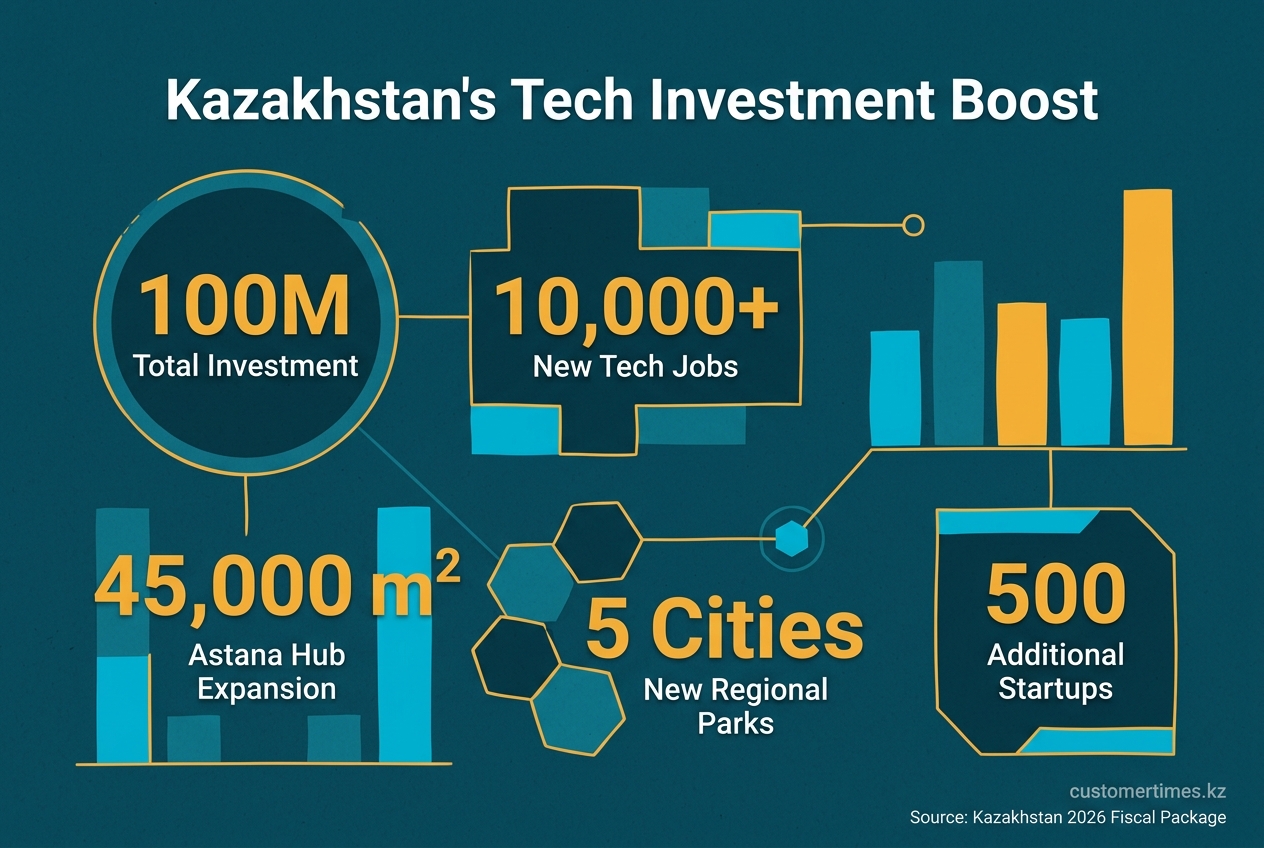
What is included in Kazakhstan's 2026 USD 100 million tech startup package?
Kazakhstan's $100 million investment is divided into three key areas: $40 million will expand the Astana Hub, $30 million will establish five new regional tech parks, and $30 million will capitalize a national venture fund-of-funds to co-invest in high-growth startups.
| Purpose | Amount (USD) | Target deliverable |
|---|---|---|
| Astana Hub scale-up | 40 million | 500 additional resident startups, 2 000 extra desks, 3 new foreign offices |
| Regional tech parks | 30 million | 5 new parks outside Nur-Sultan, 200 founder seats each, 1 000 jobs per park |
| National venture fund-of-funds | 30 million | Co-investment tickets of USD 200 k - 2 m, 40 follow-on rounds |
The funds are secured within the three-year budget law signed by President Tokayev in December 2025, with disbursements scheduled to begin in January 2026.
"We are switching from pilot grants to predictable, multi-year capital. Founders can now build 18-month roadmaps instead of surviving quarter-to-quarter."
- Astana Hub board member, January 2026 strategy session
What the USD 40 million buys in Astana Hub
The flagship Astana Hub will receive $40 million for a major expansion, adding 45,000 m² of state-of-the-art workspace. This new campus is designed to accommodate 500 additional startups and 5,000 engineers. Official plans include:
- A 10,000 m² "deep-tech hall" equipped with clean rooms for advanced chip prototyping
- A 4,000 m² data hall connected to the national AI supercomputer (an Nvidia H200 cluster with ~2 exaflops of power)
- 120 subsidized apartments to house foreign specialists
- New "soft-landing" offices in Istanbul and Warsaw to connect local founders with European markets
The expansion is strategically timed for the 2027 World Expo in Astana, with the new campus located on the expo corridor to attract international attention and investment.
Regional parks - beyond the capital
To decentralize innovation beyond the capital, the Ministry of Digital Development will allocate $30 million to launch specialized tech parks in five strategic cities:
| City | Specialisation | Seats | Local university partner |
|---|---|---|---|
| Shymkent | Agri-tech & water saving | 200 | South-Kazakhstan State Univ. |
| Karaganda | Mining-tech & energy | 200 | Karaganda Technical Univ. |
| Aktau | Logistics & port-tech | 200 | Caspian State Univ. |
| Kostanay | Crop-science & IoT | 200 | Kostanay Engineering Univ. |
| Semey | Med-tech & biotech | 200 | Semey Medical University |
Each park is set to receive $6 million for infrastructure and equipment, along with a 10-year property tax exemption. A crucial matching clause requires a 1:1 contribution from private capital for every public tenge invested, effectively doubling the total investment to $60 million.
"The goal is to stop the brain-drain to Moscow or Istanbul. A Karaganda mining engineer should be able to raise a Series-A round without leaving town."
- Vice-Minister of Digital Development, 14 January 2026 briefing
Job maths - 10 000 tech vacancies
Government projections estimate the initiative will create 10,000 net new technology jobs by the end of 2027. The expected role distribution is:
- 4,000 software engineers at Astana Hub
- 3,000 hardware and embedded specialists in regional parks
- 2,000 professionals in product management, growth marketing, and QA
- 1,000 support staff in legal, finance, and HR roles
The projected average gross salary is KZT 850,000 (approx. $1,800) per month, which is 2.6 times the national median wage. This influx of high-paying jobs is expected to add $216 million in annual payroll to the national economy.
Tax angle - what the fine print says
The 2026 Tax Code does not provide a blanket exemption for startup equity. Founders will still be subject to the progressive individual income tax (IIT) (10-15%) on shares at their fair-market value upon grant. A 5% dividend tax will also apply. The Ministry of Finance rejected a full waiver to prevent tax avoidance.
However, the highly attractive Astana Hub tax residency program remains in effect for 2026-2028. Approved resident companies continue to benefit from:
- 0% corporate income tax
- 0% VAT on exported services
- 9% IIT for employees
Foreign investor sweeteners
The government has introduced new incentives to attract foreign capital. Startups that secure over $1 million from OECD-based VCs will receive an additional three-year IIT holiday for their founding teams. These companies can also fast-track work permits for up to 20 foreign employees. Furthermore, overseas investors who deploy over $500,000 in Kazakhstani tech firms will be granted automatic e-residency.
Pipeline already visible
Anticipation for the program is high, with 180 startups already pre-selected for the first cohort, even before funds are disbursed. The initial pipeline shows a strong focus on high-growth sectors:
- 42% B2B SaaS
- 28% AI & data tools
- 15% Fem-tech & health-tech
- 15% Climate-tech & agri-tech
With an average funding request of $350,000, the $100 million fund is positioned to finance approximately 285 seed rounds, while retaining capital for subsequent Series-A follow-on investments.
This tech initiative is part of Kazakhstan's larger 2026 investment strategy, which includes $62.7 billion in total capital inflow and 475 industrial projects. The primary challenge for the new tech ecosystem will be competing for top engineering talent against established giants in mining, logistics, and energy. The success of this hundred-million-dollar investment will ultimately depend on its ability to foster a vibrant startup culture that can retain and attract the nation's best minds.