
Kazakhstan: AI Diffusion Hits 15.9%, Leads Central Asia
Alexander Shlimakov specializes in Salesforce, Tableau, Mulesoft, and Slack consulting for enterprise clients across the CIS region. With a proven track record in technical sales leadership and a results-oriented approach, he focuses on the financial services, high-tech, and pharma/CPG segments. Known for his out-of-the-box thinking and strong presentation skills, he brings extensive experience in solution sales and business development.
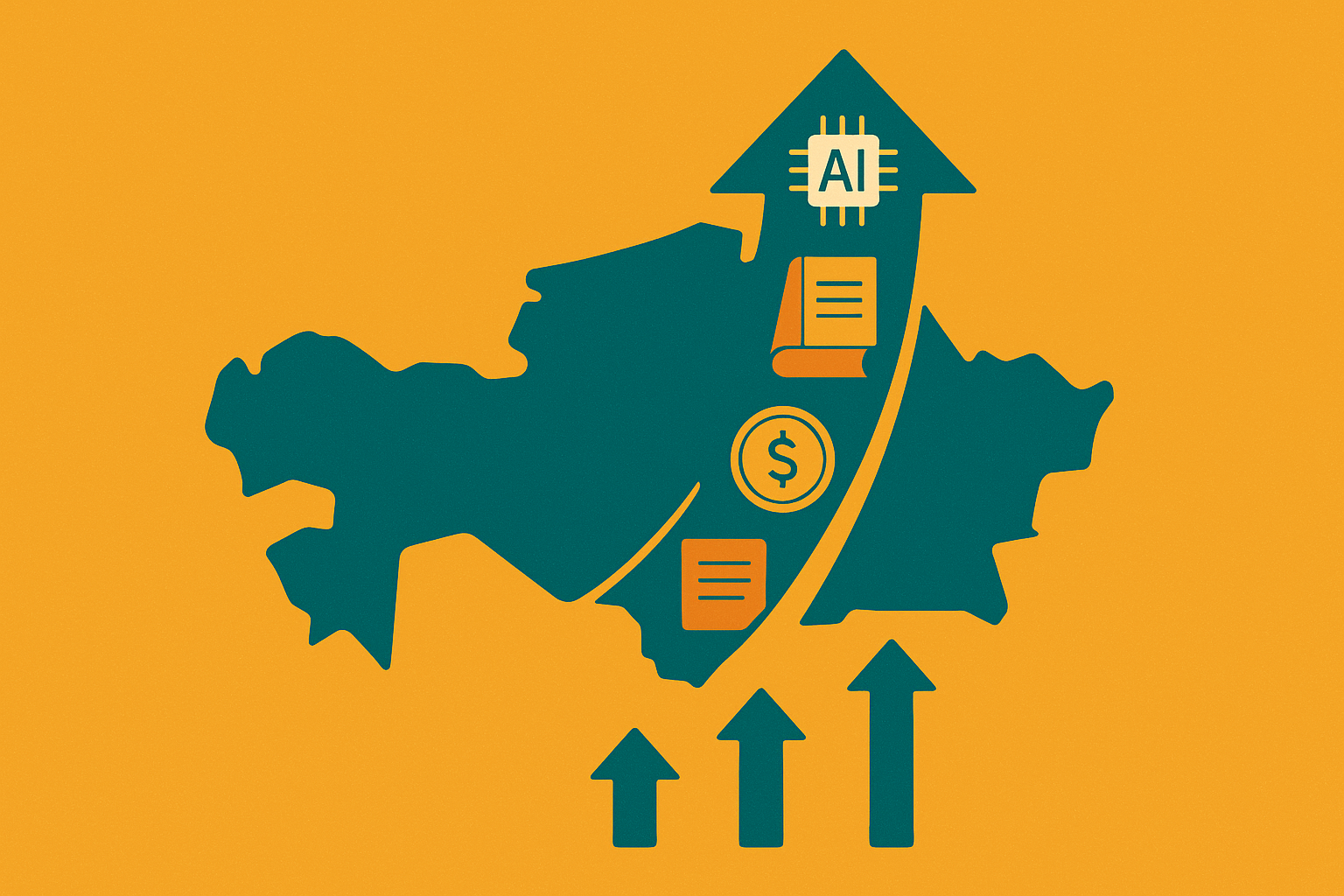
Kazakhstan leads Central Asia in AI adoption with 15.9% of its working-age population using generative AI, driven by policy, infrastructure, and investment.
In a significant leap for the region, Kazakhstan's generative AI diffusion has emerged as the clear leader in Central Asia and the Eurasian Economic Union, according to industry reports tracking digital transformation across the region.
Why is Kazakhstan leading in generative AI adoption in Central Asia?
Kazakhstan's leadership stems from a coordinated national strategy. Proactive government support, including dedicated laws and a new ministry, has been crucial. This is combined with investments in sovereign cloud infrastructure, a surge in venture capital for AI startups, and large-scale public upskilling programs.
According to industry reports, Kazakhstan's adoption rate represents a 2.2 percentage point increase from H2 2025 - among the fastest half-year growth recorded in the region. This rapid expansion is widening the gap with its neighbors.
| Country/Region | H2 2025 | Q1 2026 | Change |
|---|---|---|---|
| Kazakhstan | 13.7% | 15.9% | +2.2 pp |
| Belarus | 8.4% | 9.6% | +1.2 pp |
| Kyrgyzstan | 8.2% | 9.5% | +1.3 pp |
| Russia | 8.0% | 9.5% | +1.5 pp |
Kazakhstan now has a significant lead over its peers in the Eurasian Economic Union (EAEU).
Industry analysts note that while many economies globally have achieved substantial AI adoption rates, Kazakhstan stands out as the regional leader in Central Asia.
Why Kazakhstan is pulling ahead
-
Legal and Institutional Moves
A dedicated Law "On Artificial Intelligence" (2025) established a regulated sandbox for model testing. Additionally, government initiatives created institutional frameworks for artificial intelligence and digital development, consolidating budgets for high-performance computing, data sovereignty, and skills initiatives. -
Sovereign Infrastructure
A National AI Platform on local cloud zones launched in 2025, enabling firms to train models while complying with data residency laws. Furthermore, Alem.ai, a public-private GPU cluster in Astana, provides startups with subsidized access to substantial Nvidia H100 capacity. -
Capital Inflow
According to industry reports, venture investment in Kazakh AI startups has surged significantly in recent years, with AI surpassing fintech as a major funded digital sector. The number of registered AI companies has grown substantially over the same period. -
Human Capital
In 2025, a significant number of citizens completed short-cycle AI courses. The national goal is to train millions of people by 2030, representing a substantial portion of the population.
Enterprise adoption patterns on the ground
Observations from major CRM and analytics deployments by international system integrators reveal three dominant enterprise use cases:
- Customer-Next-Best-Action: Banks and telecoms use AI engines to deliver hyper-personalized offers via mobile apps.
- Demand Forecasting: FMCG distributors are using AI models to significantly reduce stock-outs in pilot warehouses.
- Computer Vision for Quality Control: Oil, gas, and mining operations are deploying computer vision on conveyors, substantially reducing defect leakage.
To navigate data residency requirements and keep latency low, integrators frequently deploy on-premise or local-cloud inference gateways, as most global AI clouds are hosted outside the country.
Language factor
A key catalyst for adoption has been the development of Kazakh-language large language models. Released by the state-funded Al-Farabi Centre in late 2025, these models significantly improved token-level accuracy. This improvement has lowered the barrier to entry for civil servants and SMEs, who can now use AI tools in their native language. Industry reports highlight that "improving AI capabilities in Asian languages" was a primary driver of Kazakhstan's significant quarterly growth.
Comparative snapshot (Q1 2026)
According to industry analysis, Kazakhstan demonstrates strong AI adoption rates compared to regional averages:
| Region | Relative AI Adoption |
|---|---|
| Global North | High |
| Global South | Moderate |
| Kazakhstan | Above Average |
| Central Asia avg. (ex-KZ) | Below Average |
| EAEU avg. (ex-KZ) | Below Average |
Notably, Kazakhstan shows AI diffusion rates that compare favorably with more developed economies globally.
Outlook
The Kazakh government projects that widespread AI adoption could provide substantial GDP growth, driven by productivity gains in key sectors like retail, agriculture, and mining, which collectively employ a significant portion of the workforce. With substantial growth potential remaining, Kazakhstan has built an early and significant advantage through coordinated, whole-of-government efforts that will be challenging for others to replicate.